

If you're a frequent visitor to Healthify, why not share our site with a friend? Don't forget you can also browse Healthify without using your phone data.
Osteoarthritis
Also known as OA
Key points about osteoarthritis
- Osteoarthritis is the most common type of arthritis.
- Changes that affect all parts of a joint cause pain, swelling, and stiffness.
- Joints commonly affected are knees, hips, thumbs and fingers.
- Osteoarthritis affects people of all ages.
- Exercise, healthy eating and drinking, and other treatments can help with mobility, pain and joint health.
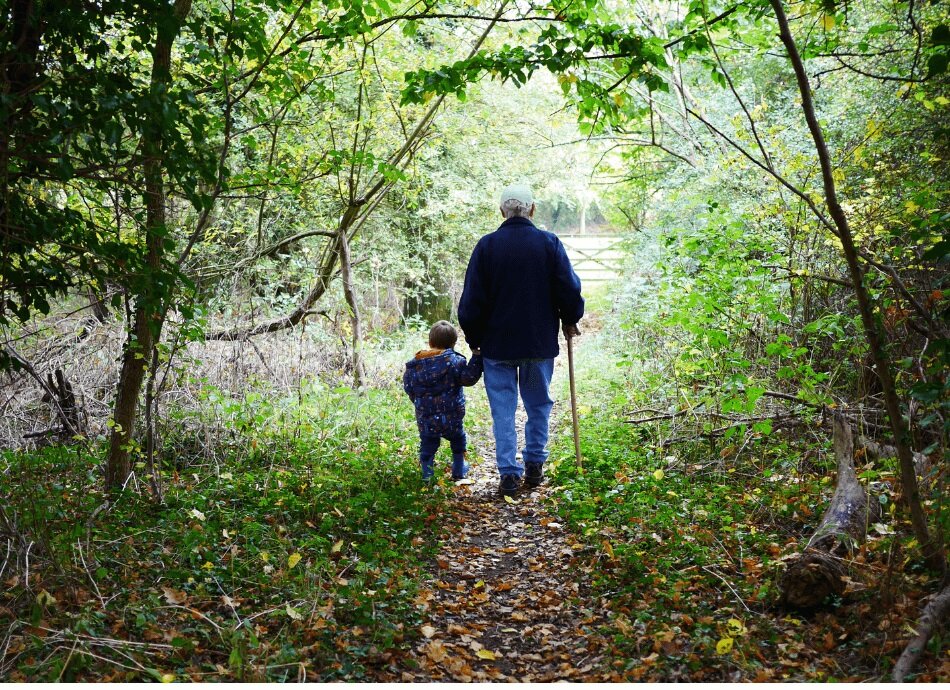
- Osteoarthritis is the most common type of arthritis. Changes in joints cause pain, swelling, and stiffness.
- Changes affect all parts of the joint including cartilage (the slippery tissue that covers the ends of bones), joint linings, ligaments and muscles.
- Joints commonly affected are knees, hips, thumbs and fingers.
- Osteoarthritis affects people of all ages and is more common in those who are older.
- You are more likely to develop osteoarthritis if you are less active, have a joint injury, or are overweight.
- Exercise and healthy eating and drinking, with other treatments, can help:
- improve mobility and daily functioning
- reduce pain and flares, and
- improve joint health.
This brief video explains how osteoarthritis affects all parts of a joint.
Video: Understanding osteoarthritis
This video may take a few moments to load.
(OsteoArthritis Knowledge, NZ, 2020)
Changes with osteoarthritis affect all parts of a joint.
- Cartilage is a firm rubbery material that covers the end of each bone and provides a smooth, slippery surface for movement. Cartilage change and loss is one part of osteoarthritis.
- Bone ends can become thicker and extend at joint edges (bony swelling).
- Joint linings can become inflamed and thickened.
- Muscles that support and move the joint can become weaker.
- Nerves can become more sensitive.
These changes can reduce movement and result in pain.
Osteoarthritis most commonly affects the knee joint, followed by the hip, and then other joints such as the small joints of the hands and base of the thumb.
Previously, osteoarthritis was thought to be a result of joint use during a person’s lifetime. But researchers now recognise that several factors lead to its development, including:
- Being overweight over a long period of time.
- Joint injury, eg, a fracture or the joint repeatedly giving way (when it buckles or collapses).
- Infection in the joint or bone.
Some forms of osteoarthritis do run in families, especially the form that affects the finger joints. However, in general, heredity is not a major reason for having osteoarthritis. The precise causes and mechanisms leading to osteoarthritis are still unknown.
Osteoarthritis develops slowly over many years. It's often very mild and may not cause many symptoms. It can stay stable over long periods or get better. Sometimes, however, the symptoms are more pronounced and may include any or all of the following:
Pain and stiffness
- Joint pain can increase with use of the joint. It doesn't mean there's increased damage to the joint.
- Stiffness usually occurs more when the joint has been rested (not moved enough).
Swelling
- Swelling occurs when irritation of the joint lining (synovial membrane) causes the production of extra joint fluid – just as your eye produces tears when it's irritated. But in the joint, the extra fluid can't escape as easily, and so it causes swelling.
- This most often occurs in the knees.
Creaking or cracking
- Joints can be noisy at any age. Noises are not a big deal and don't mean you're causing damage. Creaking or cracking sensations with joint movement often happen when soft tissues move past each other.
Bony growths
- As a result of the changes in the affected joint, the ends of the bones can change shape, forming bony growths called osteophytes.
- These may be felt as hard and bony swellings. They're especially apparent when osteoarthritis affects your finger joints.
Muscle weakness
- Your joint may feel unstable, as if it's about to give way (collapse or buckle).
If you have osteoarthritis, these symptoms can make it difficult for you to carry out many of your regular activities. Symptoms can also cause sleep problems, anxiety, depression, tiredness or fatigue.
If you're concerned about symptoms of osteoarthritis, see your healthcare provider or physiotherapist. The sooner osteoarthritis is diagnosed the sooner you can start doing things that reduce pain, maintain mobility and improve your health and joint health.
See your healthcare provider immediately if you develop any of the following:
- Sudden pain, redness, swelling, and tenderness in a joint.
- Pain in the joint that's so severe that you can't weight bear on the joint, eg, when standing or walking.
- You knee joint locks and you can't overcome this.
- Pain that doesn't improve (or gets worse) when you rest the joint.
These symptoms could be signs of more serious conditions, eg, a fracture, infection in the joint or bone, or other forms of arthritis (eg, rheumatoid arthritis).
Your healthcare provider will ask about what you're able to do and what makes your pain worse. A physical examination will be carried out with close attention to your affected joints. There are no specific blood tests for osteoarthritis, but tests may be done to exclude other types of arthritis.
X-rays are not needed to diagnose osteoarthritis but may be helpful in some instances. It's likely that any changes you see on X-ray took place slowly over a long time and will change only slowly in the future. X-rays can't tell you how long the joint has looked this way or what this means for the future. X-ray findings don't align with the amount of pain or impairment someone experiences.
Treatments for osteoarthritis can help with:
- reducing your pain
- increasing your ability to work or do activities you enjoy
- reducing how often your joints become more inflamed and painful (flares)
- improving your health and the health of your joints.
Your healthcare provider or physiotherapist is likely to advise an approach that takes into account the severity of your osteoarthritis, which joints are affected, your symptoms, other medical problems, your age, occupation and everyday activities.
Video: Knee pain info
(CHESM Thorlene, Australia, 2020)
Changes to your lifestyle
How you manage day-to-day activities can make a big difference to how osteoarthritis affects you. Most of the loss of mobility in the early stages of osteoarthritis can be reversed with a programme of exercises, and dietary change if necessary.
- Regular exercise is one of the best treatments to reduce pain and stiffness, reduce your use of medicines, improve muscle strength, balance, mood and quality of life.
- Eating and drinking well is great for your whole health as well as your joint health.
- If you're overweight, weight loss of approximately 10% can result in symptom improvement comparable to the effect of joint replacement surgery.
- Read more about exercise and weight loss.
Video: Move and improve
(OsteoArthritis Knowledge, NZ, 2020)
Medicines
Medicine for osteoarthritis focuses mainly on pain relief. Exercise has been found to reduce osteoarthritis pain as much as most medicines (but without the side effects).
If you're taking medicines for pain, it's best to try lower risk medicines first (eg, paracetamol, anti-inflammatory creams, gels or sprays). If these don't provide enough relief, other medicines (eg, NSAIDs) may be considered – usually for a short period to reduce the risk of side effects. Steroid injections into the affected joints may be recommended for some people.
Read more about the medicines used for osteoarthritis, including medicines that are not recommended and questions to ask about your osteoarthritis medicines.
Complementary or alternative therapies
Complementary or alternative treatments are not usually recommended in the treatment of osteoarthritis, due to a lack of evidence to show that they help. Some people may find them beneficial but it's not always clear how they're working. Some products may interfere with prescribed medicines. It's a good idea to talk to your healthcare provider or pharmacist if you're thinking about using any of these.
Examples of therapies include:
- Acupuncture.
- Manual therapy (eg, stretching, soft tissue and/or joint mobilisation and/or manipulation) may improve pain or function over the short term for some people.
- Heat or cooling, eg, a hot bath or cooling pack on the affected joint.
- TENS (transcutaneous electrical nerve stimulation). Read more on the non-medication approaches to managing pain page.
- Glucosamine, chondroitin and fish oil have been suggested for use in osteoarthritis. The evidence suggests that fish oil doesn't help people with osteoarthritis. Glucosamine or chondroitin may reduce pain to a small degree that is not enough for most people, and the effect is only short-term.
If you're considering the use of complementary or alternative treatments, it's important to consider the risks, benefits and costs. Read more about the considerations of using complementary or alternative therapy.
Surgery
If your joint changes, pain and disability are all severe and a comprehensive management programme including the above measures isn't helping, a joint replacement may be necessary. See: knee replacement and hip replacement.
Apps reviewed by Healthify
You may find it useful to look at some joint and bone health apps, physiotherapy and exercise apps, pain management apps and nutrition, exercise and weight management apps.
Here are some New Zealand Sign Language osteoarthritis videos produced by Platform Trust, in partnership with Deafradio and Healthify He Puna Waiora, NZ.
These videos are NZSL translations of Healthify pages on osteoarthritis.
On this page, you can find videos about:
- Osteoarthritis – overview
- How does osteoarthritis affect joints?
- What causes osteoarthritis?
- What are the symptoms of osteoarthritis?
Video: Osteoarthritis – overview
This video may take a few moments to load.
(Platform Trust, in partnership with Deafradio and Healthify He Puna Waiora, NZ, 2022)
Visit our key points about osteoarthritis information.
Video: How does osteoarthritis affect joints?
This video may take a few moments to load.
(Platform Trust, in partnership with Deafradio and Healthify He Puna Waiora, NZ, 2022)
Visit our how does osteoarthritis affect joints information.
Video: What causes osteoarthritis?
This video may take a few moments to load.
(Platform Trust, in partnership with Deafradio and Healthify He Puna Waiora, NZ, 2022)
Visit our what causes osteoarthritis information.
Video: What are the symptoms of osteoarthritis?
This video may take a few moments to load.
(Platform Trust, in partnership with Deafradio and Healthify He Puna Waiora, NZ, 2022)
Visit our what are the symptoms of osteoarthritis information.
The following links have more information about osteoarthritis. Be aware that websites from other countries may have information that differs from New Zealand recommendations.
Osteoarthritis management – a team approach(external link) NPS MedicineWise, Australia
Healthy activity & arthritis(external link) Arthritis NZ, 2014
NZSL videos about osteoarthritis Platform Trust, in partnership with Deafradio and Healthify He Puna Wairoa, NZ
Brochures
Information for people with knee arthritis(external link) University of Otago, NZ
Osteoarthritis management – A team approach(external link) NPS MedicineWise, Australia
Osteoarthritis(external link) Arthritis NZ
What is osteoarthritis?(external link) National Institute of Arthritis and Musculoskeletal and Skin Diseases, 2014 Available in the following languages: English(external link), Chinese(external link), Korean(external link), Vietnamese(external link)
Healthy activity & arthritis(external link) Arthritis NZ, 2014
Osteoarthritis and diet(external link) The Association of UK Dietitians, UK
Apps
Joint and bone health apps
Physiotherapy and exercise apps
Pain management apps
Nutrition, exercise and weight management apps
References
- Managing pain in osteoarthritis – focus on the person(external link) BPAC, NZ, 2018
- Towheed T, Maxwell L, Anastassiades TP, Shea B, Houpt J, Welch V, Hochberg MC, Wells GA. Glucosamine therapy for treating osteoarthritis(external link). Cochrane Database of Systematic Reviews, 2005
- Singh JA, Noorbaloochi S, MacDonald R, Maxwell LJ. Chondroitin for osteoarthritis(external link). Cochrane Database of Systematic Reviews, 2015
- Symptomatic management of osteoarthritis(external link), Best Practice Advisory Centre, NZ, 2008
Clinical pathways
Osteoarthritis – care and management in adults(external link) NICE Guidance, UK
Other clinical resources
Exercise for osteoarthritis pain: how strong is the evidence?(external link) Alberta College of Family Physicians (ACFP), Tools for Practice, Canada, 2020
Symptomatic management of osteoarthritis(external link) Best Practice Journal (BPJ) and Best Practice Advisory Centre NZ, 2008
Oral or transdermal opioids for osteoarthritis of the knee or hip(external link) – Cochrane Database of Systematic Reviews, updated 2014
Continuing education resources
Osteoarthritis – a focus on exercise key points(external link) BPAC, NZ, 2023
Osteoarthritis – a focus on exercise(external link) BPAC, NZ, 2023
Managing pain in osteoarthritis – focus on the person(external link) BPAC, NZ, 2018
Managing osteoarthritis – much more than just a joint replacement(external link) Dr Mark Fulcher, Goodfellow Unit, NZ
Clinical pointers – managing osteoarthritis in primary care(external link) March 2016, (30minutes) BMJ Learning, UK
CME topics relating to osteoarthritis(external link) Medscape, NZ
Podcast
A pain in the foot – Rupesh Puna(external link) Goodfellow Unit, 2020
Rupesh Puna discusses foot pain throughout the lifespan. He uses a case-based approach highlighting four common conditions: Sever’s disease, Morton’s neuroma, plantar fasciitis and osteoarthritis of the foot.
Osteoarthritis – Dan Exeter(external link) Goodfellow Unit, 2016
Dr Dan Exeter talks about non-surgical management of osteoarthritis. Dan is a sport and exercise physician based at Axis Sports Medicine clinic in Auckland. He is medical director for Athletics New Zealand and a senior lecturer at the University of Auckland.
Apps
Joint and bone health apps
Physiotherapy and exercise apps
Pain management apps
Nutrition, exercise and weight management apps
Brochures
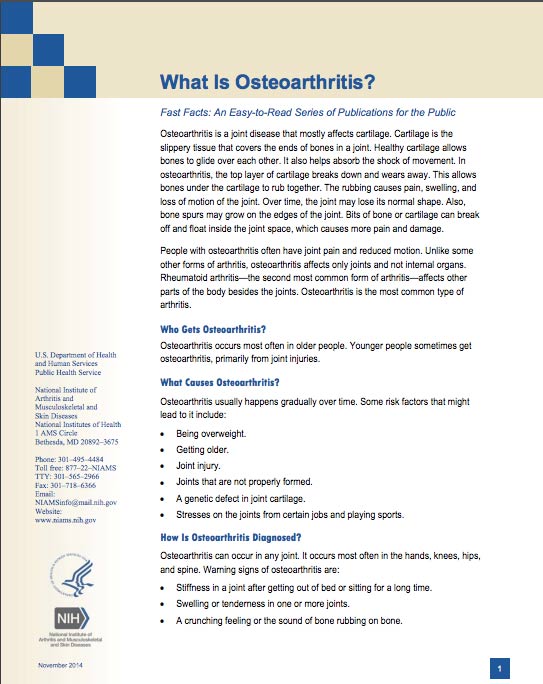
National Institute of Arthritis and Musculoskeletal and Skin Diseases, 2014
English, Chinese, Korean, Vietnamese
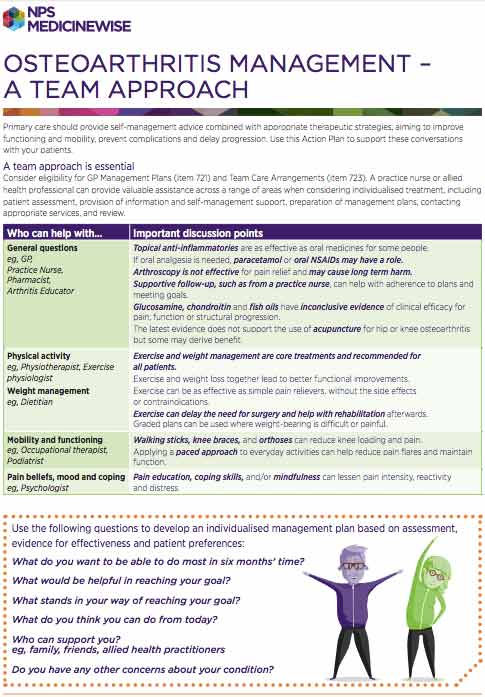
NPS MedicineWise, Australia, 2017
Arthritis NZ, 2024
Need help now?



Credits: Healthify editorial team. Healthify is brought to you by Health Navigator Charitable Trust.
Reviewed by: Dr Ben Darlow, Musculoskeletal Physiotherapy Specialist Wellington, Senior Lecturer and researcher, Department of Primary Health Care and General Practice, University of Otago, Wellington
Last reviewed:
Page last updated: