

If you're a frequent visitor to Healthify, why not share our site with a friend? Don't forget you can also browse Healthify without using your phone data.
Tonsillectomy and adenotonsillectomy | Tapahinga repe korokoro
Key points about tonsillectomy
- A tonsillectomy (tapahinga repe korokoro) is an operation to remove your tonsils. An adenotonsillectomy is an operation to remove your adenoids and your tonsils.
- Tonsillectomy or adenotonsillectomy may be needed if you experience snoring, obstructed breathing or pauses between breathing at night.
- They may also be recommended for frequent and severe tonsillitis.
- They are both short operations performed under general anaesthetic so you won't feel anything.
- It takes about 10 to 14 days to recover from the operation.

Tonsils and adenoids are lumps of tissue (similar to the glands in your neck).
The tonsils sit on either side of the back of your throat (pharynx). Adenoids sit where the back of your nose meets your throat. You should be able to see your tonsils (open your mouth wide, push your tongue down and shine a torch at the back of your throat) but only your healthcare provider can see your adenoids as they're more difficult to see.
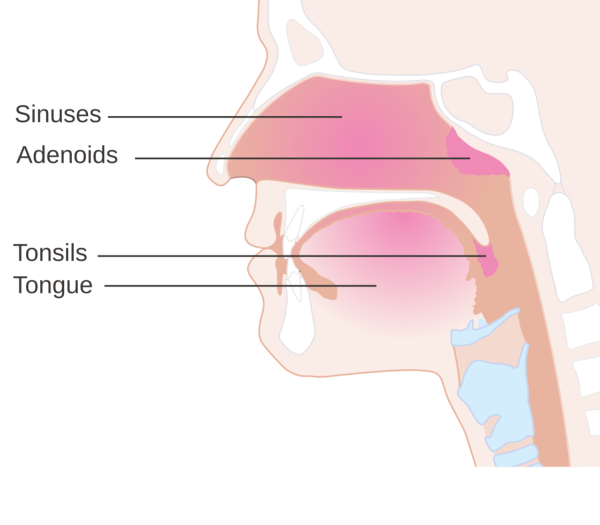
Image credit: CRUK via Wikimedia Commons(external link)

Tonsils and adenoids are part of your body’s system that fights infection (immune system) and are only important during the first few years of life.
A tonsillectomy (tapahinga repe korokoro) is an operation to remove your tonsils. About 4 in 1000 children have a tonsillectomy every year. An adenotonsillectomy is an operation to remove both your adenoids and your tonsils. Tonsils and adenoids are not essential and removing them won't harm your immune system.
Once your adenoids are removed, they very rarely grow again. After your tonsils are removed, you shouldn't get tonsillitis again but you can still get throat infections due to colds and the flu.
Tonsils and adenoids are only removed if they're doing more harm than good.
Breathing problems
Your healthcare provider may recommend an operation if your swollen or enlarged tonsils are blocking your airways and cause snoring, difficulty breathing or short pauses in breathing (sleep apnoea).
Frequent and severe bouts of tonsillitis
Your healthcare provider may recommend an operation if you or your child have ongoing or repeated infections of the tonsils (tonsillitis) that are affecting your daily life.
An operation may be recommended when there's so much damage to your tonsils that they remain infected and do not respond well to antibiotic treatment. This may mean you have a sore throat much of the time, often with bad breath and sometimes yellow, cheesy, bad-smelling and bad-tasting material in the small cracks of your tonsils.
Other reasons
- If you have an abscess behind your tonsils (quinsy) that doesn't respond to drainage.
- If you have a weakened immune system a tonsillectomy may be considered because of concerns that the tonsil infection may spread to other parts of your body.
- If a biopsy is needed to evaluate a suspected tumour of the tonsil.
During the operation
- A tonsillectomy or adenotonsillectomy usually takes less than an hour.
- It's performed under a general anaesthetic so you won't feel anything.
- The parts that need to be removed are taken out through your mouth. You don't usually need cuts on your neck or stitches in your throat.
How long do I need to be in hospital after the operation?
- After the operation, your healthcare team will check to see how well you're recovering. Their checks will include how well you're able to eat and drink.
- You should be able to go home on the same day, but you may need to stay the night.
Video: Tonsils and adenoid surgery
During healing, your throat will be very sore for 10 to 14 days. You will have pain on one or both sides that may extend to your ears, as they share some of the same nerves, and often peaks on days 4 to 5 due to inflammation.
You may get white and yellow scabs where the tonsils were removed, temporary swelling of the uvula (dangly tissue at the back of the throat) and bad breath after the surgery. Sometimes your sense of taste may change for a few weeks. These symptoms should settle down as healing progresses.
How to help the healing process
Pain relief
Regular pain relief (eg, paracetamol) can help with the pain after the operation. Not all pain relief is suitable for pain after tonsillectomy. Your doctor or nurse can advise you about what pain relief is best to use. Read more about paracetamol for adults and paracetamol for children.
Don't take aspirin or aspirin-containing medicines (such as Aspro, AsproClear or Codis). Aspirin can increase the risk of bleeding during or after the operation and may increase the risk of a serious and rare disease called Reye syndrome. If you're not sure, check the medicine label and see if it mentions the words aspirin or salicylic acid.
Staying well hydrated (drinking plenty) and chewing sugar free gum may also help with the pain.
Eating and drinking
- It may feel more comfortable having softer foods at first. However, try to eat and drink normally as soon as you can. Using the muscles in your throat will help it to heal faster.
- Avoid hot liquids, acidic or highly spiced foods for several days.
- Frozen yoghurt, cool fluids and ice blocks are a good option. Fluids are especially important to help recovery, to prevent dehydration and to prevent the build-up of debris and blood clots at the operation site.
- Taking pain relief 30 minutes before eating can help. However, follow your healthcare provider's advice about pain relief.
Rest
After having your tonsils out you may need up to two weeks off school or work while your throat gets better. Get plenty of rest and try to avoid any heavy exercise.
Other tips for self-care
- Gargle with warm salt water and brush your teeth after meals.
- Try to avoid smoking or alcohol – smoking will slow healing and increase the risk of infection while alcohol may increase the bleeding risk after surgery.
- Try to keep away from people with colds and coughs and dusty, smoking environments while your throat is healing.
There are risks associated with any surgery. Your healthcare provider will discuss the risks of having a tonsillectomy with you.
- bleeding that doesn't stop after 10 minutes of rest, elevation and sucking on ice
- a large amount of bleeding (more than 1 to 2 teaspoonfuls of blood)
- increasing pain that's not being controlled by your pain relief
- a temperature higher than 38.5°C that doesn't get better with paracetamol or keeps coming back
- difficulty keeping down fluids
- vomiting up red, brown or black blood more than twice
- difficulty breathing.
Other problems you may have include:
Fever (high temperature)
A high temperature is common in the first day or two after the surgery. It generally passes but if it remains high you should get advice.
Bleeding
Severe bleeding is rare, but a small amount or bleeding or seeing spots of blood is fairly common.
- If there's a large amount of blood (more than 1 to 2 teaspoonfuls), or if the bleeding continues for more than 10 minutes, seek urgent help.
- If you do bleed, suck on some ice, have cold water to drink and rest your head on a high pillow.
- Bleeding is more common at first and again at about 7 to 14 days after the operation when the scabs fall off. Keep an eye out for further bleeding if it occurs, as the risk of re-bleeding within 24 hours is higher – if it happens again, see a healthcare provider urgently.
- Dehydration and too much activity after the operation can increase the chances of bleeding.
- It's best to avoid going away in the 3 weeks following the operation in case of bleeding.
Vomiting (feeling sick)
You might also vomit (bring up) small amounts red, brown or black blood once or twice in the first day. You don't need to worry about this. But if it happens more often, or if you're not able to keep fluids down, make sure you see a healthcare provider.
Infection
Infection following the operation is uncommon. Contact your healthcare provider if you have a persistent fever that doesn't settle down with self-care.
Ongoing pain
Contact your healthcare provider if you have ongoing pain that's not being controlled by the pain relief that was recommended.
Tonsillectomy(external link) ENTinfoNZ
Tonsillectomy and adenoidectomy (T&A) – discharge care(external link) Royal Children's Hospital, Melbourne, Australia, 2025
Apps
Sleep and snoring apps
Swallowing difficulty apps
References
- Tonsillectomy in children(external link) KidsHealth, NZ, 2024
- Tonsillectomy(external link) Auckland ENT Group, NZ
- Post-operative care instructions for tonsillectomy and adenoidectomy(external link) Nelson ENT, NZ
- Information on surgery (tonsil removal and grommet insertion) in Aotearoa New Zealand(external link) Health Quality & Safety Commission, NZ, 2021
- Guidelines for tonsillectomy 2024(external link) The Australian Society of Otolaryngology Head and Neck Surgery
- Cooper L. Post-tonsillectomy management – a framework(external link) Aust Fam Phys. 2016;45(5):297–299
- Tonsillectomy +/- adenoidectomy post-operative nursing management(external link) Royal Children's Hospital, Melbourne, Australia, 2022
- Advice following a tonsillectomy(external link) NHS, UK, 2023
When does tonsillectomy pain peak?
Pain after a tonsillectomy (removal of tonsils) often peaks about 4 to 5 days after the surgery because of inflammation in the area.
How long is the recovery from a tonsillectomy?
You will have a sore throat for 10 to 14 days after having your tonsils removed and will probably need up to 2 weeks off work or school. You can help your recovery by resting, taking pain relief medicines as advised, drinking plenty of fluids and eating wisely. Soft food may be easiest to manage at first but try to get back to normal eating when you can to keep your throat muscles active. Avoid smoking and alcohol.
Ear pain after tonsillectomy
It's common to get ear pain after a tonsillectomy because some nerves are shared by your ears and your throat. It should settle as your throat heals and becomes less sore.
Need help now?



Credits: Healthify editorial team. Healthify is brought to you by Health Navigator Charitable Trust.
Reviewed by: Dr Grace Lee, FRNZCGP and Clinical Educator
Last reviewed: