

You can now add Healthify as a preferred source on Google. Click here to see us when you search Google.
Fractures
Key points about fractures
- A fracture is a broken bone.
- Common causes of broken bones include injuries, weakened bones such as osteoporosis and overuse (stress fractures).
- There are many different types of fractures and they can be described in different ways.
- Symptoms include pain, swelling, tenderness, bleeding or bruising around the injured area.
- If you think you may have a broken bone, seek medical attention immediately.
- Treatment depends on the type of fracture and how bad it is.

A fracture is a broken bone. It's commonly caused by an injury, overuse (stress fracture) or from having weakened bones due to osteoporosis.
Signs that a bone has broken can include pain, swelling, not being able to move the injured part, the area looking out of shape or lumpy, and possibly hearing your bone break.
- has a serious injury or accident
- can’t move after the injury
- has bones breaking out of the skin
- has severe pain
- has a lot of bleeding
- is confused, drowsy or unresponsive.
If you suspect someone has a broken neck, broken back or a head injury, don’t move them. It's important that you keep their head, neck and spine from moving.
There are many different types of fractures and they can be described in different ways.
Fractures can be open or closed
- An open fracture, also known as a compound fracture, means your skin is also broken along with your fracture.
- Your skin may be punctured or pierced by your broken bones or get injured at the same time your bones are broken.
- This type of fracture has a higher chance of getting infected.
- A closed fracture means your bones are broken but your skin is not.
Fractures can be displaced or non-displaced
- A displaced fracture means your bone has moved out of line from its original position.
- A non-displaced fracture means your bone hasn't moved out of place despite being broken.
Other ways of describing a fracture include the way in which it's broken
- A transverse fracture – the break is straight across your bone.
- An oblique fracture – the break is at an angle across your bone.
- A spiral fracture – the break forms a spiral and twists around your bone.
- A comminuted (segmental) fracture – your bone breaks into 3 or more pieces.
- A greenstick fracture – your bone only breaks on 1 side, this type of fracture only happens in children as their bones are soft.
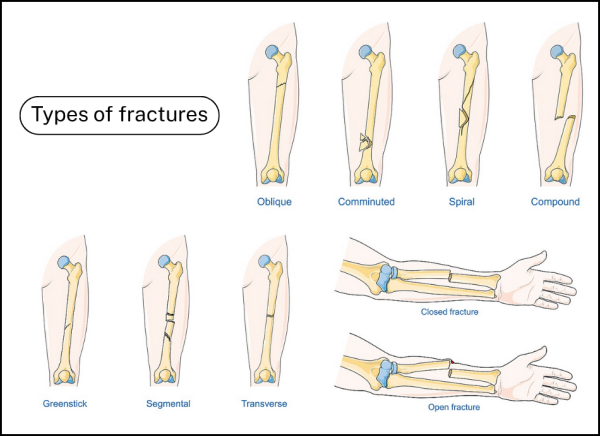
Image credit: Laboratoires Servier via Wikimedia Commons(external link)

The most common symptoms of a fracture include:
- intense and immediate pain
- swelling
- redness, bleeding, bruising and tenderness of the skin around the area
- not being able to move or use the injured area
- tingling and numbness of the skin around or below the injured area
- the area looking out of shape or out of place
- possibly hearing or feeling your bone break.
Injuries to the head should always be treated seriously as there may be damage to the brain. Read more about head injuries.
If you come across someone who may have a broken bone, there are things you can do before medical help arrives.
- Find out if the person is bleeding or losing any blood. If they're bleeding, call 111 to ask for an ambulance and apply pressure directly on the wound. If you see exposed bones, apply pressure around the bone and not on top of the bone. Don't try to put the bone back into place, you might make it worse.
- Cover any wounds with a clean cloth or a clean piece of clothing.
- Try to make the person comfortable.
- Try to keep the injured part still and support it with a pillow, a blanket, soft towel or folded clothing.
- Raise an injured arm or leg above the level of the heart (if possible) to reduce swelling.
- Don't give the person anything to eat or drink as they may need to have surgery.
- Get medical help. If the person doesn't need an ambulance, drive them to your nearest urgent care clinic or hospital emergency department.
If you don't know what to do, call Healthline on 0800 611 116 to ask for advice.
The bones in your body are strong and can withstand a lot of weight and force. They bend slightly when under pressure from an external force to prevent themselves from breaking. If this force is too strong, bones can break in the same way a plastic ruler snaps when it's bent that little bit too far.
Generally, a stronger force causes a more severe fracture. A weaker force, such as a fall, may cause your bones to crack rather than break completely. If the force is very strong, such as in a car crash, your bones may break into many pieces.
The following are the most common causes of broken bones:
- Injury or accident – a fall, car crash or tackle during a rugby game can put very strong force on your bones and break them.
- Osteoporosis – osteoporosis (low bone density) weakens your bones and increases your risk of fractures and broken bones. This means a mild force that wouldn't normally harm a healthy bone can break a weaker bone. This is also called a pathological fracture.
- Overuse – repeated movements can put pressure and stress on your bones and cause stress fractures. This is more common for athletes and people who do a lot of high impact sport such as running, basketball and gymnastics.
If you think you may have a broken bone, seek medical attention immediately.
Your healthcare provider will assess your general condition, as well as your injury. They'll ask questions about how the injury happened, any other symptoms and your past medical history. They'll also examine your injured area to check for signs of fractures such as swelling, tenderness or whether your limb looks deformed or out of shape.
The most common way to diagnose a fracture is by an X-ray. An X-ray shows the type of fracture and where it is within your bone. Sometimes an MRI or a CT scan may be needed.
Your treatment will depend on the type of fracture and how badly the bone is broken.
- A minor fracture may be held in place with a cast or splint.
- A more severe fracture may need surgery to put in pins, plates or screws to hold your bone in place.
Treatment aims to move your broken bone back to its original position if it's out of alignment (displaced) and then hold it in place while it heals. The process of moving your bone back to its original position is called reduction and holding your bone together (stopping it from moving) is called immobilisation.
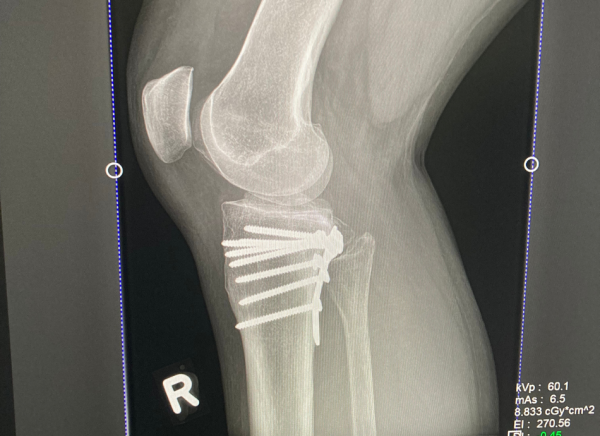
Image credit: Healthify He Puna Waiora
Reduction
Reduction can be done with a general anaesthetic, which puts you to sleep while the procedure is being done. It can also be done with just sedation (medicine to make you sleepy) and pain relief if your fracture isn't too displaced.
Immobilisation
Your bones can be held in place to allow healing by:
- a sling – a device that's used to support your shoulder and arm
- a splint or a brace – a device used to protect and support your injured area (the hard part of a splint doesn’t go all the way around your limb to allow some movement)
- a cast – a hard protective covering made from plaster or fibreglass.
Some fractures may not need reduction and immobilisation. Fractures that are caused by weakened bones (pathological fracture) or by repetitive stress may be treated differently.
Other treatments
Your healthcare provider may prescribe pain relief, depending on the amount of pain you’re having, and antibiotics if you have an open wound that might get infected. You may also be referred to a physiotherapist who can teach you specific exercises to reduce joint or muscle stiffness, regain muscle strength and modify your activity while your fracture is healing.
When your bones are put back into their original position, they can heal by forming new bone around the edge of the broken parts.
First, your body tries to protect the injured area by forming a blood clot around the fracture and sends nutrients for healing. Next, the blood clot is replaced by a soft type of bone, called callus, which closes the break and hardens over a few weeks. Finally, the callus is gradually replaced by new regular bone. The bone gradually remodels itself to increase strength and correct the shape – this can take years.
Video: How broken bones heal
There are things you can do to help your recovery, including:
- following your healthcare provider's advice on which activities you can and can't do while your fracture is healing
- doing gentle exercises as advised by your healthcare provider or physiotherapist
- keeping your cast dry (if you have a cast)
- stopping smoking – smoking reduces your body’s ability to heal
- taking pain relief medicines if you have any pain (ask your prescriber or pharmacist if you don't know what's suitable for you).
Read more tips for recovering from a fracture.
Not all fractures can be prevented, but you can improve your bone health and reduce the risk of fractures by:
- doing regular weight-bearing exercise
- eating a balanced diet
- avoiding or limiting alcohol
- stopping smoking
- maintaining a healthy weight (aim for a BMI of 20 to 25)
- getting enough vitamin D.
If you've had a fall in the past, ask your healthcare provider for advice on falls prevention.
Read more tips to keep your bones healthy.
Apps reviewed by Healthify
You may find it useful to look at some falls prevention apps and osteoporosis apps.
Fractures can take a long time to heal – many weeks or even months. Recovery time depends on:
- your type of fracture
- how serious it is
- your age
- your nutrition (how well you eat and drink)
- whether you smoke
- other health conditions, such as diabetes
- some medicines you might be taking
- how closely you follow your healthcare provider’s advice.
The pain will generally stop long before your fracture is healed. However, it can take a much longer time for your fracture to heal enough that you can return to all your normal activities.
If there are complications, it may take a little longer to recover. Complications of fractures can be early or delayed.
Possible early complications
- Damage to nearby tissues such as skin, nerves or blood vessels.
- Damage to nearby organs such as your lungs or bladder.
- Compartment syndrome – this is a condition where pressure builds up in the tissues around your broken bone, blood then can’t flow into that area properly, causing extreme pain. Compartment syndrome needs to be treated quickly.
- Wound infection if it's an open fracture.
- Losing too much blood.
- Fat embolism – this happens when the broken bone in your body releases fat globules causing a blockage in your blood vessels. This condition is life-threatening and more common when long bones, such as your femur, tibia or pelvis are fractured.
- Deep vein thrombosis or pulmonary embolism.
Possible delayed complications
- Malunion – when your fracture doesn’t heal properly and causes a deformity.
- Non-union – when your fracture doesn’t heal at all.
- Delayed union – when your fracture takes longer than usual to heal.
- Joint stiffness.
- Contractures – when muscles or tendons shorten due to injury, limiting the movement of your limb.
- Osteoarthritis.
The following links provide further information about fractures. Be aware that websites from other countries may have information that differs from New Zealand recommendations.
First aid – fractures and dislocation(external link) St John, NZ
Dealing with fractures(external link) Patient Info, UK broken toe(external link), broken upper arm(external link), forearm injuries and fractures(external link), scaphoid wrist fracture(external link)
Fractures in children(external link) KidsHealth, NZ
Caring for your child's cast(external link) Starship Foundation, NZ
Brochures
How do bones heal?(external link) Starship NZ, 2016
Recovering from a hip fracture(external link) ANZHFR and Health Quality & Safety Commission, NZ, 2021
Apps
Falls prevention apps
Osteoporosis apps
References
- All acute fractures and injuries(external link) Auckland Regional HealthPathways, NZ, updated 2024
- Complications from fractures(external link) Patient Info, UK
- Fractures(external link) Medline Plus, US
Fractures | Ngā whatinga kōiwi (Frailty care guides 2023)(external link) Health Quality & Safety Commission | Te Tahū Hauora
Clinical standards for fracture liaison services in New Zealand(external link) Osteoporosis New Zealand, 2016
Kim D. How to treat – osteoporosis(external link) New Zealand Doctor, 2024
What's the difference between a fracture and a break?
They mean the same thing, a broken bone can also be called a fracture or a bone fracture.
What are stress fractures?
Stress fractures are breaks that occur when the bone is put under pressure (eg, from overuse) rather than broken in a trauma such as a car accident or from a heavy fall.
Will fractures heal on their own?
Some fractures can heal on their own, depending on the type, location and severity of the fracture. However, they may heal out of alignment meaning that the bone ends up being distorted which can cause complications in the future. It may have to be rebroken and set so that it heals properly. Some fractures won’t heal because continued use stops the healing process.
If you think you have a broken bone it’s best to see a healthcare provider and have it checked. If it’s broken they'll be able to treat it so you heal better and more quickly.
Brochures
Starship, NZ
ANZHFR and Health Quality & Safety Commission, NZ, 2021
Need help now?

Credits: Healthify editorial team. Healthify is brought to you by Health Navigator Charitable Trust.
Reviewed by: Dr Penzy Dinsdale, Rural Hospital Registrar
Last reviewed: