

You can now add Healthify as a preferred source on Google. Click here to see us when you search Google.
Discoid eczema
Also known as nummular eczema or discoid/nummular dermatitis
Key points about discoid eczema
- Discoid eczema is a common type of eczema where there are itchy, coin-shaped patches on your skin.
- It’s common on your legs and arms but can occur anywhere on your body.
- It often comes and goes over months or years, but there are medicines that can keep it under control and help relieve your symptoms.
- Taking care of your skin and protecting it from minor injuries can reduce the number of new patches.
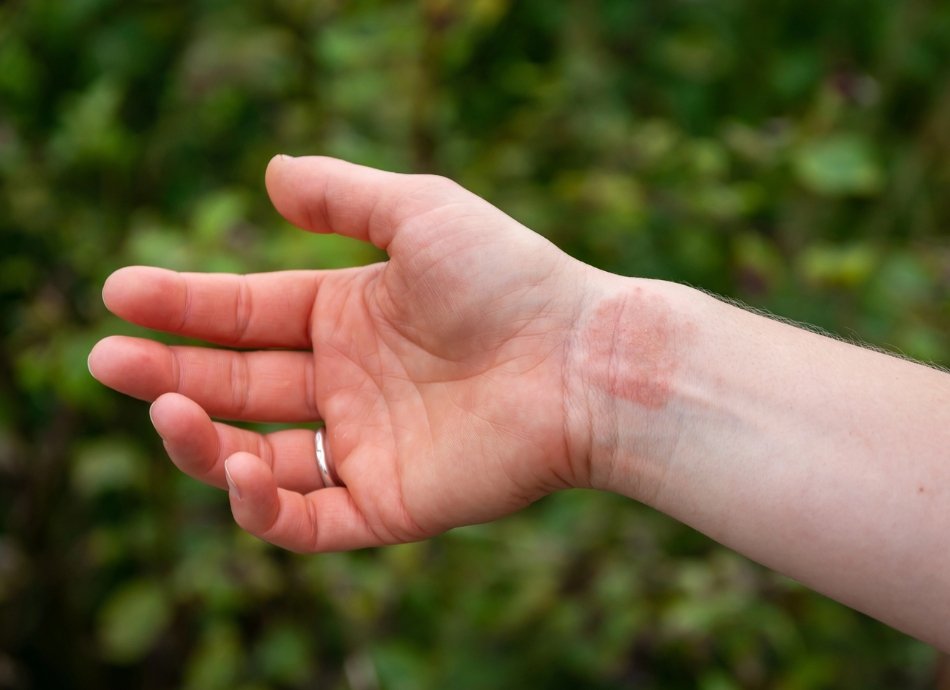
Eczema is a type of dermatitis. Dermatitis is inflammation of your skin. It refers to a group of conditions that cause itchiness, redness and dry skin.
Discoid eczema causes itchy, swollen and cracked circular or oval patches, sometimes with fluid-filled blisters and oozing. It’s also called nummular eczema or nummular or discoid dermatitis. Nummular means coin-shaped, and discoid means disc-shaped.
It usually appears on your legs and arms, but it can affect any part of your skin.
It can occur at any age.
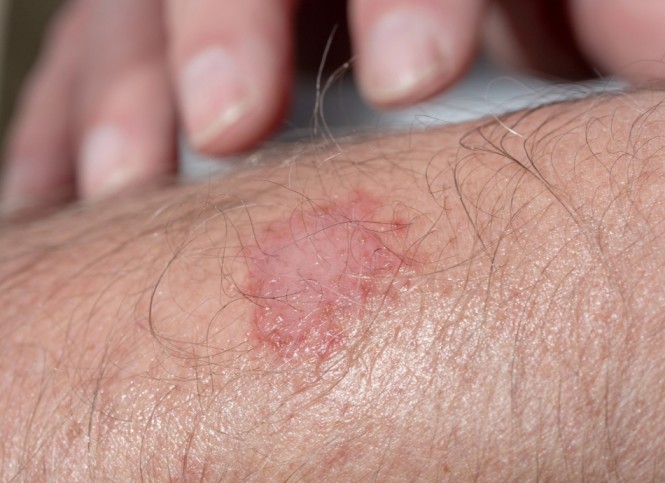
Image credit: DepositPhotos
The cause of discoid eczema is unknown. It’s sometimes associated with Staphylococcus aureus bacteria. These bacteria can cause skin infections such as impetigo (school sores) or wound infection, but discoid eczema is a reaction to the bacteria, not an infection.
Patches of discoid eczema can also appear in response to:
- an injury, such as a scratch, insect bite or burn
- contact dermatitis
- dry skin
- venous dermatitis
- scabies (a contagious mite infestation)
- a fungal infection somewhere else on your body.
Some people with discoid eczema also have a history of atopic eczema, but discoid eczema doesn’t usually run in families as atopic eczema can.
Discoid eczema usually affects your legs or arms, but it can appear on any part of your skin. Patches often occur on both sides of your body, but these are generally not symmetrically distributed, unlike other forms of eczema/dermatitis, such as atopic or seborrhoeic dermatitis.
The patches can spread rapidly or gradually over days, weeks, or months. The most bothering patches are round or oval and about 1 to 3 cm wide. There are sometimes many scattered little itchy spots or blisters.
You may have 1 patch of discoid eczema or many patches. The patches are usually very itchy. The skin between them may be dry or normal in texture.
A patch usually starts as a group of red spots and tiny bumps or blisters. These quickly grow into a red, swollen round patch that often oozes fluid or develops a crusted surface. If you have darker skin, the bumps and blisters can look dark brown or purplish compared to the surrounding skin. The patches may become dry and scaly.
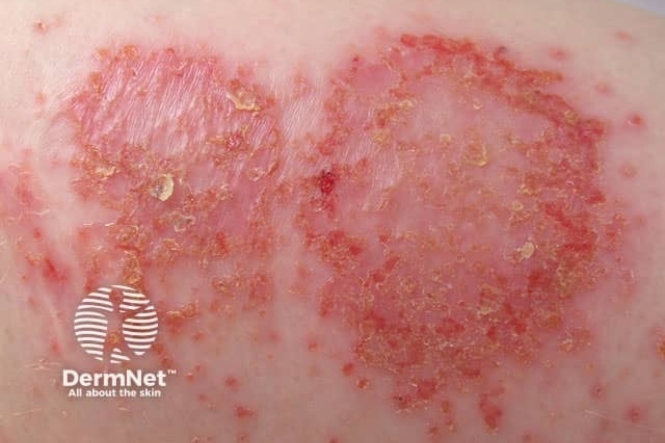
Image credit: DermNet NZ
Discoid eczema can happen along with with atopic eczema. It can also be mistaken for ringworm (tinea, a fungal infection).
Discoid eczema can become infected, and then you may:
- have 1 or more patches with a yellow crust or pus
- have hot, swollen, tender or painful skin
- feel sick, hot or shivery.
See your healthcare provider if you think your skin is infected.
Your healthcare provider will usually diagnose discoid eczema based on the look of the patches on your skin. Sometimes tests are done to rule out other possible causes.
These tests may include:
- skin scrapings to look for fungal infection
- swabs to check for bacterial infection
- patch testing to test for allergic contact dermatitis
- a skin biopsy.
You may be referred to a skin specialist (a dermatologist) to confirm the diagnosis or for investigations and treatment.
While discoid eczema can't be cured, the symptoms can be controlled and it may resolve by itself after a few weeks or months. The goal of treatment is to reduce itch and inflammation.
Using emollients regularly improves eczema and protects the skin barrier, reducing the risk of future flare-ups. Emollients can also be used as a soap substitute to cleanse the skin. A wide variety of emollients, or moisturisers, are available to manage dry skin and itch. They can be purchased from supermarkets or pharmacies, and some can be prescribed by your healthcare provider. It’s a good idea to try different options to find the one that suits you best. Read more about emollients and moisturisers.
Lukewarm baths can also help soften crusts and ease itchiness. Although it may provide short-term relief, it’s best to avoid hot water, as it can make your dermatitis worse. Use an emollient instead of regular soap, as soap can dry out the skin. Adding emollient bath oils to the water can also be helpful – but watch out as they make the bath slippery. After bathing or showering, gently pat your skin dry and apply more leave-on emollient to keep your skin well moisturised.
Steroid creams and ointments may be used to reduce inflammation. Once discoid eczema appears, the affected skin may become itchy and red, or darker than your usual skin tone. If this happens, your healthcare provider may prescribe a steroid cream or ointment to help reduce inflammation and clear the eczema. The strength of the steroid will depend on how severe your eczema is and what part of the body is involved. In adults, stronger steroids are often used for a few weeks (usually 2 to 4 weeks), depending on where the eczema is on the body. Only apply steroid creams or ointments to the areas of skin affected by eczema, unless your healthcare provider advises otherwise. Areas of dry skin without eczema should be treated with an emollient (moisturiser) instead. Read more about steroid creams and ointments.
Antibiotics may be prescribed for secondary infection. They can help discoid eczema inflammation, too. Because long courses can induce resistant bacteria and intestinal problems, dermatologists no longer prescribe long-term courses of antibiotics for discoid eczema.
Anti-inflammatory oral medications are prescribed by dermatologists when discoid eczema doesn’t settle with creams alone. These include courses of systemic steroids (prednisone) for a few weeks, methotrexate, and immunosuppressants for months or years. You may receive phototherapy (ultraviolet ray treatment).
If you have discoid eczema, self-care to protect your skin is important for managing the condition and preventing flare-ups.
- Do what you can to avoid minor skin injuries, as these may trigger new patches of discoid eczema. If your hands are affected, wear gloves to protect them from friction (rubbing), cleaning products, chemicals, and excessive water – all of these can irritate your skin.
- Use emollients as often as needed on your skin to relieve itching, scaling and dryness. Read more about how to use emollients and moisturisers.
- Have a warm, not hot, bath or shower each day using an emollient instead of soap and apply skin treatments soon after.
- Avoid any allergens if patch testing has shown you react to a particular substance (allergen). However, discoid eczema is not usually due to allergy.
- Don’t scratch eczema patches if you can avoid it. Wash your hands often and keep your nails short to reduce the risk of skin damage or infection.
Discoid eczema can’t be cured, but there are treatments that help control it. It can last for months or years and may keep coming back even after it appears to have cleared.
Patches of discoid eczema may disappear completely. However, if you have darker skin, you may have light or dark marks for several months after the eczema has cleared.
References
- Discoid eczema(external link) NHS, UK, 2023
- Discoid eczema(external link) British Association of Dermatologists, UK, 2023
- Discoid eczema(external link) DermNet, NZ, 2020
- Discoid eczema(external link) NEC, UK
Need help now?



Credits: Healthify editorial team. Healthify is brought to you by Health Navigator Charitable Trust.
Reviewed by: Professor Amanda Oakley CNZM, Dermatologist, Health New Zealand | Te Whatu Ora, Waikato
Last reviewed: