

You can now add Healthify as a preferred source on Google. Click here to see us when you search Google.
Venous dermatitis
Also known as venous eczema, or varicose, gravitational or stasis dermatitis or eczema
Key points about venous dermatitis
- Venous dermatitis is a long-term skin condition that affects your lower legs.
- It’s common in people with varicose veins, but it also occurs in people without them.
- It can cause leg swelling and skin problems, including ulcers and hardening of the tissues.
- Treatment includes wearing compression stockings, keeping your legs up when you're sitting down, staying active and good skin care. Sometimes steroid ointments or creams are also used.

Venous dermatitis is a chronic (long-term) skin condition that affects your lower legs. It’s also known as venous eczema, gravitational or stasis dermatitis or eczema.
Dermatitis is inflammation of the skin. There are various causes of dermatitis, which results in itchiness, redness, and dry skin. Venous dermatitis results from increased pressure in the veins of your legs and the leakage of blood into the tissues. It’s common in older people with or without varicose veins.
Over time, the affected skin becomes harder and discoloured. Your skin may break down, leading to ulcers. Delayed healing is usual after minor injuries or surgical procedures.
If you have venous dermatitis, it’s important to:
- keep your legs up when you're sitting down
- stay active, and
- keep your skin moisturised.
The most important treatment is compression to improve the blood flow and reduce swelling and blood leakage into the tissues.
Venous dermatitis is usually caused by increased pressure in the veins in your legs. This can happen if the valves in these veins aren’t working properly. Blood leaks backwards, increasing pressure in the veins. This causes fluid to leak out of the veins into the surrounding tissue, and your immune system reacts to this fluid, causing inflammation.
Your risk of getting venous dermatitis is greater if you:
- are older – about 1 in 5 people over 70 years of age have venous dermatitis
- are a woman
- are obese or overweight
- are pregnant
- have a family history of venous insufficiency (when the veins in your legs have trouble sending blood back to your heart)
- have high blood pressure
- aren’t able to move for a long period of time
- have varicose veins or a history of deep vein thrombosis (DVT) (a blood clot in a leg vein) or cellulitis (infection of the deep layers of your skin)
- have to stand for long periods of time
- have had surgery or an injury to your legs.
Venous dermatitis affects 1 or both of your lower legs. Your leg(s) may be swollen, especially at the end of the day or after standing for long periods.
The skin all around your leg(s) becomes itchy, dry, scaly and flaky and may change colour – light skin can look red or brown, while dark skin can look dark brown, purple or grey. Your skin may become weepy or crusty. The affected skin feels cool to touch (unlike cellulitis, when it feels warmer than the surrounding skin).
Although venous dermatitis usually starts in the sock area of one leg, it can sometimes spread to the other leg, your forearms, and become widespread on your body and limbs. This spread of dermatitis is due to an overactive immune system.
You may have tender, tight skin that eventually becomes hardened. The skin on your leg(s) becomes fragile, so injury and leg ulcers are more likely, and healing is slow.
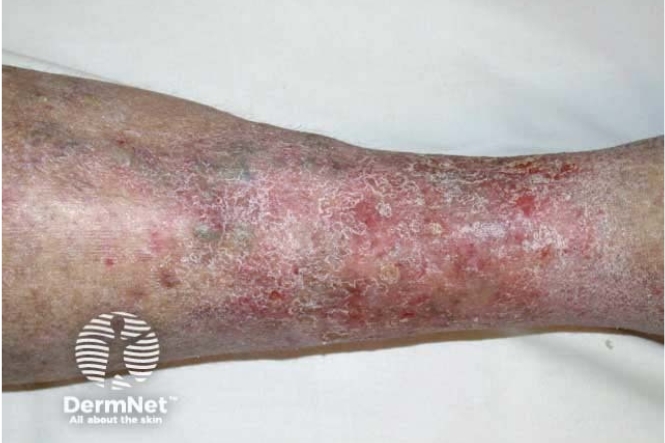
Image credit: DermNet NZ(external link)
Your healthcare provider can usually diagnose venous dermatitis by looking at your skin, examining your legs and feet, and asking questions to find out if you have a problem with the flow of blood in your leg veins. They may ask whether you’ve had conditions such as varicose veins, deep vein thrombosis (DVT), leg ulcers, cellulitis or surgery or injury to your legs.
If needed, you may be referred to a skin specialist (dermatologist) or a vascular specialist who manages conditions affecting your blood vessels for further tests and advice.
Treatment of venous dermatitis aims to improve your skin condition, relieve your symptoms, and improve your blood flow. This involves self-care along with the use of moisturisers (emollients), compression stockings and topical steroids. If these aren’t enough, you may be referred to a skin specialist (a dermatologist). You may also see a healthcare provider or surgeon who can treat varicose veins if you have these.
Emollients
You should use a moisturiser (which adds moisture to the skin) or emollient (which softens skin) at least twice a day and in large amounts. They're intended to relieve dryness, soothe the itch and reduce scratching. Use your moisturiser more often if you have very dry skin or a flare-up of your dermatitis. Find out about different types of emollients and how to use them. You may need an emollient ointment for very dry skin or a cream for less dry skin. You can also use one as a soap substitute, since regular bar soap can dry out and irritate your skin.
You can get an emollient with a prescription from your healthcare provider or over the counter at a pharmacy.
If you're using emollients containing paraffin (such as petroleum jelly), take care because emollients can soak into clothing and bedding, and the paraffin oils make these items catch fire more easily. This is especially important if you’re applying large amounts over large areas. Keep away from open flames (including candles) and don't smoke (or be near people who are smoking) when using emollients containing paraffin.
Compression stockings
Medical compression stockings improve the blood flow in your leg veins and reduce the pressure in the veins. You’ll usually need to put them on when you get up in the morning before you get out of bed and take them off when you go to bed. Find out more about compression stockings and how to wear them.
Topical corticosteroids
Your healthcare provider may prescribe a steroid cream or ointment (also called a topical steroid) to use on dermatitis to reduce inflammation during a flare-up. You can apply your moisturiser before or after the topical steroid. Use the steroid just on the inflamed, dry, itchy parts and only for as long and as often as your healthcare provider tells you. Read more about topical steroids and how to apply them.
Medicated bandages
Community nurses may recommend bandages coated with zinc oxide, with an outer bandage to prevent mess, as they can be soothing when applied to eczema. They help reduce scaliness and protect your skin from knocks and scratches.
Antibiotics
See your healthcare provider if your skin becomes hot and inflamed, oozes fluid or if you feel feverish and sweaty. You may have a skin infection that requires antibiotic treatment.
Things to avoid
- Ingredients of creams and cosmetics can irritate your skin or cause allergies. It’s best to avoid products containing perfumes, preservatives, and unrefined lanolin.
- Soap and bubble bath can dry out your skin and irritate eczema. Use your emollient as a soap substitute, applying it to wet skin in place of soap.
- Hot water can dehydrate your skin and cause itching. Bathe or shower in cool to warm water.
- Liniments and alcohol rubs shouldn't be used on your legs, as they irritate your skin and dry it out more.
- Avoid tight socks or trousers that cut into your flesh. Instead, make sure the tops of stockings and socks are loose-fitting for comfort. Compression socks should feel firm but comfortable.
There are things you can do to help the circulation, or blood flow, through your legs if you have venous dermatitis.
- Put your legs up as high as possible when sitting. Try to have them as high as your hips or higher if you can. You can use cushions or pillows to prop them up.
- Keep active. Go for regular walks if you can.
- Avoid sitting or standing for long periods. If you have to sit or stand still for long periods of time, regularly flex your feet or tap your toes, rise up onto your toes or bend at the knees.
- Raise the foot of your bed if you can.
- Try losing weight if you’re overweight or living with obesity.
- Wear compression stockings.
Taking care of your skin is also important
- Use emollients to moisturise your skin often and regularly.
- Do your best to avoid injuring your skin. Move furniture at home so that you’re less likely to bump into it.
When to see your healthcare provider
- If you get signs of infection, such as hot, red, inflamed skin, or you feel hot, sweaty and unwell.
- If you have ongoing, persistent itching or discomfort that affects your daily life.
- If you have swelling in your legs that doesn’t improve with rest or raising your legs (elevation).
If you’re at risk of getting venous dermatitis, such as if you have varicose veins, you can reduce your risk by following the self-care advice above.
If you have varicose veins or a leg ulcer, talk to your healthcare provider about getting these treated too.
Venous dermatitis is often a long-term problem. A good daily skin care routine and doing things to improve the circulation in your legs can help prevent flare-ups.
If your symptoms don’t get better with self-care and the treatments discussed above, your healthcare provider may suggest you see a dermatologist (skin specialist).
You may need to be referred to a vascular surgeon (who specialises in arteries and veins) if you have a persistent leg ulcer or if you have a blockage in the arteries of your leg. They may suggest an operation or laser treatment for your veins.
Brochure
Varicose eczema factsheet(external link) National Eczema Society, UK
References
- Varicose eczema – overview(external link) NHS, UK, 2023
- Varicose eczema – treatment(external link) NHS, UK, 2023
- What is venous stasis dermatitis?(external link) WebMD, US, 2024
- Venous eczema(external link) DermNet, NZ, 2016
- Varicose eczema – gravitational eczema(external link) Patient, UK, 2023
- Varicose eczema factsheet(external link) National Eczema Society, UK, 2021
Yosipovitch G, Nedorost ST, Silverberg JI, et al. Stasis dermatitis – an overview of its clinical presentation, pathogenesis, and management(external link) Am J Clin Dermatol. 2023;24(2):275–286
Need help now?


Credits: Healthify editorial team. Healthify is brought to you by Health Navigator Charitable Trust.
Reviewed by: Professor Amanda Oakley CNZM, Dermatologist, Health New Zealand | Te Whatu Ora, Waikato
Last reviewed: