

You can now add Healthify as a preferred source on Google. Click here to see us when you search Google.
Contact dermatitis
Key points about contact dermatitis
- Contact dermatitis is inflammation of your skin caused by something it comes into contact with – something that either irritates your skin or causes an allergic reaction.
- The symptoms include redness, itchiness and dry skin.
- Things that can cause contact dermatitis include soaps, detergents, cosmetics, jewellery, solvents and water.
- It’s common for people in certain jobs such as hairdressing, healthcare and mechanics.
- Avoiding what causes your symptoms is important and treatment with emollients and topical steroids can also help.
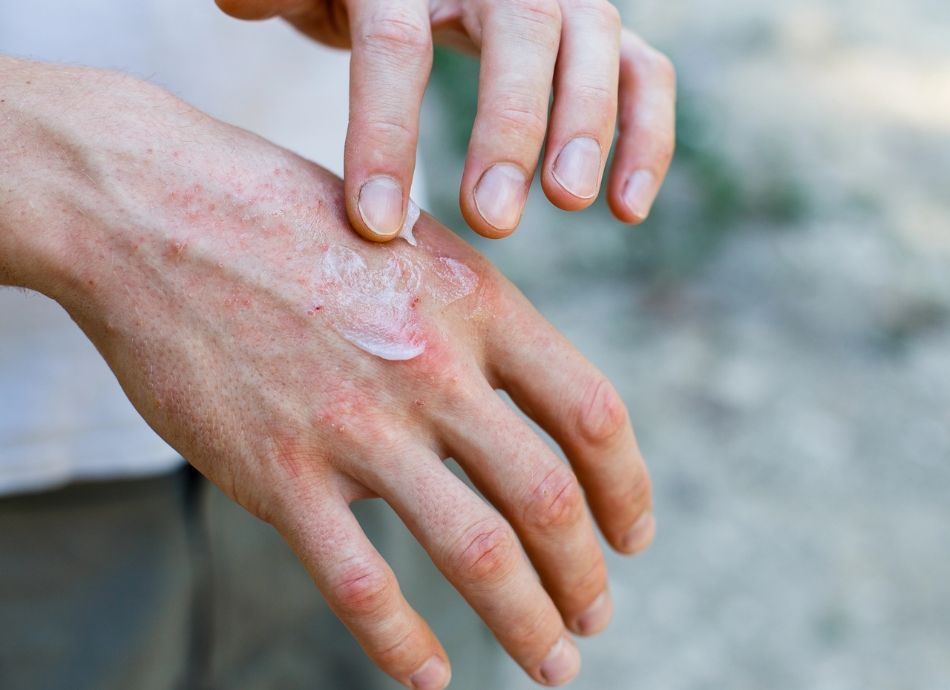
Dermatitis is inflammation of your skin. It refers to a group of conditions that cause itchiness, redness and dry skin.
Contact dermatitis is inflammation of your skin in response to something that touches it. This could be something that irritates and damages it, or something you’re allergic to (an allergen) and which most people don't react to.
- Contact dermatitis is usually caused by irritants. Most often, wet work is to blame due to repeated exposure to water, especially with the addition of soaps, detergents, or solvents or in cold conditions.
- Allergic contact dermatitis is less common – it can be caused by an allergic reaction to chemicals in products such as cosmetics, household items, or work materials, or to metals such as nickel in jewellery.
Avoiding whatever causes your skin symptoms is the best way to manage contact dermatitis, along with using barrier creams and protective clothing, especially gloves.
Contact dermatitis can be caused by something that irritates your skin or by an allergic reaction to something that touches your skin.
Irritant contact dermatitis
Irritant contact dermatitis happens when something (an irritant) damages the protective barrier of your skin faster than it can heal. You’re more likely to get it if you have eczema (atopic dermatitis). Irritant contact dermatitis is often job-related, with hand dermatitis common in cleaners, hairdressers, food handlers and healthcare workers. Nappy rash is a form of irritant contact dermatitis caused by urine and faeces.
Irritants include soaps, hand sanitisers, detergents, chemicals, friction, sweating, heat and especially, repeated exposure to water. Scrubbing or rubbing your skin can make dermatitis worse by further breaking down the surface of your skin.
This type of dermatitis usually develops after you've been exposed repeatedly to several irritants, but it can develop after a single exposure to a strong irritant.
Allergic contact dermatitis
Allergic contact dermatitis happens when your immune system reacts abnormally to something that touches and penetrates your skin but is harmless for most people. The substance that causes the contact allergy is called an allergen. Allergic contact dermatitis is less common than irritant contact dermatitis. They can both occur at the same time.
Allergens that can cause contact dermatitis include:
- nickel in jewellery
- additives in rubber products
- medical strapping and plasters
- plants,
- chemicals in cosmetics, hair dyes, fragrances, shampoos, wet wipes or cleaning products.
Some creams and ointments may also cause contact dermatitis because of a base ingredient (such as lanolin), a preservative, an active ingredient (antibiotics such as neomycin) or added perfumes or plant materials.
Allergic contact dermatitis develops when your skin has been exposed to an allergen before, sometimes for years, without developing symptoms. For example you may have regularly dyed your hair, then suddenly you get a blistering rash from the product that appeared completely harmless last time you used it. Only people who have become allergic to a specific allergen will develop symptoms.
Chemicals and irritants in the workplace may increase the risk of allergic dermatitis, especially if you:
- are in contact with dyes, glues, acids, or alkalis
- work in very hot or cold temperatures
- frequently wash your hands
- wear personal protective equipment for long periods.
Allergic contact dermatitis is common in metal workers, hairdressers, beauticians, health care workers, cleaners, painters, and florists. Education and careful prevention are essential if you're exposed to strong allergens, as any future allergy will continue for the rest of your life. This means that a reaction will occur whenever your skin comes into contact with the allergen.
Photocontact dermatitis
Sometimes, contact dermatitis only occurs after your skin is exposed to ultraviolet rays. This might happen for anyone due to the presence of photoactive compounds in certain plants. For example, a rash may occur if the juice of a lime is spilt on your skin and exposed to the sun. This is not an allergy; it’s due to psoralen in the lime.
If you’re allergic to a certain chemical in your sunscreen, a rash may only appear on areas of skin that have been exposed to the sun, even though the sunscreen was also in contact with areas of your skin that weren’t exposed. This isn't common and is called photoallergic contact dermatitis.
If you have contact dermatitis, a rash appears where your skin came into contact with an irritant or allergen. However, dermatitis can sometimes spread to other areas that weren't in direct contact with the substance. Irritant and allergic contact dermatitis can look similar, and sometimes they occur together.
Common symptoms include:
- itching or burning
- redness or darker skin tone (depending on skin colour)
- swelling and blistering
- dry, cracked, or scaly skin
- painful splits or sores
- changes in skin colour after healing (lighter or darker patches).
With irritant contact dermatitis, symptoms can appear within minutes to hours of contact with a strong irritant, or after days or weeks of repeated exposure to a mild irritant. It most often affects your hands and face.
With allergic contact dermatitis, the reaction usually develops 24 to 72 hours after contact with an allergen you’ve been sensitised to (become allergic to). Allergic contact dermatitis usually improves once the allergen is no longer in contact with your skin, although healing can take several days, weeks or longer.
Repeated or long-term exposure to an irritant or allergen can cause chronic symptoms such as thickened, cracked, and painful skin.
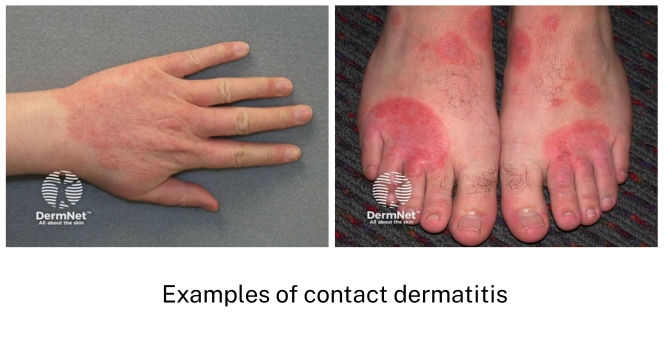
Image credit: DermNet NZ(external link)
Your healthcare provider can usually diagnose contact dermatitis by looking at your skin and asking questions about your symptoms, daily activities, and any substances you may have come into contact with.
You may be asked about your work, hobbies, and the products or chemicals you use at home. Sometimes you’ll be referred to a skin specialist (dermatologist) for evaluation and patch testing.
The pattern and location of your rash often help identify the cause.
If you have allergic dermatitis, your rash usually improves when you avoid the allergen but returns quickly with even slight contact. You may need:
- patch testing to find the allergen causing your reaction – this is where diluted allergens are applied to your skin in patches to see if a reaction occurs
- repeat open application tests if a specific product (eg, a cream or cosmetic) is suspected – this is where you apply the product to a small area of previously unaffected skin over several days to see if a reaction occurs.
There’s no specific test for irritant contact dermatitis.
The main goal of treating contact dermatitis is to find and avoid the substance (irritant or allergen) that’s causing your skin reaction. Once this is done, most people’s skin improves over several weeks, depending on how long it’s been inflamed. Severe damage may be difficult to clear up without treatment. Treatment also focuses on soothing the skin, reducing inflammation, and restoring the barrier function of the skin.
Looking after your skin and avoiding the things that cause irritation or allergy are the most important ways to manage contact dermatitis. Try to identify what’s causing your skin reaction and avoid it as much as possible.
Protect your skin
- Whatever the cause of your dermatitis, you should protect your skin from soaps, detergents and other harsh substances. Use soap substitutes instead of bar soaps.
- Wear protective gloves or clothing if you need to handle irritants at home, work or school (eg, if you’re doing wet work or using cleaning agents). Remove the gloves as soon as possible afterwards. Make sure the inside of the gloves is thoroughly clean and dry.
- Using barrier creams can help protect your skin. Barrier creams are designed to form a thin layer on your skin’s surface to help reduce contact with irritants, allergens, or harsh substances. They’re applied to your skin and are often used together with gloves or other protective equipment. For example, silicone-based barrier creams may be used before handling solvents. Be aware that some chemicals easily pass through barrier creams. Check with a work safety supplies shop to make sure you have the right cream and gloves for your personal situation.
To ease irritation
- Use a cool, damp cloth (cool compress) to help soothe itching or redness.
- Use an emollient (moisturising cream or ointment) several times a day to help moisturise, repair and protect your skin.
- At night, using a thicker ointment can help keep your skin soft and reduce dryness.
- If your skin is sore, red, irritated and inflamed, you can apply a steroid cream or ointment directly to the affected area to help ease the symptoms. These are used for flare-ups for a few days – long term use of steroid creams affects how well your skin works as a barrier and should be avoided.
- If you have severe contact dermatitis, involving large areas of your skin, your healthcare provider may prescribe steroid tablets, such as prednisone.
- You may be referred to a dermatologist for long-term methotrexate or another systemic treatment for your dermatitis.
When to see your healthcare provider
See your healthcare provider if:
- you can’t identify what’s causing your skin reaction
- your symptoms don’t improve with self-care
- your rash is severe, spreading, or affecting your daily life.
The best way to prevent contact dermatitis is to avoid contact with whatever causes your symptoms. If this isn’t possible, there are things you can do to reduce the risk of an allergen or irritant causing symptoms.
- If you come into contact with an irritant or allergen, rinse the affected area with warm water and an emollient as soon as possible.
- Use gloves to protect your hands but take them off every so often as sweating can make any symptoms worse. You can wear cotton gloves underneath rubber gloves if the rubber also irritates you. Choose nitrile gloves if you think rubber is aggravating your dermatitis.
- Use emollients on your skin often and in large amounts to protect your skin and keep it hydrated.
Contact dermatitis usually improves or clears up completely if you can avoid whatever causes your symptoms. Treatments also help ease the symptoms.
If you have chronic (long-term) contact dermatitis, it may take a while to see improvement in your symptoms. You’ll need to keep up with constant skin care, especially if your hands are affected. It may take up to 6 months for the barrier function of the affected skin to be properly restored – during that time, you’ll react easily to irritants that other people can tolerate.
Contact allergy is permanent. Be very careful to avoid touching your allergen or allergens if you’ve been able to identify them or they've been confirmed by patch tests.
Sometimes, contact dermatitis can lead to secondary rashes elsewhere, such as discoid eczema or autoeczematisation (disseminated eczema).
References
- Irritant contact dermatitis(external link) DermNet, NZ, 2021
- Allergic contact dermatitis(external link) DermNet, NZ, 2016
- Eczema (dermatitis) in adults(external link) 3D (Lower North Island) HealthPathways, NZ, 2025
- Contact dermatitis(external link) BMJ Best Practice, UK, 2025
- Contact dermatitis(external link) NHS, UK, 2023
- Allergic contact dermatitis(external link) ASCIA, Australia, 2024
Need help now?



Credits: Healthify editorial team. Healthify is brought to you by Health Navigator Charitable Trust.
Reviewed by: Professor Amanda Oakley CNZM, Dermatologist, Health New Zealand | Te Whatu Ora, Waikato
Last reviewed: