

If you're a frequent visitor to Healthify, why not share our site with a friend? Don't forget you can also browse Healthify without using your phone data.
Kidney infection
Also known as pyelonephritis
Key points about kidney infection (pyelonephitis)
- A kidney infection is a painful condition that’s usually caused by an infection of your bladder.
- If it’s not treated urgently with antibiotics, it can become life-threatening or cause permanent damage to your kidneys.
- Symptoms include fever and chills, lower back pain and nausea or vomiting. You may also have symptoms of a bladder infection such as pain when you pee.
- If you have a severe kidney infection, you may need to go to hospital for treatment.
- There are things you can do to help prevent kidney infection, such as drinking plenty of water and not ‘holding on’ when you feel the need to pee.

A kidney infection, also called pyelonephritis, is a type of urinary tract infection. It’s a painful condition that’s usually caused by an infection of your bladder that travels to 1 or both of your kidneys. If it’s not treated urgently with antibiotics, it can cause a life-threatening reaction known as sepsis and permanently damage your kidneys.
Kidney infections are less common than bladder infections. They’re more common for women, children, during pregnancy and for older people.
Repeated episodes of acute (sudden-onset) pyelonephritis can lead to chronic pyelonephritis where there’s scarring of your kidney due to repeated infections.
A kidney infection is caused by bacteria (germs), often E. coli. These get into your urethra (the tube that you pee out of) and move up to your bladder and ureter (the tube that connects your bladder and kidney) and into your kidney. Usually, the infection only affects 1 kidney.
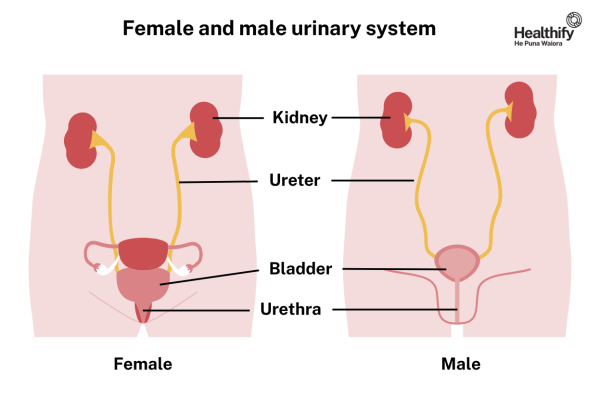
Image credit: Healthify He Puna Waiora
Often you’ll have an infection of your bladder (cystitis) at the same time or before you have a kidney infection. Cystitis is more common in women and most people with cystitis don’t get a kidney infection. You can also develop a kidney infection without cystitis, eg, if you have kidney stones, diabetes or a weakened immune system.
Kidney infections tend to be more common in women and people assigned female at birth than men. This is because their urethra is shorter so the bacteria are more likely to reach their bladder and then their kidneys.
A kidney infection or pyelonephritis is also more common if you:
- are pregnant
- are sexually active
- have diabetes
- have a weakened immune system
- have a catheter or any tubes in place to drain your bladder
- have kidney stones or other kidney problems
- have difficulty emptying your bladder completely, eg, if you have an enlarged prostate or spinal damage
- have urinary reflux, where urine flows backwards from your bladder towards your kidneys (this is more common in children).
Symptoms of a kidney infection include:
- fever and chills
- pain in your lower back just below your ribs (on one or both sides)
- nausea (feeling sick) or vomiting (being sick)
- loss of appetite
- weakness or tiredness
- confusion, especially in older people.
These symptoms usually occur suddenly, over a day or two. You may also have symptoms of bladder infection (cystitis or lower urinary tract infection). These include:
- a painful or burning sensation when you pee
- an urgent need to pee
- needing to pee more often than usual
- pink, cloudy or smelly urine (pee)
- blood in your pee
- lower tummy pain.
If a kidney infection is serious and untreated, it may develop into sepsis, which is life threatening.
- slurred speech or confusion
- extreme shivering or muscle pain
- passing no urine (pee/mimi) for a day
- severe breathlessness
- feeling like you're going to die
- mottled or discoloured skin.
Call Healthline free on 0800 611 116 if you are unsure what to do. Ask ‘Could this be sepsis?’
If you've been given antibiotics and are feeling worse or have more of the symptoms above, contact your healthcare provider or go to the nearest emergency department. Don't wait until the morning.
Your healthcare provider will talk to you about your symptoms and examine you. If they think you might have a kidney infection, you’ll be asked to provide a urine (pee) sample to test for bacteria, blood or pus. They may also get a blood test done to check for bacteria or other germs and kidney function blood tests to check how well your kidneys are working. You may also need an ultrasound scan of your kidneys while you’re sick or after you’ve recovered.
Further tests are usually advised if you’re male, if you have recurring kidney infections, or if you have a kidney stone or a possible abnormality of your kidney. An ultrasound scan is often the first test done and sometimes a CT scan is also done.
A kidney infection needs to be treated urgently with antibiotics. If it's not treated quickly, the infection can get worse and cause sepsis. This is when your immune system has a severe reaction to the infection, which can cause serious damage to your kidneys or other organs and can even lead to death.
A kidney infection usually starts to clear up within a few days of taking the antibiotic, but you must take the whole course of antibiotics to make sure the infection is completely cleared.
Your antibiotic may need to be changed to a different one after few days if:
- you're not getting better or
- your urine test results show that a different antibiotic is needed.
In some cases, such as if you’re vomiting or mildly dehydrated, your healthcare provider may give you intravenous (IV) antibiotics and fluids (through a vein in your arm) rather than oral antibiotics (by mouth). For a severe kidney infection, you may need to go to hospital for treatment. You may also be prescribed medicine such as paracetamol for pain and fever.
There are things you can do to help your recovery from a kidney infection.
- Drink lots of fluids – water is best. Take small sips if you feel sick.
- Ask your healthcare provider how much fluid you can drink if you have kidney problems.
- Avoid coffee and alcohol until your infection has cleared as these can irritate your bladder.
- Take paracetamol for fever and pain. Avoid ibuprofen and other NSAID pain killers, unless your healthcare provider says they’re okay, as they may increase your risk of further kidney problems.
- Rest – it can take a couple of weeks before you feel able to go back to work.
- Don’t hold in your pee if you feel the need to go.
- When you pee, always try to empty your bladder completely.
Doing the following things can help to prevent kidney infections.
- Drink plenty of water to flush any bacteria out of your urethra and bladder. Drink 1.5 to 2 litres a day and aim for pale yellow urine.
- Don't delay peeing – avoid 'holding on'.
- Make sure your bladder is as empty as possible every time you pee.
- Women should always wipe from the front (vagina) to the back (anus) after going to the toilet.
- Treat constipation as this can increase the risk of urinary tract infection.
- Pee before and soon after having sex.
- Keep diabetes under good control.
- Get kidney stones treated if you have these.
- Alternative approaches, such as cranberry capsules or juice, may be helpful.
Most people recover fully from a kidney infection if it’s diagnosed and treated early.
However, a small number of people develop complications such as permanent kidney damage or sepsis, which can be life-threatening. These are rare, but are more likely if you get seriously ill with a kidney infection, if you have a problem with your kidneys (such as chronic kidney disease), or if you have kidney stones, urinary reflux (where your urine flows backwards from your bladder up the ureters to the kidneys), diabetes, a poor immune system, or are pregnant or aged over 65.
If you’re pregnant, a kidney infection may cause your baby to be born early or with a low birthweight. Read more about urinary tract infection in pregnancy.
Brochures
Kidney infection(external link) Patient information from BMJ, BMJ Best Practice, UK, 2020
References
- Pyelonephritis(external link) Auckland Regional HealthPathways, NZ, 2023
- Pyelonephritis(external link) Patient, UK, 2022
- Kidney infection – pyelonephritis(external link) Patient, UK, 2024
- Kidney infection(external link) NHS, UK, 2025
What causes a kidney infection?
A kidney infection is usually caused by bugs (bacteria) that get into your urethra (the tube you pee through) and move up into your bladder and kidneys. This is why some people also have symptoms of a bladder infection (cystitis) when they have a kidney infection. However, some people get a kidney infection without a bladder infection. This is more likely if you have diabetes, a weakened immune system or a problem with your kidney, such as kidney stones.
Are kidney infections painful?
A common symptom of kidney infection is pain in your loin on the affected side(s). This is the area at the side of your lower back below your ribs and over the area where your kidney is. You may also have lower tummy pain if you also have a bladder infection.
When do I need to go to the hospital if I have a kidney infection?
Many kidney infections can be treated by your healthcare provider, but you may need to go to hospital if:
- you have a severe infection that’s causing you to be very unwell
- your symptoms don’t improve quickly with antibiotics
- you’re in a higher risk group (eg, you're pregnant, older than 65 or male) or you have a weakened immune system (eg, because of diabetes, steroid medication, or renal transplant)
- you have underlying bladder or kidney problems such as kidney disease or stones, or bladder emptying issues from spinal cord injury, catheters or recent procedures)
- you've had recent hard-to-treat urine infections or travelled to places where infections don’t respond well to antibiotics (antibiotic-resistant bacteria).
Need help now?



Credits: Healthify editorial team. Healthify is brought to you by Health Navigator Charitable Trust.
Reviewed by: Dr Grace Lee, FRNZCGP and Clinical Educator
Last reviewed: