

Want to see Healthify first in search? Add Healthify as a preferred source for trusted health knowledge and guidance.
Mental health conditions
Key points about mental health conditions
- We all experience some ups and downs, sometimes feeling low and other times being happy.
- A mental health condition occurs when ongoing symptoms cause significant distress and affect your ability to function.
- It can influence the way you think, feel, behave and/or relate to others.
- There's treatment and support to help you with a mental health condition, and things you can do to help yourself get better.
- This page focuses on mental health conditions that can be formally diagnosed.

Mental health is a state of mental well-being that enables people to with cope with the normal stresses of life, realise their abilities, learn and work well, and contribute to their community.
Mental distress is emotional suffering. You might feel isolated, overwhelmed, worried, upset, unmotivated, have difficulty sleeping or find it hard to concentrate.
Mental health conditions are ongoing states of mental distress that affect your mood, thinking and behaviour. If you have an ongoing significant mental health condition which affects your ability to function in your family, at work or in your community, you may be diagnosed with a mental disorder such as:
- depression
- perinatal depression or anxiety
- seasonal affective disorder
- anxiety disorder
- panic disorder
- obsessive compulsive disorder (OCD)
- phobias
- social anxiety disorder
- psychosis
- schizophrenia
- bipolar disorder
- eating disorders
- PTSD
- hoarding disorder
- personality disorders, such as borderline personality disorder
- addiction.
The good news is that there are treatments and support to help you with these conditions. The sooner you get help the better.
There's also plenty you can do to reduce your risk of developing a one of these condition and to help yourself get better if you do develop one.
If you're feeling distressed, talk to someone now. Phone or text 1737(external link) anytime, day or night.
If you have a mental health condition, you can experience problems in the way you think, feel or behave. This can significantly affect your relationships, work and quality of life.
Symptoms are different for each person, but a common sign is if your behaviour changes – suddenly or gradually. These changes can sometimes be a reaction to life events, or there can be no clear reason. Being in a constant state of mental distress can be very damaging, mentally and physically.
Mental disorders have symptoms which are different for each condition.
Many diagnoses for mental disorders fall into 2 groups – psychotic disorders and mood disorders. The symptoms for each are different.
Psychotic disorders
- These include disorders such as schizophrenia and bipolar disorder (previously called manic depression), where you find it hard to know what’s real.
- Your ability to make sense of thoughts, feelings and other information is seriously affected. What you see, hear and feel is real to you, but people around you don’t share your experiences.
- Because of this, your behaviour might not fit with the place you’re in or the people you’re with
- You might stop doing your usual activities and stop caring for yourself
- Effective medication and support from mental health professionals mean that most people who experience this type of distress are able to live productive and rewarding lives.
Mood disorders
- These include depression (where you experience overwhelming feelings of sadness or irritability), and anxiety disorders (with intense feelings of anxiety or fear).
- They come with changes such as:
- loss of interest in things you once enjoyed and difficulty sleeping with depression, or
- racing heart and difficulty breathing with anxiety disorders.
- Together these symptoms make it difficult to cope with work, study, relationships and other demands.
- Mood disorders can be effectively treated with talking therapy and sometimes medicines. You can learn to understand your mental health condition, manage your symptoms and lead a satisfying life.
- Share your thoughts and feelings with friends, whānau or a counsellor.
- Talking your problems through as soon as they appear can really help relieve stress and anxiety.
- Get help as soon as you notice any sign of mental distress before it develops into something more serious.
- Eat nutritious food, get enough sleep and exercise regularly. These have healing effects – especially when you feel anxious or under stress.
- Build and maintain your self-esteem(external link). You will feel better more often, enjoy your life more and do more of the things you have always wanted to do.
- Learn to relax. There are many relaxation techniques and mindfulness methods to chose from.
- Spend time doing the things you love to do, such as sport, hobbies, gardening, time in nature or with your whānau.
- Find out about online programmes and courses that are designed to help you manage mental health conditions. Some are free, some have a cost and some need a referral from our health car provider.

Image credit: Healthify He Puna Waiora, NZ
With care, you can recover from a mental health condition. Some mental health conditions go away completely. Some come and go. Others become part of your life, which you learn to manage. All mental health conditions are better with compassion (for yourself and from others) and good healthcare.
Get support as soon as you realise you have mental distress, before it develops into a more serious mental health condition. This will make your journey to recovery easier. But whenever you reach out, you'll no longer be managing on your own and, with support, your situation will improve.
One of the most important things that helps is compassion and understanding from those around you. A person with a mental health condition can face isolation and discrimination from others – some people may react with embarrassment, rejection and abuse if they don’t understand why you're acting unusually. Tell your friends, family and whānau what is happening for you – often they will be able to help you.
If you're distressed or finding it hard to cope there are many places to go to get help. You can talk to somebody at your medical centre or free phone or text 1737 any time of the day or night, or go to the 1737 digital hub(external link).
Find a mental health service within your area(external link).
Emergency helplines
Suicide crisis helpline(external link) 0508 828 865
Regional mental health crisis assessment teams – find the number to call in your region(external link)
Lifeline(external link) 0800 543 354 or text 4357
Alcohol drug helpline(external link) 0800 787 797 or text 868
Depression helpline(external link) 0800 111 757 or text 4202
Youthline(external link) 0800 376 633 or text 234 or email [email protected]
There are also lots of self-help resources, such as websites and books, right through to seeing a specialist mental health professional or accessing an emergency service. The New Zealand Mental Health Foundation(external link) has a comprehensive list of mental health support services.
Find more mental health services.
Mental distress – what you need to know
Mental health services for young people
Mental health support
Mental health topics
Mental health and wellbeing apps
Supporting a friend with a mental health condition
Self-care when a parent has a mental health condition
Practical advice to support you on those bad days
Staying well(external link) Mental Health Foundation, NZ
Nōku te Ao(external link) – a nationwide programme to end prejudice and discrimination against people with experience of mental distress
#RadNotBad – stories about people's experience of mental illness(external link) Mental Health Foundation, NZ
Ignite(external link) NZ
Online self-help programmes and courses
Programmes and courses – mental health
Brochures
The Royal College of Psychiatrists website (UK) has mental health information translated into multiple languages(external link).
Te Kete Fatigue – relaxation [PDF, 53 KB] Healthify He Puna Waiora, NZ, 2022
Te Kete Fatigue – deep breathing [PDF, 61 KB] Healthify He Puna Waiora, NZ, 2022
Have a friend or family member who’s unwell? [PDF, 1.1 MB] Healthify He Puna Waiora, NZ and Mediboard, 2023
Helplines and local mental health services(external link) Mental Health Foundation, NZ, 2022
Emotional wellness checklist(external link) NIH, US
Apps
Mental health and wellbeing apps overview
References
- Mental health(external link) World Health Organisation, 2026
- DSM-5-TR(external link) American Psychiatric Association, US, 2022
- Emotional wellness checklist(external link) NIH, US
See our page mental health for healthcare providers
Brochures
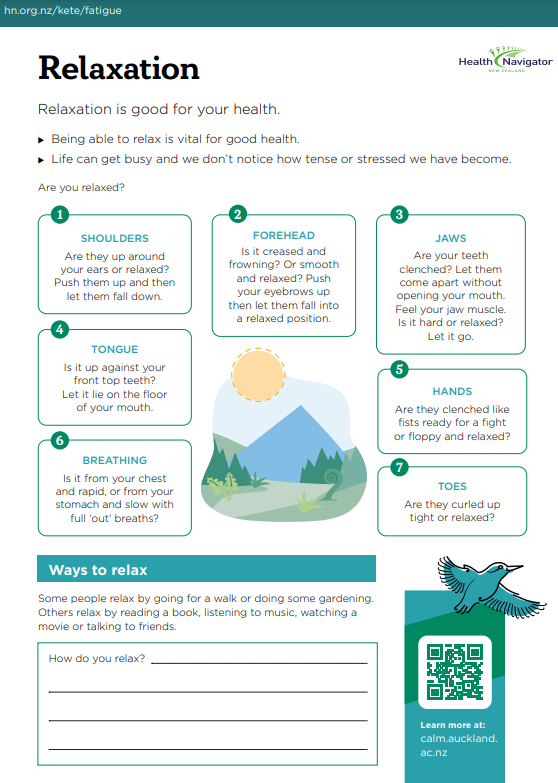
Healthify He Puna Waiora, NZ, 2022

Healthify He Puna Waiora, NZ and Mediboard, 2023
Mental Health Foundation, NZ, 2022
Need help now?

Credits: Healthify editorial team. Healthify is brought to you by Health Navigator Charitable Trust.
Reviewed: by Rudy Bakker, Addiction Coordinator, East Health Trust, Auckland