

If you're a frequent visitor to Healthify, why not share our site with a friend? Don't forget you can also browse Healthify without using your phone data.
Laryngitis
Key points about laryngitis
- With laryngitis, your larynx becomes inflamed due to overuse, irritation or infection.
- Laryngitis may be short-lived (acute) or long lasting (chronic).
- Most laryngitis is triggered by a temporary viral infection, such as a cold, or straining of your voice and isn't serious.
- If you have a hoarse voice that doesn't go away it can sometimes be a sign of a more serious underlying medical condition.
- You can manage most acute cases of laryngitis with self-care, such as resting your voice and drinking plenty of fluids.

Larynx
Your larynx contains your vocal cords which are used in speaking and singing. It’s surrounded by bands of cartilage which create the bump in your neck known as your Adam’s apple. Your epiglottis also sits inside your larynx. It’s a flap or valve that covers up your trachea (windpipe) when you swallow so food and fluid don’t ‘go down the wrong way’ into your lungs.
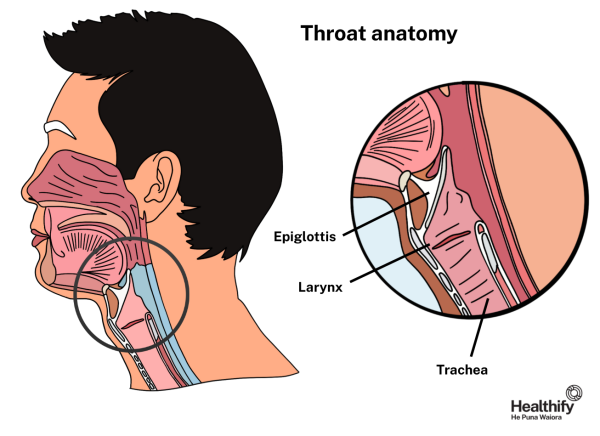
Image credit: Healthify He Puna Waiora
Laryngitis
Laryngitis is when your larynx, or voice box, becomes inflamed from overuse, irritation or infection. It normally goes away by itself within a week or so (acute laryngitis), but it can be long lasting (chronic laryngitis).
Most laryngitis is caused by a viral infection or straining of your voice and isn't serious. Ongoing hoarseness may be a sign of a more serious underlying medical condition.
Laryngitis will usually get better with self-care, such as resting your voice and drinking plenty of fluids.
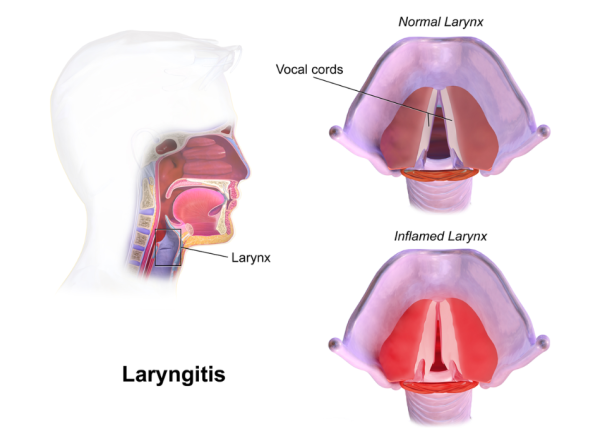
Image credit: Bruce Blausen via Wikimedia Commons(external link)

Laryngitis doesn’t usually last very long and gets better when the underlying cause gets better. Causes of acute (sudden onset) laryngitis include:
- a viral infection, such as a cold or flu
- vocal strain, caused by overuse or yelling
- a bacterial infection – this is less common but is usually more severe.
Laryngitis that lasts longer than 3 weeks is known as chronic laryngitis. It's generally caused by irritation over a long time, such as from:
- exposure to irritating substances, such as allergens, cigarette smoke, stomach acid coming up into your throat (acid reflux) or workplace chemicals
- some medicines, such as steroid inhalers, antihistamines, some blood pressure medicines
- overusing your voice, by:
- speaking too much
- speaking too loudly
- shouting or singing
- coughing or clearing your throat a lot.
Rarely, an ongoing hoarse voice might be due to a more serious problem such as vocal cord injury, a lump on your vocal cords or laryngeal cancer.
Laryngitis usually comes on suddenly and gets worse during the first 3 days. The main symptoms are:
- a hoarse or croaky voice
- a weak voice or losing your voice
- a sore or raw feeling throat
- a dry and irritating cough.
Laryngitis is often linked to other illnesses such as colds and flu, so you may also have symptoms related to these. Children sometimes get a high temperature as well.
It’s likely to be obvious that you have laryngitis if you’re having problems with your voice, possibly with a cough and a sore throat. If you’re not sure that it’s laryngitis or it doesn’t get better within a couple of weeks, talk to a healthcare provider.
They can have a look at your throat and might do some tests to see what the problem is. These may involve:
- taking a throat swab to send off for testing
- a blood test
- a referral to an ear, nose and throat (ENT) specialist if needed.
Laryngitis normally goes away by itself within a week or so. You don't usually need to see your healthcare provider. You can manage most acute cases of laryngitis at home with self-care.
Self-care for laryngitis
- Give your voice a rest by trying to talk as little as possible.
- Drink plenty of fluids.
- Keep the air moist by putting out bowls of water or using a humidifier – central heating and air conditioning make the air dry.
- Gargle with warm salty water (not recommended for children).
- Avoid smoking and smoky, dusty places.
Medicines for laryngitis
Antibiotics are usually not helpful because most laryngitis is caused by a virus, not bacteria.
- Use paracetamol or ibuprofen (if it's safe for you) for pain and inflammation.
- Cough syrup may help soothe your throat.
- Use pain-relief (anaesthetic) lozenges for the pain.
Many cough syrups and medicated lozenges are not suitable for children. Talk to your pharmacist about products you can give your child.
See a healthcare provider if:
- it's very painful or difficult to swallow
- you develop a sore throat and fever
- you're coughing up blood
- your symptoms don't improve after 2 to 3 weeks despite resting your voice
- you have neck lumps or swelling that doesn't settle after 2 to 3 weeks
- you lose weight without meaning to
- you keep getting laryngitis or voice problems.
- Avoid getting coughs and colds: Wash your hands often and avoid contact with people who have upper respiratory infections such as colds or flu.
- Don't smoke and avoid second-hand smoke: Smoke dries your throat and irritates your vocal cords.
- Drink plenty of water: Fluids help keep the mucus in your throat thin and easy to clear.
- Avoid clearing your throat: This causes an abnormal vibration of your vocal cords and can increase swelling. It also causes your throat to secrete more mucus and feel more irritated, making you want to clear your throat again.
- Avoid overusing your voice: Overuse of your voice can cause inflammation of your larynx. Serious damage to your vocal cords can result from strenuous talking or singing when you have laryngitis.
Apps reviewed by Healthify
You may find it useful to look at some quit smoking apps.
References
- Larynx(external link) Better Health, Australia(external link)
- Laryngitis(external link) NHS, UK, 2024(external link)
- Laryngitis(external link) Patient Info, UK, updated 2024
- Reveiz L, Cardona AF, Ospina EG. Antibiotics for acute laryngitis in adults(external link) Cochrane Database of Syst. Rev. 20i5;5:Article CD004783
- Laryngitis(external link) eMedicineHealth, US
How long does laryngitis last?
Laryngitis is usually due to having a virus such as a cold and it generally clears up within a couple of weeks. If you have longer lasting (chronic) laryngitis it may last for weeks or months, depending on the cause.
Is laryngitis contagious?
Laryngitis itself isn’t contagious but if it’s caused by a viral or bacterial infection you could pass the infection on to others and they may get laryngitis as a symptom.
What does laryngitis look like?
Because your larynx sits in your throat below the back of your mouth you can’t easily see your vocal cords to look for laryngitis. A specialist doctor can use a laryngoscope to see your vocal cords. With laryngitis they get inflamed and look swollen and reddened compared to normal (see the image in the causes of laryngitis section above).
Need help now?



Credits: Healthify editorial team. Healthify is brought to you by Health Navigator Charitable Trust.
Reviewed by: Dr Grace Lee, FRNZCGP and Clinical Educator
Last reviewed: