

You can now add Healthify as a preferred source on Google. Click here to see us when you search Google.
Fracture risk assessment
Key points about fracture risk assessment
- Osteoporosis is a health condition where your bones are thinner and weaker than normal, which means they can break more easily.
- A fracture risk assessment estimates your risk of breaking a bone due to osteoporosis within the next 10 years.
- Knowing your fracture risk lets you take steps to protect your bones, including lifestyle changes or taking medicines to strengthen your bones.

A fracture risk assessment is a calculation to estimate your risk of breaking a bone due to osteoporosis within the next 10 years. These breaks are often called fragility fractures.
What is a fragility fracture?
Fragility fractures happen when a bone breaks from a small fall or everyday activity, because your bones are weak. These fractures usually happen in the wrist, hip, spine, or upper arm. They don't include skull, hands and feet fractures.
- Fracture risk assessments also consider your age, lifestyle factors such as smoking or alcohol use, whether you’ve broken a bone before and whether you're taking certain medicines. Read more below about how a fracture risk assessment is done.
- Many fractures that happen from weak bones can be prevented by checking for osteoporosis early and getting the right treatment.
- Knowing your risk early means you and your healthcare team can take steps to protect your bones, lower your risk of breaking a bone, and help you stay active and independent as you get older.
- Find out more about who should have a fracture risk assessment.
Why is a fracture risk assessment done?
A fracture risk assessment estimates your fracture risk to see if a bone density scan (DEXA scan) is needed. A DEXA scan checks how strong your bones are and identifies if you would benefit from bone protection treatment. Learn more about DEXA scans.
Why should you avoid a fracture?
- A fracture can cause pain and difficulty moving.
- It can make everyday activities harder and reduce quality of life.
- Some people may lose their independence and need help from others.
- Certain fractures, especially for older adults, can be serious or even life-threatening.
- If you've had one fracture you're more likely to have another one, so preventing fractures is very important.
Some people are more likely to develop osteoporosis and have fractures. Factors that increase your chances of getting osteoporosis or breaking a bone are called risk factors. If you have 1 or more of the following risk factors, you should have a fracture risk assessment.
Note: While studies show that people of Polynesian descent, including Māori, tend to have stronger bones (higher bone mineral density) and a lower risk of fractures, individual risk can still vary. A fracture risk assessment may still be recommended if other risk factors are present.
The following are risk factors for osteoporosis and fractures that are used to guide who should be assessed.
Family history and fracture risk
- If you have a parent who has had a hip fracture.
- If you've fallen in the past, feel unsteady on your feet, or have less muscle strength.
- If you take medicines that affect balance and increase the risk of falls by causing dizziness or drowsiness. See medicines and falls risk.
Older age
- Women over 60 years of age.
- Men 75 years of age and over.
Lifestyle factors
- Smoking.
- Low body weight (body mass index less than 20 kg/m2).
- Low physical activity or are immobile.
- Drinking more than 2 standard alcoholic drinks daily.
- Not getting enough protein in your diet.
- Severe vitamin D deficiency.
Medical conditions
Some medical conditions can increase your risk of osteoporosis and fractures. These include:
- Menopause, including early menopause (eg, caused by surgery or treatment).
- Missing periods for more than 6 months in women under 45 years of age, not due to hormone treatment or birth control.
- Diabetes (type 1 and type 2).
- Hormone-related conditions such as Cushing syndrome, hypogonadism, hyperparathyroidism and untreated hyperthyroidism.
- Digestive conditions that affect nutrient absorption such as coeliac disease or inflammatory bowel disease.
- Eating disorders.
- Blood-related conditions such as organ or bone marrow transplants and myeloma.
- HIV.
- Chronic liver disease or moderate to severe kidney disease
- COPD.
- Spinal cord injuries.
- Rheumatoid arthritis.
- Some cancers and their treatments, especially breast cancer, prostate cancer, and blood cancers.
Medicines
Some medicines can reduce bone strength by interfering with bone formation, calcium absorption, or hormone levels. This increases the risk of osteoporosis and fractures over time. These include:
- Ongoing steroid use, such as prednisone 5 mg/day for more than 3 months.
- Medicines that lower testosterone levels such as goserelin or leuprorelin.
- Aromatase inhibitors such as anastrozole, exemestane and letrozole.
- Some medicines to treat cancer (chemotherapy).
- Prolonged proton pump inhibitors (PPIs) such as omeprazole, lansoprazole and pantoprazole.
- Methotrexate.
- Pioglitazone.
In Aotearoa New Zealand, the FRAX and Garvan tools are the most commonly used tools for estimating fracture risk. Because they include different risk factors, they may produce different estimates for the same person.
If the fracture risk is clearly high or clearly low, FRAX and Garvan generally give similar results. However, if the risk is borderline, it can be helpful to use both tools and base decisions on the higher risk estimate.
FRAX tool
- It estimates your 10-year risk of hip fractures and other major fractures such as your spine, arm or shoulder.
- It includes ethnicity, smoking, alcohol use, and steroid medication use, which the Garvan tool doesn't include.
- This tool is used internationally. In Aotearoa New Zealand, the FRAX NZ version uses local population data. However, the United Kingdom model is recommended for people of European descent.
Garvan Fracture Risk Calculator
- It estimates 5- and 10-year risk of hip fracture or any fragility fracture.
- It takes into account how many fragility fractures someone has had before and how often they have fallen in the past year, which FRAX doesn't.
- This tool was developed in Australia and validated mainly in Australian populations.
- It may be preferred for people with frequent falls or in very old adults.
Your healthcare provider may suggest a bone density scan (called DEXA scan) to measure your bone strength. The result can be added to your FRAX or GARVAN assessment to give a more precise risk estimate. Learn more about DEXA scans.
The results will indicate a low, moderate or high fracture risk. The fracture risk varies depending on the type or location of the fracture. If you've already had a fracture from a minor injury, you're automatically considered to be at high risk.
Low fracture risk
A low fracture risk means your bones are strong enough that you're very unlikely to break a bone in the next 10 years, due to osteoporosis.
Risk of fracture:
You have a less than 1.5% chance of hip fracture, and less than a 10% chance of having a major bone fracture such as your spine, wrist or shoulder.
Actions:
No medicines are required, but it's important to focus on healthy habits that support strong bones.
Moderate fracture risk
A moderate fracture risk means you have a higher than average chance of breaking a bone in the next 10 years due to osteoporosis.
Risk of fracture:
You have a 1.5 to 3% chance of hip fracture, and a 10 to 20% chance of a major fracture such as your spine, wrist or shoulder.
Actions:
Your healthcare provider will arrange a DEXA scan to assess your bone strength. Whether you need medicines to strengthen your bones depends on other factors, such as your age, health, and personal preferences. Your healthcare provider can help you decide.
Note: If no treatment is started, the chance of breaking a bone can double every 5 to 6 years.
High fracture risk.
A high fracture risk means you have a high chance of breaking a bone in the next 10 years due to osteoporosis.
Risk of fracture:
You have more than a 3% chance of hip fracture, and more than a 20% chance of having a major bone fracture such as your spine, wrist or shoulder.
If you’ve already had a fracture from a minor injury, you are automatically high risk.
Actions:
You will be advised to start prescription medication, such as bisphosphonates, to help protect your bones. Your healthcare provider will arrange a DEXA scan to assess your bone strength.
Not all fractures can be prevented, but you can strengthen your bones and reduce the risk of osteoporosis and fractures through medicines and healthy lifestyle choices. There are some medicines that can lower the risk of future broken bones by 30 to 70%, depending on the type of medicine and where the fracture might happen.
Lifestyle changes
- Eat a balanced diet rich in calcium.
- Keep alcohol to safe limits, less than 2 drinks per day and at least 2 alcohol-free days per week.
- Stop smoking.
- Maintain a healthy weight (aim for a BMI of 20 or higher).
- Get safe sun exposure or take vitamin D supplements if needed. Read more about vitamin D.
- Take steps to prevent falls, such as checking your vision, reviewing your medicines, and keeping walkways clear.
Read more tips to keep your bones healthy.
Exercise – especially weight-bearing exercise
Regular exercise, which is essential for general wellbeing, helps prevent and treat osteoporosis. Bones become stronger when they're active, just like muscles.
The best exercises to strengthen your bones are ones that work your muscles against gravity, and where you bear your own weight. These include exercises such as running, dancing, tennis, skipping, hopping and walking. Resistance training such as lifting weights or using gym equipment helps to strengthen your upper body, and keep bones healthy.
Medicines to strengthen bones
Medicines used to strengthen bones work mainly by slowing or stopping bone loss or rebuilding bone. Read more about osteoporosis medicines.
Live Stronger NZ(external link)
All about osteoporosis(external link) Osteoporosis NZ
Osteoporosis and you(external link) Osteoporosis NZ
Osteoporosis and fractures(external link) Osteoporosis NZ
Brochures
Note: Some resources are from overseas so some details may be different in New Zealand, eg, phone 111 for emergencies or, if it’s not an emergency, freephone Healthline 0800 611 116.
Bone health risk factor test(external link) Osteoporosis NZ
All about osteoporosis(external link) Osteoporosis New Zealand, 2017
Osteoporosis – It's hip to know your risk(external link) Bone Health New Zealand
Building stronger bones: Do the best by your bones – preventing osteoporosis(external link) Bone Health New Zealand
Apps/tools
Bone health tests
Physiotherapy and exercise apps
Osteoporosis apps
Falls prevention apps
References
- Fracture Risk Assessment(external link) Osteoporosis New Zealand
- Fractures | Ngā whatinga kōiwi (Frailty care guides 2023)(external link) Health Quality and Safety Commission, NZ, 2023
- Osteoporotic fracture prevention – a new approach(external link) BPAC, NZ, 2008
Brochures
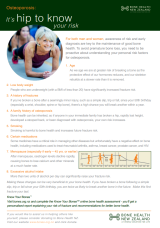
Osteoporosis – It's hip to know your risk
Bone Health New Zealand
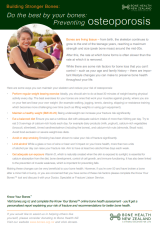
Building stronger bones: Do the best by your bones – preventing osteoporosis
Bone Health New Zealand
Need help now?

Credits: Healthify editorial team. Healthify is brought to you by Health Navigator Charitable Trust.
Reviewed by: Healthify clinical advisors
Last reviewed: