

You can now add Healthify as a preferred source on Google. Click here to see us when you search Google.
Managing common symptoms in palliative care
Key points about common symptoms with a terminal illness
- If you're living with a terminal or life-limiting illness, you may have a number of symptoms to manage.
- Common symptoms include pain, nausea and vomiting, constipation, loss of appetite, breathlessness, and weakness and fatigue.
- Your healthcare team will work with you and your whānau to support your quality of life by making sure any symptoms you have due to your illness are well managed.
- This page provides as overview of these symptoms and includes links to other palliative care pages on Healthify so you can learn more about the possible causes and how to manage them.

Not everyone with a terminal illness has pain, but it's often people’s biggest fear and for some people it can be troublesome. Pain can usually be well managed by your healthcare team. You may be prescribed medicines such as paracetamol, a non-steroidal anti-inflammatory or an opioid such as morphine. Read more about medicines for pain relief and opioids in palliative care.
Self-care tips
- Talk with your healthcare team about when your pain started, where it is and anything that helps to relieve it.
- Take any regular pain relief medications as prescribed – don’t just wait until your pain starts. There’s no risk of becoming dependent on pain medications when they’re prescribed appropriately to control pain.
- Complementary treatments such as massage, listening to music and different relaxation techniques may help. Read more about managing pain without medicines.
Nausea and vomiting may be caused by medicines, treatments or the disease process. Your healthcare team can prescribe anti-nausea medications to help. Read more about medicines for nausea and vomiting.
Self-care tips
Here are some things you can try:
- Sit quietly when you feel nauseous.
- Try taking anti-nausea medicines at least half an hour before you eat.
- Eat smaller, frequent meals.
- Avoid foods or smells that make your nausea worse, cold food might be easier to eat.
- Food such as soups, yoghurts and smoothies are easier for your body to digest.
- Try ginger in biscuits, drinks or tablets.
- Drinks such as peppermint tea and lemonade may help.
- Sip drinks slowly, you may find it's better to drink between rather than with meals.
Read more about nausea and vomiting.
Constipation (when you find it difficult to pass poo) can be caused by eating and drinking less or being less active. It can also be a side effect of medicines you're taking or due to another condition. Your healthcare team may prescribe one-off or regular medication for constipation such as laxatives. Read more about laxatives.
Self-care tips
- Drink small, frequent amounts of fluids.
- Ask your healthcare provider to prescribe a laxative if you're beginning a drug such as morphine (an opioid) with constipation as a common side effect.
- Continue to move around and be active as much as you can.
- Eat high-fibre foods such as porridge, wholemeal bread and certain vegetables and fruits.
The image below shows a good way to sit on the toilet to help relieve constipation.
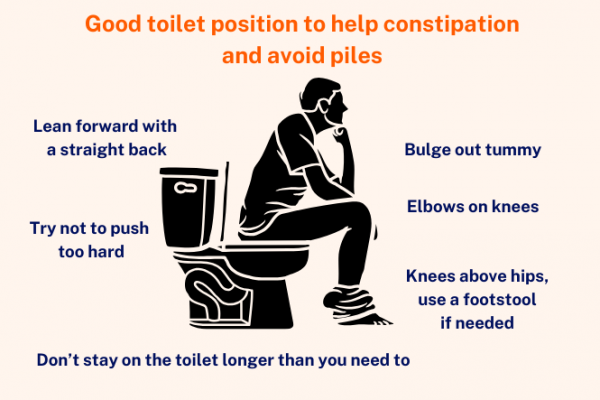
Image credit: Healthify He Puna Waiora
Read more about constipation.
If you've lost your appetite you may not feel hungry or have any interest in food and you may feel full after eating only a small amount.
Loss of appetite may be due to nausea and vomiting, but if you’re less active than you used to be your body needs less energy. It's common towards the end of life.
Self-care tips
Even if you don't feel like eating it's important that you keep eating nourishing food so your body has the energy it needs to help you cope better with your illness.
- Eat small amounts often.
- Eat high-calorie meals to give you the energy you need. Read more about high energy high protein diets.
- Don’t force yourself to eat something you can't face.
- If nausea (feeling sick) is a problem, read more about how to manage nausea.
- Gentle exercise before meals may make you feel more like eating.
Read more about poor appetite.
Breathlessness is the uncomfortable feeling of being short of breath and it being hard to breathe.
Breathlessness can be caused by the disease process affecting your heart or lungs, but it can also be caused by anxiety or be a side effect of medicines and treatments.
- If your breathlessness has come on suddenly, seek medical help.
- If breathlessness develops slowly and comes and goes, your healthcare team may prescribe anti-anxiety medications, nebulisers or steroids.
Oxygen can be useful in some conditions but in others it will make little difference. Your healthcare provider can advise and prescribe this when appropriate.
Self-care tips
- If anxiety is the cause, try some relaxation and breathing techniques, or listening to music.
- Consider a walking aid such a walking frame to still maintain your independence while conserving your energy.
- A change in position can help.
- Rest often and sleep when you need to.
- Wear loose-fitting clothes.
- Plan activities so you can do them bit by bit with breaks in between.
Fatigue is a feeling of extreme tiredness and lack of energy. It can make your body feel weak. Weakness and fatigue are very common near the end of life. It could be caused by a variety of different things such as the progression of your condition, lack of sleep, lack of nutrition, or your treatment or medicines.
Although it's important to keep doing as much as you can, make sure you find time to look after yourself and rest.
Self-care tips
- Use your energy for the things you enjoy – accept help with less important activities such as household chores.
- You may need to move things around your house so you don’t have to walk so far between the areas of the house you use the most.
- Talk with your healthcare team about services and equipment available to support your daily activities.
- If you're having problems eating, read more about poor appetite and ways to manage it.
Read more about weakness and fatigue.
Image credit: Freepik
A hospice guide for carers(external link) Hospice NZ
Managing pain and other symptoms(external link) NHS Choices, UK
Managing the symptoms of cancer(external link) Macmillan Cancer Support, UK, 2016
Emotions and cancer(external link) Cancer Society of NZ
References
- Palliative care symptom topics Healthify He Puna Waiora, NZ
See our page Palliative care for healthcare providers.
Need help now?



Credits: Healthify editorial team. Healthify is brought to you by Health Navigator Charitable Trust.
Last reviewed: