

You can now add Healthify as a preferred source on Google. Click here to see us when you search Google.
Palliative care in the last few days of life
Key points about the last few days of life
- Even when you know someone close to you is terminally ill, the last few days of their life can be unexpected.
- You may notice some changes physically and in their thinking that indicate they’re close to death.
- Everyone’s last few days of life are different, and it can be difficult to predict how and when someone will die.
- It can be helpful to recognise and understand changes that happen in the last few hours or days of life so you can support your loved one who is dying.

It’s normal for people to not have much of an appetite in their last few days of life. Eventually, someone who’s dying will stop eating and drinking. Although this can be distressing, it’s a normal part of the dying process. You can help to keep them comfortable by offering them small sips of water through a straw or from a teaspoon or wetting their lips with water.
In a person’s final few days or hours they’ll spend more and more time asleep. They may wake up for periods during the day and night and may be able to spend some time talking, or they may just find comfort from you being there with them. You may find they’re drifting in and out of consciousness.
They may not be able to communicate much with you, but that doesn’t mean they can’t hear what you’re saying. Spend time talking with them, play their favourite music, read to them or just sit and hold their hand.
During the dying process, a person’s breathing may become less regular. They may have periods of shallow breathing followed by periods of rapid deeper breathing. There can be long pauses between each breath. Their breathing may also become noisier and sound rattly because they can’t cough or swallow normal fluids in their chest or throat. This is usually more distressing for people hearing it than for the person dying. They may be more comfortable with a change of position onto their side (with the help of a nurse of carer) or you can use a small fan or open a window if they’re feeling breathless.
The person’s hands and feet can start to feel cold because of changes in their blood circulation, and their skin can become pale and uneven in colour. Covering them with blankets, or putting gloves or socks on for them, can help keep them warm. Gentle massaging or their hands and feet may also be comforting.
You may find the person becomes agitated and confused. Sometimes they might have hallucinations where they see or talk to people who aren’t actually there. They may shout or lash out, which can be distressing for you if this isn’t their usual behaviour.
There are some simple things you can do that may help:
- Have 1 or 2 familiar people sitting with them.
- Remind them who you are – you may need to this often.
- Have familiar things around them, such as photos and favourite items.
- Remind them of the day and time and help them have regular routines during the day and at bedtime.
- Help them wear their glasses and hearing aids if they have these.
- Reassure them that they’re safe if they say things that aren’t true.
If no underlying cause is found for the confusion and changes in behaviour, the person can be given medicines to help ease their restlessness, anxiety or confusion.
Your guide to hospice care(external link) Hospice NZ
A hospice guide for carers(external link) Hospice New Zealand
Brochures
Last days of life – understanding what is happening Palliative Outcome Initiative, NZ available in Arabic, [PDF, 905 KB] simplified Chinese, [PDF, 946 KB] Hindi, [PDF, 821 KB] Korean, [PDF, 963 KB] Samoan, [PDF, 1 MB] Tongan [PDF, 920 KB]
End of life care for advanced cancer patients(external link) Choosing Wisely, NZ
Hospice care. Palliative Outcome Initiative, NZ available in Arabic [PDF, 921 KB], simplified Chinese, [PDF, 813 KB] Cook Islands Māori, [PDF, 885 KB] Hindi [PDF, 774 KB], Korean [PDF, 1.3 MB], te reo Māori [PDF, 992 KB], Samoan, [PDF, 965 KB] Tongan(external link)
Signs than indicate that death is near(external link) Hospice New Zealand
Podcast
Ending life well – a podcast series for carers(external link) In episode 7 of this series, a palliative care nurse practitioner talks about what to expect at the end of life. This podcast series was developed by the specialist palliative team at Otago Community Hospice and is supported by Hospice New Zealand.
References
- Changes in the last hours and days(external link) NHS Choices, UK, 2023(external link)
- What happens when someone is dying(external link) NHS Inform, UK
- Te Ara Whakapiri – principles and guidance for the last days of life(external link) Health New Zealand | Te Whatu Ora
Last days of life – recognising dying | Ngā rangi whakamutunga o te oranga – te kite i te matenga(external link) Health Quality & Safety Commission, NZ
Te ara whakapiri – principles and guidance for the last days of life(external link) Health NZ | Te Whatu Ora
Te ara whakapiri – toolkit [DOCX, 522 KB] Ministry of Health, NZ
Ongoing care of the dying person(external link) Hospice Waikato, NZ
Care during the last days of life Pairuri (palliative care)(external link) HQSC NZ
Recognising the dying person – flow chart(external link) Health NZ | Te Whatu Ora
Medical management planning - general principles(external link) Health NZ | Te Whatu Ora
Bereavement risk assessment tool [DOCX, 48 KB] Ministry of Health, NZ
Symptom management guidelines(external link) Health NZ | Te Whatu Ora
Discharge checklist(external link) Health NZ | Te Whatu Ora
When death approaches(external link) Health NZ | Te Whatu Ora
Dying at home(external link) Health NZ | Te Whatu Ora
Home care in the last days of life(external link) Health NZ | Te Whatu Ora
Serious illness conversation guide Aotearoa(external link) Health Quality & Safety Commission, NZ
Brochures
Hospice care. Palliative Outcome Initiative, NZ, 2020
Arabic & English, Simplified Chinese & English, Cook Island Māori & English, Hindi & English, Korean & English, te reo Māori & English, Samoan & English, Tongan & English
Palliative Outcome Initiative, NZ, 2020
English & Arabic, English & Simplified Chinese, English & Hindi, English & Korean, English & Samoan, English & Tongan
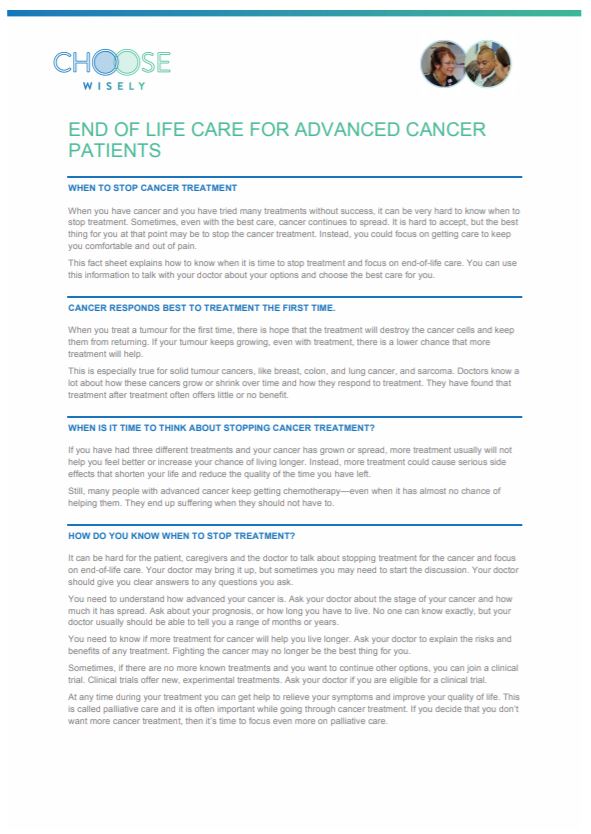
Choosing Wisely, NZ, 2016
Need help now?

Credits: Healthify editorial team. Healthify is brought to you by Health Navigator Charitable Trust.
Reviewed by: Dr Andrew Muir, FRNZCGP, Clinical Diploma in Palliative Medicine
Last reviewed: