

You can now add Healthify as a preferred source on Google. Click here to see us when you search Google.
Osgood-Schlatter disease
Key points about Osgood-Schlatter disease
- Osgood-Schlatter disease is a condition causing knee pain from irritation of the tendon attached to the shin bone.
- It mostly affects sporty young people during their growth spurt (8 to 15 years of age). Girls are usually affected earlier than boys.
- Common symptoms include pain just below your kneecap that gets worse with activity. Sometimes a small hard bony bump can form below the knee cap.
- Osgood-Schlatter disease usually improves over time and usually settles once growth spurts have stopped.
- If treatment's needed it may include modifying your activities, pain relief medicines, physiotherapy, knee support and rest. Surgery is rarely required.

Osgood-Schlatter disease is a condition that causes knee pain in adolescents. It usually affects boys between the ages of about 11 to 15 years, and girls 8 to 13 years of age.
Osgood-Schlatter disease is caused by the overuse of quadricep (thigh) muscles putting repeated strain on the patella (kneecap) tendon that attaches to the tibia (shin) bone. Overuse of quadricep muscles commonly happens in sports that involve a lot of running, jumping or kicking.
Common symptoms include pain just below your kneecap that gets worse with activity. Sometimes a small hard bony bump can form there. Symptoms may last for several months and may come and go during growth periods (for up to 24 months). It almost always gets better once the growth spurt is over.
If treatment's needed it may include activity modification (eg, doing less running and jumping), taking pain relief medicines and physiotherapy. Some people may need to take a short period of rest or use knee support. Surgery is rarely needed.
Osgood-Schlatter disease affects the upper part of your shin bone (tibia) due to the overuse of the quadricep muscles (located on the front of your thigh).
During adolescence, the tibia is still growing. Overuse of the quadricep muscles can put stress on the tendon that attaches the patella (kneecap) to the upper part of the growing tibia. This causes irritation of the soft growth area where they connect, and leads to pain just below the kneecap.
Sometimes the tendon can pull a small flake of bone off the tibia and cause a callus (healing bone) to form. This can cause a hard bony bump.
You're at greater risk of getting Osgood-Schlatter disease if you're:
- a boy
- a teenager
- playing a lot of sports that involve kicking, running or jumping.
Common symptoms include:
- pain just below your kneecap that gets worse during and after activity
- pain that gets better after resting
- pain that can last for a few months and up to 2 years
- a small, hard and tender bony bump or swelling under your kneecap.
Symptoms usually happen on one side but can also happen on both knees. Knee movement isn't affected.
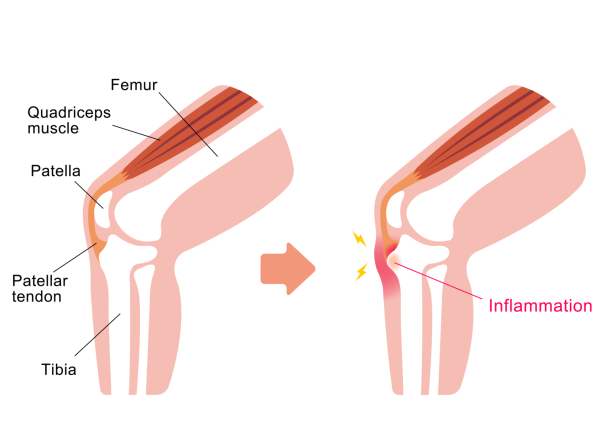
Image credit: Depositphotos
Your healthcare provider will ask you questions related to your symptoms and examine your knee area. They may also order a knee X-ray to rule out other conditions.
Osgood-Schlatter disease isn't serious or harmful. It usually goes away by itself without any treatment once the tibia (shin bone) has stopped growing.
If treatment is needed, it will focus on relieving your symptoms:
- Rest and activity: Most people will be encouraged to stay active. The aim will be to find the right balance between rest and activity. Your healthcare provider may make recommendations about the activity type, and discuss changes, alternatives, timing and frequency of your activity.
- Icing: Applying ice (in a bag or tea towel) to your knee for 15 to 20 minutes at a time after activity or sports may be helpful.
- Pain relief medicines: A short course of pain relief medicines may be helpful to manage discomfort. Talk to your healthcare provider or pharmacist about which medicine is the best for you.
- Physiotherapy: Stretching and strengthening exercises are particularly helpful to strengthen the muscles around your knee, helping to reduce pain.
- Knee support: If it's advised by your healthcare provider, using knee tape, a splint or crutches for a limited amount of time may help.
- Surgery: Very rarely, surgery may be done to remove the bony bump if your symptoms don't go away after the above treatment.
Apps reviewed by Healthify
You may find it useful to look at some physiotherapy and exercise apps.
Osgood-Schlatter disease is not a serious or harmful condition. It usually goes away by itself after several weeks to months without any treatment once the tibia is fully grown.
Osgood-Schlatter disease(external link) Patient Info, UK
Osgood-Schlatter syndrome(external link) Family Doctor, NZ
Osgood-Schlatter disease(external link) Kids Health, NZ
Osgood-Schlatter disease(external link) MSD Manuals, MS
Brochures
Osgood-Schlatter disease(external link) Royal Children's Hospital Melbourne, Australia
Apps
Physiotherapy and exercise apps
References
- Osgood-Schlatter syndrome(external link) Family Doctor, NZ
- Osgood-Schlatter disease(external link) Patient Info, UK, updated 2023
Can Osgood-Schlatter go away?
Yes, Osgood-Schlatter disease will go away in time – usually within months, however it may last up to 2 years. It only affects rangatahi while they’re still growing, so once their tibia (shin) bone has reached maturity, the pain will go away.
Can you get rid of Osgood-Schlatter disease?
Osgood-Schlatter disease will go away by itself over time, once the shin bone has reached growth maturity. You can manage the symptoms by limiting or modifying activities and sports that involve a lot of jumping or running, icing the knee, taking pain medicine and seeing a physiotherapist for stretching and strengthening exercises to support your knee.
Why does Osgood-Schlatter happen?
Osgood-Schlatter disease happens during growth spurts when running, jumping or kicking repeatedly puts stress on the tendon below the kneecap. This pulls on the soft growth area of the shinbone (tibia) causing irritation and pain.
Need help now?



Credits: Healthify editorial team. Healthify is brought to you by Health Navigator Charitable Trust.
Reviewed by: Dr Grace Lee, FRNZCGP and Clinical Educator
Last reviewed: