

If you're a frequent visitor to Healthify, why not share our site with a friend? Don't forget you can also browse Healthify without using your phone data.
Dilatation and curettage
Also know as dilation and curettage or a D&C
Key points about dilatation and curettage
- Dilatation and curettage (D&C) refers to the opening of your cervix (dilatation) and removal of tissue from your uterus (womb) using an instrument called a curette, or a suction tube.
- It can be done to investigate uterine bleeding problems, to remove pregnancy tissue after a miscarriage or to perform a surgical abortion.
- A D&C can be done under general anaesthetic or is sometimes done under local anaesthetic and sedation.

Dilatation and curettage, also known as D&C, is a procedure done to remove tissue from the inside of your uterus (womb).
Dilatation refers to the dilating or opening of your cervix to allow access to your uterus and curettage refers to the use of a surgical instrument called a curette, to take a tissue sample or remove tissue. A suction tube may be used instead of a curette.
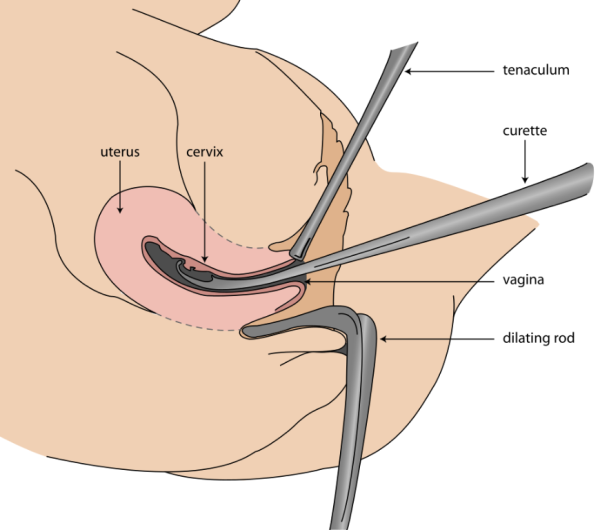
Image credit: Fred the Oyster via Wikimedia Commons(external link)

There are a number of situations where dilatation and curettage is used:
- To investigate uterine bleeding problems.
- To investigate post-menopausal bleeding (bleeding after menopause).
- To remove pregnancy tissue that hasn't come away after a miscarriage or an incomplete medical abortion.
- To perform a surgical abortion.
A D&C may be done at the same time as a hysteroscopy. This is where a light and camera are put into your uterus (via your vagina) to look for any abnormalities, such as uterine polyps or fibroids, and to help with taking tissue samples.
The procedure is usually done as day surgery. It may be done under a general anaesthetic (where you’re put to sleep) or may be done with local anaesthetic and sedation.
Before the procedure you may be given medication to help soften your cervix and make dilation easier.
A speculum will be used to gently open your vagina and make it easier to check the walls and see your cervix. A dilatation (or dilation) instrument is used to open your cervix (the neck of the womb) enough to insert a curette (a slim metal instrument with a curved top). This is used to gently scrape the inside of your uterus (womb) to remove tissue. A suction tube may be used instead of, or as well as, a curette.
No cuts or stitches are done when you have a D&C
Depending on the reason for the D&C:
- a sample of tissue may be removed so it can be tested in the lab
- tissue that’s left over from a miscarriage, pregnancy tissue, or a polyp or fibroid may be completely removed.
Once you’ve recovered from the procedure you’ll be able to go home and will be given instructions for how to look after yourself and when and where to get follow-up.
- You can expect to have some cramping and bleeding after the procedure and you may need some pain relief. Panadol is recommended, but if you need something stronger, ask your healthcare team how it’s best to manage your pain.
- Take it easy for a day or so.
- If you’ve had a general anaesthetic it’s important not to drive, drink alcohol, operate heavy machinery or make important decisions in the first 24 hours after your procedure.
- For the first week, or while you're still bleeding, it’s best to:
- have a shower rather than a bath
- avoid swimming
- avoid penetrative sexual intercourse
- use sanitary pads rather than tampons or menstrual cups.
When to seek help
- If you have pain rather than discomfort after the procedure, and especially if it doesn’t settle, get advice from your healthcare provider or call Healthline on 0800 611 116.
- If your bleeding is heavy or lasts longer than 10 days or you pass large clots.
- If you have signs of infection (a high temperature/fever, pain, vomiting, vaginal discharge – especially if it’s smelly) it’s important to contact and see a healthcare provider.
A D&C is usually a straighforward procedure and most people have no complications. However, with any medical or surgical procedure there are some risks. There is a small risk of bleeding or infection with the procedure. There is a very low risk of a uterine perforation, when a hole is made in your uterus. Scar tissue formation in the uterus (Asherman syndrome) is an uncommon complication.
References
- Dilatation and curettage (D&C)(external link) Better Health, Australia
- D and C (dilation and curettage) procedure(external link) Healthline, US, 2020
- Dilation and Curettage (D&C)(external link) American Society for Reproductive Medicine, Reproductive Facts, US, 2023
- Surgical abortion(external link) Abortion Services in New Zealand
- Miscarriage at hospital (D&C)(external link) Miscarriage Support, NZ
- Hysteroscopy RANZCOG, Australia, 2025
- Dilatation and curettage (D&C)(external link) Department of Health, Western Australia
Dilation and curettage and hysteroscopy
Dilatation (or dilation) and curettage (D&C) is a procedure where your cervix is dilated (opened) and a curette (spoon-like instrument) is put into your uterus to gently scrape away tissue or take a tissue sample. Sometimes a hysteroscopy is done at the same time. This is where a hysteroscope (a thin telescope) is inserted through your cervix. It’s attached to a light and camera and monitor allowing the gynaecologist or surgeon to look inside your uterus.
How long after a D&C will I get my period?
You will have some period-like bleeding for a week to 10 days after the procedure. Your next menstrual period might be a few weeks late. You may find your period is heavier than usual.
Is a D&C the only way to manage a miscarriage?
If you have an incomplete miscarriage (where some of the pregnancy tissue remains in your womb) or a missed miscarriage (where the pregnancy has stopped growing but the tissue stays in your womb) you may need some medical treatment. You may be able to take medicines to speed up the process of passing the pregnancy tissue (medical management), or you may need a D&C to have the pregnancy tissue removed (surgical management). Talk to your healthcare provider about which option is best for you. Read more about miscarriage.
Need help now?



Credits: Healthify editorial team. Healthify is brought to you by Health Navigator Charitable Trust.
Reviewed by: Dr Judy Ormandy, Obstetrician and Gynaecologist, Wellington
Last reviewed: