

If you're a frequent visitor to Healthify, why not share our site with a friend? Don't forget you can also browse Healthify without using your phone data.
Appendicitis
Key points about appendicitis
- Appendicitis is the inflammation of your appendix – a small, finger-like pouch in your gut wall.
- It's not clear why an appendix becomes inflamed but it may be due to a blockage caused by poo or undigested food.
- The main symptom is tummy pain that starts around your belly button and moves to your lower right tummy as it gets worse. You may also feel sick, have runny poo and a fever.
- Appendicitis can cause complications such as infection and inflammation, which can be life threatening if your appendix ruptures (bursts). Get medical help quickly if you have the symptoms below.
- Treatment usually involves surgery to remove your appendix.

Your appendix is a small, closed-end tube about 5 to 10 cm long located at the beginning of your large bowel (colon). It's in your right lower tummy area. The function of the appendix isn't entirely understood but it's thought to contain bacteria that hep with digestion and may help with the development of the immune system for young children. However, it's safe to live without your appendix.
If it becomes inflamed, that's called appendicitis. The main symptom is tummy pain that starts around your belly button and moves to your lower right tummy as it gets worse.
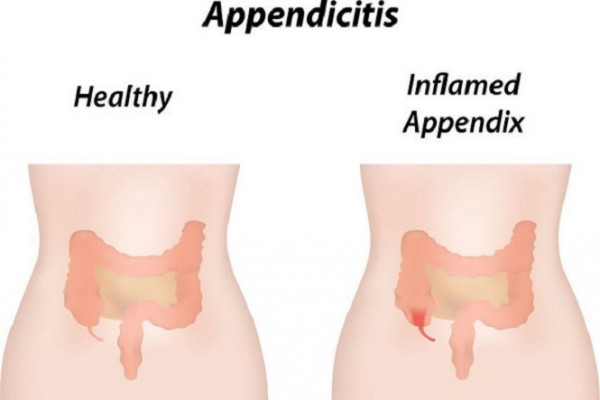
Image credit: 123rf
If you think you or your child has appendicitis, it’s important to get help quickly as it can burst if it’s not treated and then the infection can spread into your abdominal space or bloodstream.
- pain that suddenly gets worse and spreads across your tummy
- pain that temporarily improves then gets worse again
- severe ongoing tummy pain
- your tummy feels hard and tight
- your tummy appears swollen
- fever (high temperature)
- nausea (feeling sick) and vomiting (being sick)
- fast heartbeat
- shortness of breath or rapid breathing
- pain when coughing
- any movement, particularly of your legs at your hips, is painful.
Appendicitis usually affects young people 10 to 20 years of age, but it can happen at any age.
It's not clear why an appendix becomes inflamed. It may be due to a blockage caused by faecal matter (poo) or undigested food, or swelling in the appendix wall. This provides a rich breeding ground for bacteria, causing your appendix to become infected, swollen and full of pus.
The blockage could also be caused by a tumour in older adults or a swollen lymph node in your gut due to an upper respiratory tract infection.
The main symptom of appendicitis is tummy pain. At first, you may notice a dull pain around your navel (tummy button). As the inflammation gets worse, the pain becomes sharper and may move down to the lower right-hand side of your tummy.
The pain can quickly become more severe over 6 to 24 hours. If you gently press this area of your tummy it can make the pain worse. Coughing, sneezing or walking may also worsen the pain.
Appendicitis doesn’t always follow this ‘classic’ course. You may feel the pain higher in your tummy, particularly if you’re pregnant, or closer to your anus (back passage). You may only have mild pain that doesn’t get worse until your appendix bursts.
Other symptoms may include:
- fever
- nausea (feeling sick)
- vomiting (being sick)
- diarrhoea (runny poo)
- constipation (hard poo)
- loss of appetite.
If you have any of the symptoms above, contact your healthcare provider urgently.
Appendicitis can cause complications, including peritonitis, abscesses and sepsis.
Peritonitis
If you have appendicitis and don’t seek medical treatment, the inflammation can get worse and your appendix can burst. Once your appendix bursts, the entire lining of your abdomen (the peritoneum) can become infected with bacteria, and this can cause severe pain in your whole abdomen (tummy area). This is known as peritonitis (the inflammation of your peritoneum). Peritonitis is life threatening and needs to be treated immediately with antibiotics, and you’ll need surgery to remove your appendix.
Symptoms of peritonitis can include:
- severe continuous tummy pain
- your tummy feels hard and tight
- a swollen tummy
- a fever (high temperature)
- nausea (feeling sick) and vomiting (being sick)
- a fast heartbeat
- shortness of breath or rapid breathing
- tummy pain when you move – particularly when you cough, or move your legs or hips.
Abscess
After your appendix bursts, pus can collect around it and form a lump or mass where your body is trying to fight off the infection. This can cause pain around your right lower tummy area. If this happens, you will need surgery to drain the pus, as well as treatment with antibiotics.
Sepsis
If it’s not treated, bacteria from a burst appendix can enter your bloodstream causing sepsis. This is a serious condition causing inflammation all around your body and symptoms such as a fever, fast heartbeat and breathing rate and low blood pressure. Read more about sepsis.
Your healthcare provider will ask you about your symptoms and examine you, pressing your right lower tummy to see if the pain gets worse. They may also order tests to confirm the diagnosis and rule out other conditions that can have the same symptoms.
Tests that may be done include:
- a blood test to look for infection
- a pregnancy test if it's possible you could be pregnant
- a urine (pee) test to rule out urine infection.
If you're very unwell, you may be sent to the hospital immediately and have these tests in the hospital. The hospital may also do an ultrasound or CT scan to confirm the diagnosis.
Treatment is normally surgery (an operation) to remove the inflamed appendix – ideally before it bursts. If you're very unwell, your surgeon may operate straight away rather than ordering more tests. If you don’t need surgery urgently, you may be given antibiotics and observed for a time.
The surgery is called an appendicectomy or appendectomy. The procedure can be done through a keyhole surgery (laparoscopic) or an open surgery. Your surgeon will let you know the best treatment options for you and discuss the possible risks of each surgery.
Laparoscopic appendectomy
In straightforward, non-complicated situations, your surgeon will often perform the appendectomy using the keyhole technique. This involves making very small cuts or holes in your tummy and inserting a video camera and surgical tools to remove your appendix without the need for a larger cut. This technique is usually preferred as the recovery is quicker than an open surgery.
Open appendectomy
In some cases, an open approach is used, where a slightly larger cut is made on your right lower tummy area to remove your appendix. This technique is usually used if:
- your appendix has burst and formed a lump or mass around it
- your appendix isn't in the usual place
- you're pregnant
- something is found during the laparoscopic procedure meaning your surgeon needs more space to work in
- you've had an open abdominal surgery previously which has led to scarring.
If your appendix has already ruptured and you have peritonitis, a larger cut in the middle of your tummy (laparotomy) may be needed to remove your appendix and wash out the fluid contents that have leaked from the ruptured appendix.
Once you have been discharged from hospital after your surgery, you need to:
- care for your incision (surgery) site – see below
- drink plenty of fluids and eat more fibre
- attend follow-ups and see your healthcare provider again
- limit your activity
- manage your pain.
Care for your incision (surgery) site
- Keep the site of the surgery clean – your healthcare team will tell you how best to clean and care for your particular surgical wound.
- Your healthcare team will tell you when you can remove the dressing – this will normally be 48 hours after the surgery.
- You may have dissolvable stitches, or regular stitches that need to be removed at a later date.
- Ask your surgeon or healthcare provider when you need to go back and get the stitches removed.
Read more about caring for your surgical wound at home.
Drink plenty of fluids and eat more fibre
- You may have constipation (hard poo) for a short period after your surgery.
- Follow the diet advised by your healthcare team. They may suggest you start with clear liquids after your operation, move on to soft foods, then fibre-rich meals with fluids when you can manage it.
- It's also important not to take codeine for pain relief as it can make your constipation worse.
- Your healthcare provider can prescribe medicine for you if your constipation is a problem.
See your healthcare provider again
- You will usually have a follow-up visit 10 to 14 days after your surgery.
- In the meantime, call your healthcare provider immediately if any of the following signs of infection develop:
- fever
- new redness spreading outward from your incision site
- pus or other drainage from your incision
- you suddenly get severe nausea/vomiting
- new and worsening severe abdominal (tummy) pain.
Limit activity
- Don't do any heavy lifting or strenuous activity until you've been seen at your check-up appointment.
- Ask your surgeon about when it's safe to return to your regular job – this will depend on the type of work you do and whether your appendectomy was laparoscopic or open (see the treatment section above).
Manage pain
- The pain should be minimal after the first few days.
- Your surgeon will provide you with a prescription for pain relief medicines to take if you need them.
- If the pain doesn't go away or gets worse, contact your healthcare provider.
Appendicitis – a patient’s guide(external link) Family Doctor, NZ
Appendicitis(external link) Patient Info, UK
Appendicitis in children(external link) KidsHealth, NZ, 2023
References
- Acute abdominal pain in children(external link) Auckland Regional HealthPathways, NZ, 2023
- Appendicitis, suspected(external link) Starship Clinical Guidelines, NZ, 2024
- Appendicitis(external link) Patient Info, UK
- Appendicitis in children(external link) KidsHealth, NZ, 2023
- Ruptured appendix(external link) Healthline, US, 2022
- Appendectomy(external link) Cleveland Clinic, US, updated 2025
Clinical resources
Appendicitis, suspected(external link) Starship Clinical Guidelines, NZ, 2024
Telehealth clinical module – abdominal assessment(external link) ProCare, NZ, 2021
Appendicitis(external link) MSD Manuals, US
Podcast
Appendicitis controversies(external link) Emergency Medicine Cases, Canada (Duration 1:12:22)
Where do you feel appendix pain?
The pain generally starts around your belly button and then moves to your lower abdomen (tummy/puku) on the right side.
Will appendicitis pain come and go?
It may come and go at the start but usually becomes constant as it gets worse and moves to the right side of your lower tummy.
How is appendicitis treated?
Appendicitis generally needs surgery to remove your appendix. If it’s not very severe, you may be given antibiotics and watched for a while to see how it develops. Even if the diagnosis isn’t absolutely clear, you may have your appendix removed as it’s better to have the surgery than risk your appendix bursting and the complications that can happen if it does.
What happens with a burst appendix?
If your appendix isn’t removed when you have appendicitis it may swell to the point where it cuts off the blood supply to part of the appendix wall. As that part dies, a hole can develop allowing the infected contents to escape into your abdomen. This is called a burst, perforated or ruptured appendix. It’s very risky as it can lead to peritonitis (infection of the lining of your abdomen) and abscesses (collections of pus around the burst appendix). If your appendix bursts there’s an initial relief of pain as the pressure is released but it doesn’t last.
Need help now?



Credits: Healthify editorial team. Healthify is brought to you by Health Navigator Charitable Trust.
Reviewed by: Dr Grace Lee, FRNZCGP and Clinical Educator
Last reviewed: