

You can now add Healthify as a preferred source on Google. Click here to see us when you search Google.
Supporting people with dementia – conversation and companionship
Key points about supporting people with dementia through conversations and companionship
- Living with dementia is a very different experience for each individual and also for every caregiver or companion.
- It can be hard to have conversations and spend time with people whose memories are not working as they once did.
- On this page Sarah talks about what she learned from supporting her mother with dementia and shares some tips she hopes others will benefit from.
- You can read more at Saturdays with Mum(external link).
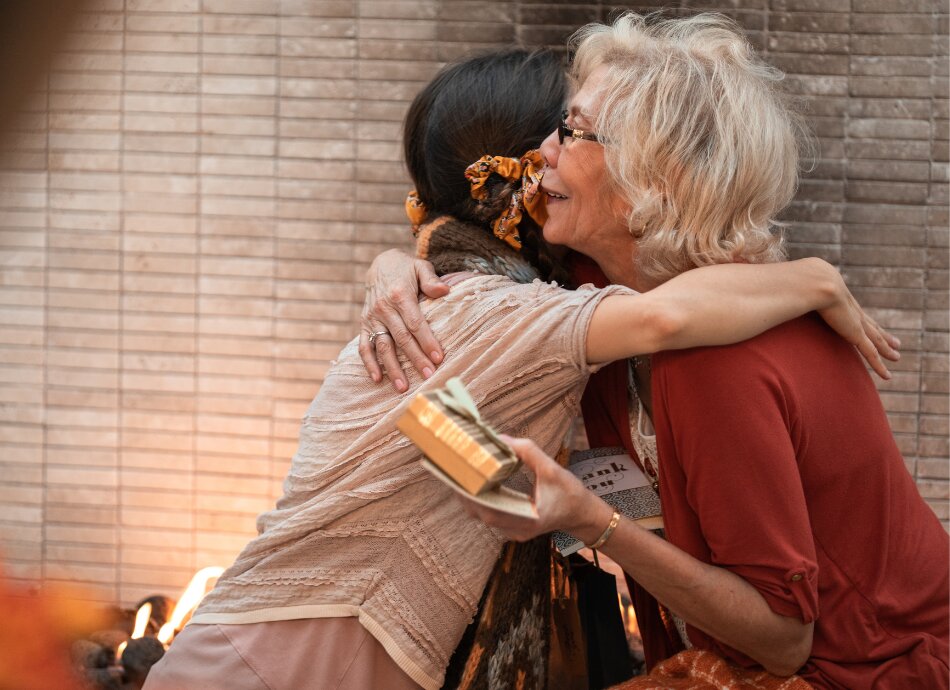
Sarah supported her mother who was living in a rest home for several years and has kindly provided some tips based on her own experiences. You can also read her suggestions for supporting people with dementia through knowledge, kindness and understanding and how to look after yourself as a carer or companion.
As Mum’s condition progressed, I struggled to cope with repetition. People living with dementia sometimes cycle through the same stories and questions, which can be frustrating and unsatisfying for both parties. Conversations are like tennis – someone serves the ball and the other person hits it back. After a while, I started treating our discussions the same way. I’d deliberately elicit favourite stories, knowing that Mum would enjoy telling them. So, while out on a drive I would ask about a favourite landmark. Mum would then tell me a related story, often in a slightly different way, or with details I’d not heard before. I was serving the shots and Mum was hitting them back.
The ‘tennis strategy’ helps because it gives both parties an active role in the conversation – one as the enquirer and the other as the subject matter expert.
Many people who are living with dementia continue to retain considerable knowledge and expertise in a range of areas. Mum was no different – she loved being involved in things she was good at. It was just that she no longer had the capacity to initiate things.
For a long time, it was easy to find meaningful and satisfying tasks appropriate to her interests, skills and level of functioning. Over the years we spent many hours chatting while Mum gardened, knitted and mended clothes, for family and friends.

Image credit: Healthify He Puna Waiora
And my mother continued to be a mine of information about all sorts of things from cooking, baking and preserving to politics, history and geography. The daily quiz was a great opportunity for her to highlight the gaps in general knowledge among the younger generation.
Providing opportunities for people to use and pass on their knowledge and skills maintains expertise, increases self-esteem and keeps things interesting.
Once Mum moved to a rest home, she was no longer struggling to manage life on her own. And with regular, nutritious meals she quickly regained some of her previous energy. Mum loved all kinds of expeditions and activities but it was sometimes hard to come up with ideas.
Here’s what worked for Mum and me
Local walks – leisurely strolls to nearby cafes, libraries and shops. Op shops, especially those with a chair where Mum could rest and observe while I looked round. Driving to an interesting suburb and walking around, looking at houses and gardens, chatting with people in the neighbourhood.
Short drives – finding a playground, with a well-placed bench for watching children and parents on the swings and slides. Driving to the beach, taking off our shoes and walking on the wet sand. Parking the car in the main street, doing small errands while Mum stayed in the car, watching the world go by.
Longer drives – choosing routes likely to revive old memories and spark new conversations. Treating the experience like a movie – appreciating the scenery and seeing activities unfold without worrying about keeping up with the plot. If things get tiring, putting on some favourite music to reduce the pressure to talk.
Visits to my house – arranging informal time with family and close friends. Helping to prepare and eat favourite foods, spending time with grandchildren, having a nap in familiar surroundings. Participating in routine household activities like podding and chopping fruit and veges, folding the washing, even sorting the junk drawer!
Sensory experiences – focusing on sight, sound, smell, taste and touch:
- Art galleries for exhibitions of familiar paintings. Libraries for much-loved books. Streaming platforms for revisiting classic, familiar movies.
- Photos and images in albums, on cell phones or iPads, especially those involving family, pets or familiar places. Printed photos displayed on walls, as a conversation starter for staff and visitors.
- Music for prompting early memories and sparking joy. Working out when Mum was a teenager, searching online for popular songs of that era, playing them to test her preferences. Visit Playlist for Life(external link) for information about how to set up a playlist and how music helps people who are living with dementia.
- Perfume for triggering emotions and memories. Department stores often have a good selection. Reduced sense of smell is common with many types of dementia so experiment with strong fragrances and ignore the rest.
- Favourite foods – especially those not often provided in residential facilities. Snacks, seasonal foods and distinctive flavours. Picnics, outside on park benches, in public gardens and at the beach. When Mum become too tired to go out, creating an ‘indoor picnic’ by setting up a small table in her room.
- Touch through gentle stroking, hugs and handholding. Walking barefoot together on grass, taking a dip in a hydrotherapy pool, paddling in the waves at the beach.
Much of the pleasure comes from taking it gently, noticing and savouring the little things. Slow down, pace yourself, and keep things simple.
Need help now?



Credits: Sarah Scott
Reviewed by: Healthify editorial team. Healthify is brought to you by Health Navigator Charitable Trust.
Last reviewed: