

You can now add Healthify as a preferred source on Google. Click here to see us when you search Google.
Laxatives for adults
Medicines used to treat constipation are called laxatives
Key points about laxatives in adults
- Treatment with a laxative is needed only if lifestyle measures, such as eating plenty of fibre, drinking enough fluid, and exercising regularly do not work well in relieving constipation.
- Talk to your healthcare provider or pharmacist if you think you need a laxative. Read more about constipation.
- Note: The information below is for laxative use in adults. For information about the safe use of laxatives in children, see laxatives (children).

There are several types of laxatives that differ in how quickly they start working, how helpful they are in different situations, their taste, cost and possible side effects. Some of them are available from your pharmacy, and others on prescription from your healthcare provider. The four main groups of laxatives are:
- bulk-forming laxatives (or fibre supplements)
- stimulant laxatives that act on the bowel's nervous system to get the bowel moving
- osmotic laxatives that draw water into the bowel
- stool or poo softeners.
More detailed information about these four types of laxatives, including common brand names, is provided below.
There are different forms of laxatives. Some can be taken by mouth; others such as an enema inserted in the bottom.
- Tablets, capsules, syrups, drops and powders are taken by mouth, and depending on the type of laxative, can take hours or days to work.
- Rectal laxatives (enemas or suppositories) are inserted into the rectum (bottom). These are usually effective within minutes to an hour and are mainly used as a last resort to treat severe constipation.
Drink plenty of water:
- When taking laxatives, you should try to drink at least 8 to 10 cups of water a day.
- This is because laxatives, especially an osmotic laxative, can make you dehydrated.
- If you take a bulk-forming laxative and you don't drink enough fluid this can cause a blockage in the gut as the poo may become dry and difficult to pass.
Use laxatives only for short periods of time:
- Long-term use can make your body dependent on them, so your bowel no longer works normally without them.
- Generally, it's recommended that you don't take laxatives for more than 5 to 7 days in a row.
- If you still have constipation after taking laxatives for several days contact your healthcare provider for advice.
Bulk-forming laxatives are high in fibre which adds bulk to the poo. The bulky size stimulates the bowel muscles, causing poo to move along, leading to an easier bowel movement.
- They usually take 2 to 3 days to cause a bowel movement.
- Bulk-forming laxatives may be useful in people with haemorrhoids, anal fissure, chronic diarrhoea associated with diverticular disease and irritable bowel syndrome.
- They're not recommended for constipation caused by opioids, or in people unable to maintain adequate fluid intake, at risk of dehydration or with problems swallowing.
- It's important to drink enough fluids when using bulk-forming laxatives – not drinking enough fluids can cause blockage of the gut.
Examples include:
- unprocessed bran or oat bran
- psyllium (Konsyl D®, Mucilax®, Metamucil®, Bonvit®)
- sterculia (Normacol®, Normafibe®)
Read more about bulk-forming laxatives.
These laxatives soften the poo.
- The oral softeners usually cause a bowel movement after 12 to 72 hours.
- The rectal softeners (enema) usually cause a bowel motion within 30 minutes.
Examples include:
- Tablets and drops:
- Docusate (Laxofast capsule, Coloxyl tablet).
- Coloxyl drops.
- Enema:
- Docusate (Coloxyl enema).
Osmotic laxatives draw water into the bowel. The bowel becomes filled (distended) with extra fluid, and this stimulates the muscles of the walls of the bowels to contract and squeeze the bowel movement along.
- The oral liquids usually take 1 to 3 days to cause a bowel motion.
- The rectal osmotic laxatives (enema) usually cause a bowel motion within 30 minutes.
Examples include:
Stimulant laxatives stimulate the nerves in the bowel, causing muscle contractions and in this way gets the bowel moving.
- The tablets or capsules usually cause a bowel movement after 8 to 12 hours. A bedtime dose is recommended, so you're likely to feel the urge to go to the toilet sometime the next morning.
- The rectal stimulant laxatives (suppositories or enemas) are quick acting and cause a bowel movement after 15 minutes but may take up to 1 hour.
- Stimulant laxatives are used for constipation caused by opioids or when complete emptying of the bowel is required such as before surgery (operation).
Examples include:
Like all medicines, laxatives can cause side effects, although not everybody gets them. The common side effects of laxatives are stomach pain or cramps, bloating, gas in the tummy, flatulence or 'farting'. Other side effects include:
- Constipation: Ongoing use of laxatives can cause constipation because the bowel loses muscle and nerve response and can no longer move poo out. This results in dependency on the laxative, so that higher doses are needed to poo.
- Diarrhoea and dehydration: Taking too much of some laxatives can lead to diarrhoea and losing too much salt from the body.
Read more about medicines and side effects and reporting a reaction you think might be a side effect.
New Zealand Formulary Patient Information
- Bulk laxatives (external link)
- Docusate(external link)
- Docusate and sennoside(external link)
- Sennosides(external link)
References
- Laxatives(external link) NZ Formulary
Brochures

Medicines and side effects
Healthify He Puna Waiora, NZ, 2024
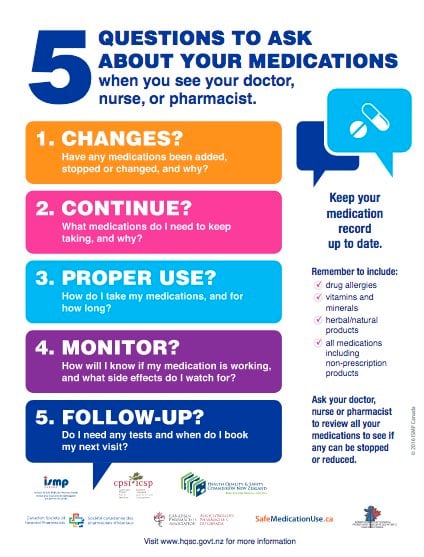
5 questions to ask about your medications
Health Quality and Safety Commission, NZ, 2019 English, te reo Māori
Free helplines



Credits: Sandra Ponen, Pharmacist, Healthify He Puna Waiora. Healthify is brought to you by Health Navigator Charitable Trust.
Reviewed by: Angela Lambie, Pharmacist, Auckland
Last reviewed:
Page last updated: