

You can now add Healthify as a preferred source on Google. Click here to see us when you search Google.
Duolin
Also called ipratropium + salbutamol
Key points about Duolin
- Duolin® is used to treat COPD.
- Ipratropium + salbutamol sounds like 'eye-pra-troe-pee-um' and 'sal-bew-ta-mol'.
- Find out how to take it safely and possible side effects.

Duolin® is a combination of two medicines, ipratropium and salbutamol, mixed together in a puffer (inhaler). The combination is sometimes used to treat a breathing problem called COPD.
It’s usually only used for a short time when other medicines aren’t helping enough to control your COPD symptoms or as an add-on medicine in a hospital during severe breathing problems. It works by relaxing and opening up your air passages, making it easier to breathe and helping ease shortness of breath, chest tightness and wheezing.
Duolin belongs to a group of medicines known as bronchodilators or relievers (it's called a reliever medicine because it quickly relieves your breathing problems).
Using an inhaler device enables the medicine to go straight into your airways when you breathe in. This means that your airways and lungs are treated, but very little of the medicine gets into the rest of your body.
In Aotearoa New Zealand, Duolin is available on a prescription written by a prescriber. It comes as an inhaler and nebulising solution. Nebulisers are used when using an inhaler isn't suitable. Read more about nebulisers.
Brand change: Nebulising solution
From 1 February 2026, the funded brand of Duolin nebulising solution has temporarily changed due to supply issues. The new funded brand is Cipla.
Cipla nebulisers have the same active ingredients, ipratropium and salbutamol, in the same amounts as Duolin and should work in the same way.
- Different packaging: The packaging of Cipla is different. It comes as vials (instead of ampoules) and each vial is 3 mL (instead of 2.5 mL).
- Different name: The vials inside the foil pack are labelled “albuterol”. Albuterol is the US name for salbutamol. The vials are labelled “albuterol 3 mg” – this is the same dose as 2.5 mg salbutamol.
- Cipla is not approved by Medsafe, but it is approved in the United States. Read more about unapproved medicines.
- The stock of Cipla nebulising solution expires in July 2026, so it's intended as a short-term alternative while the Duolin supply issue is resolved.
For more information about this change, including images of the Cipla box label, visit Pharmac: Duolin nebuliser supply issue(external link).
If you have any questions about this brand change, talk to your healthcare provider.
Note: This brand change does not affect the Duolin inhaler.
Use your MDI with a spacer
- A spacer is an attachment to use with your inhaler. It's a chamber that holds the medicine before you inhale, giving you a more controlled, deeper inhalation. This can be especially helpful if you're short of breath.
- Using your MDI with a spacer makes it easier to use the inhaler and helps to get the medicine into your lungs, where it’s needed (with less medicine ending up in your mouth and throat).
- Read more about spacers.
Check your technique
- To get the most benefit from your inhaler, it's important to use the correct technique.
- Ask your healthcare provider to show you how to use your MDI and spacer devices.
- Even if you’ve been shown before, ask your healthcare provider to explain how to use your inhaler if you still have any questions.
The video below provides some guidance on how to use a spacer with your MDI. Note: Your MDI or spacer may look different to the one in the video below.
Video: How to use your spacer device
(Healthify He Puna Waiora, NZ and Auckland District Health Board, 2018)
Here are some things to know when you're using Duolin. Other things may be important as well, so ask your healthcare provider what you should know about.
- Follow your COPD action plan: Ask for a written COPD action plan from your healthcare provider. This will tell you how many puffs to use for each dose, and what to do if your symptoms get worse.
- Driving: Duolin can make you feel dizzy or make your vision blurry. Be careful when driving or using tools until you know how this medicine affects you.
- Alcohol: Duolin can make you feel tired or dizzy. Limit or avoid drinking alcohol while taking Duolin as alcohol may increase these side effects.
- Take care not to get the spray from the Duolin inhaler or nebuliser into your eyes: If this happens, rinse your eyes thoroughly with water.
- Other medicines: Duolin interacts with some medicines, including other inhalers, herbal supplements and rongoā Māori, so check with your healthcare provider before starting Duolin and before starting any new products.
- Pregnancy or breastfeeding: Talk to your healthcare provider if you're pregnant, planning a pregnancy or want to breastfeed.
Like all medicines, Duolin can cause side effects, although not everyone gets them. If you're concerned about any symptoms you think might be related to your medicine, talk to your healthcare provider. The following information offers some guidance but doesn't include all possible side effects.
Common side effects
Tell your healthcare provider if these side effects bother you.
- Headache.
- Dry mouth, sore throat or a different taste in your mouth: Rinse your mouth after using the inhaler.
- Feeling dizzy: Be careful when getting up from either lying down or sitting to avoid falls. These effects put you at risk of falls and injuries, especially if you’re an older adult. Stand up slowly. If you do feel dizzy, sit or lie down for a few moments. Don’t drink alcohol.
- Having problems peeing.
- Feeling shaky or nervous, tremor.
- Muscle cramps.
- Constipation (difficulty passing poo) or diarrhoea (runny poo).
- Having problems sleeping.
Tell your healthcare provider immediately or phone Healthline free on 0800 611 116 if these occur
- Blurred vision.
- Changes in your heartbeat (fast or irregular).
Phone 111 for an ambulance or go to your nearest accident and emergency (A&E) clinic if these occur
- Signs of an allergic reaction such as itchy skin, and rash, swollen lips or tongue, problems breathing, like a tight chest or shortness of breath.
Read more about medicines and side effects and reporting a reaction you think might be a side effect.
The following links provide further information on ipratropium + salbutamol:
Salbutamol and ipratropium(external link) New Zealand Formulary Patient Information
Brochures
Ipratropium & salbutamol in te reo Māori(external link) New Zealand Formulary Patient Information
COPD action plan(external link) Asthma and Respiratory Foundation, NZ English(external link), te reo Māori(external link), Samoan(external link), Tongan(external link), simplified Chinese(external link)
Medicines and side effects(external link) Healthify He Puna Waiora, NZ, 2024
5 questions to ask about your medications(external link) Health Quality and Safety Commission, NZ, 2019 English(external link), te reo Māori(external link)
References
- Ipratropium bromide + salbutamol(external link) New Zealand Formulary
- Compound short acting bronchodilator preparations(external link) New Zealand Formulary
- Duolin metered dose aerosol inhaler(external link) Medsafe datasheet, NZ
- Duolin nebules(external link) Medsafe datasheet, NZ
- An update on the pharmacological management of stable COPD(external link) BPAC, NZ, 2023
- Anticholinergic burden in older people(external link) BPAC, NZ, 2024
- New Zealand COPD guidelines(external link) Asthma and Respiratory Foundation, NZ, 2025
What is Duolin used for?
Duolin is sometimes used to treat COPD. It belongs to a group of medicines known as bronchodilators or relievers (it's called a reliever medicine because it quickly relieves your breathing problems). It’s usually only used for a short time when other medicines haven’t worked or as an add-on medicine in a hospital during severe breathing problems.
How does Duolin work?
Duolin is a bronchodilator that works by relaxing and opening up the air passages, making breathing easier and improving shortness of breath, chest tightness and wheezing.
It contains a combination of two medicines, ipratropium and salbutamol.
Brochures
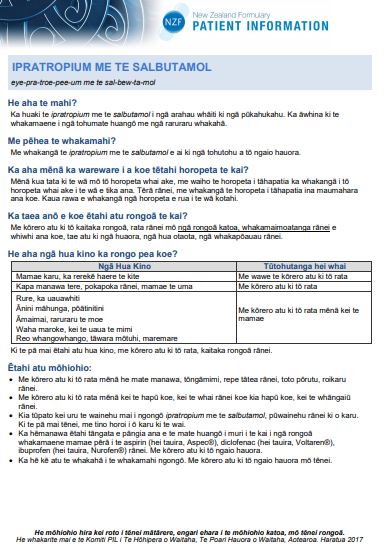
New Zealand Formulary Patient Information
Asthma and Respiratory Foundation, NZ
English, te reo Māori, Samoan, Tongan, simplified Chinese.
Medicines and side effects
Healthify He Puna Waiora, NZ, 2024
Free helplines



Credits: Healthify editorial team. Healthify is brought to you by Health Navigator Charitable Trust.
Reviewed by: Stephanie Yee, Pharmacist, Auckland
Last reviewed: