

You can now add Healthify as a preferred source on Google. Click here to see us when you search Google.
Xanthoma
Key points about xanthomas
- Xanthomas are small lumps under the surface of the skin containing fat (lipid, cholesterol).
- Xanthomas vary in size, shape and thickness and can appear anywhere, most commonly on upper eyelids and tendons, and over joints such as your elbows and knees.
- The most common form of xanthoma is xanthelasma – yellowish bumps on the eyelids.
- While the growths themselves aren’t harmful, xanthelasma and other xanthomas are usually a sign of high cholesterol and lipids that needs treatment.
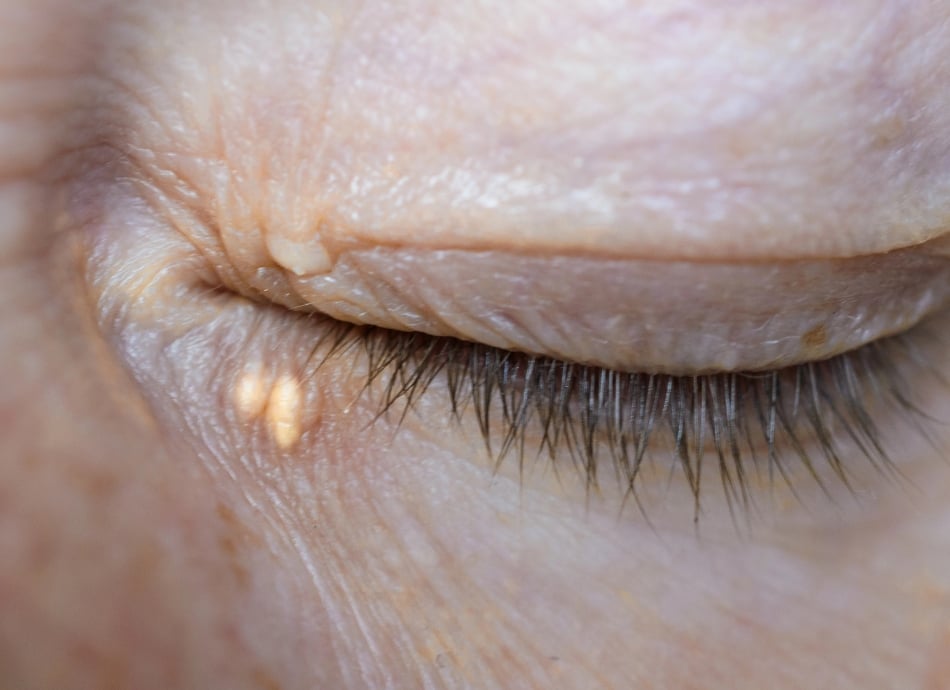
Xanthomas are painless white or yellow fatty deposits under the surface of your skin. They can vary in size and typically occur on eyelids, and over tendons and joints such as knees and elbows.
They may be a sign of an underlying lipid or metabolic problem that's led to increased cholesterol or lipids circling in your blood. Xanthomas are your body's way of storing the extra fats, and they can be reabsorbed and go away when the underlying conditions are treated.
Xanthomas are caused by temporary or persistent high levels of blood lipids, or fats. Conditions that cause xanthomas or contribute to their growth include:
- high cholesterol and inherited metabolic disorders such as familial hypercholesterolemia (high blood cholesterol caused by a gene that runs in families)
- certain cancers
- diabetes
- hypothyroidism
- primary biliary cirrhosis
- pancreatitis.
There are different types of xanthomas, depending on what’s causing them and where on your body they show up.
- Xanthelasma is the most common type where soft, white/yellow, flat papules (solid bumps) or plaques (thick patches of skin) are found on the upper or lower eyelid (see the image below).
- Eruptive xanthomas are crops of small (2 to 5 mm), red-yellow papules over your buttocks, elbows, knees and shoulders. The number of xanthomas may increase and spread to involve your limbs or mouth. They can be a sign of very high blood triglycerides (a type of blood fat) caused by uncontrolled diabetes. They may go away on their own, or after treatment over a few weeks (see the image below).
- Tendinous xanthomas are nodules (large bumps) in the skin over tendons and ligaments, such as on your knuckles, Achilles tendon, elbows or feet. This type is also associated with high blood cholesterol (hypercholesterolaemia or high LDL levels).
- Tuberous xanthomas are firm, painless red or yellow nodules that can grow very round and large. They appear over pressure areas such as your knees, elbows, heels and buttocks. They’re often associated with high cholesterol levels (type 3 hyperlipoproteinemia).
- Diffuse plane xanthomatosis involves flat patches or thicker plaques on your palms. Rarely, they can occur anywhere on the body. When they’re found around the fingers and toes it's usually a sign of familial high blood cholesterol (a genetic condition).
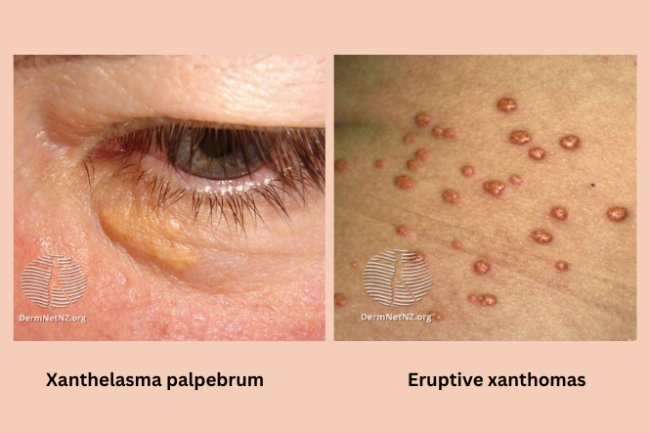
Image credit: DermNet NZ(external link)
If you think you may have a xanthoma, show your healthcare provider. You may need to have a blood test to check for cholesterol and lipid levels, metabolic disorders, liver function, thyroid problems and diabetes.
While it’s important to address the underlying conditions, xanthomas themselves aren’t dangerous. You can just leave them alone, as the growths are painless and treatment is only to make your skin look better.
If you wish to treat them the options include:
- Treating any underlying causes of high cholesterol and lipids, such as with dietary changes and medicines (if recommended). This can reduce their size and prevent new ones appearing.
- Topical trichloroacetic acid.
- Electrodesiccation.
- Laser vaporization.
- Surgical removal.
However, xanthomas can come back again, or new ones may appear if the underlying causes are not treated.
Apps reviewed by Healthify
You may find it useful to look at some skin care (dermatology) apps.
Keeping your blood cholesterol and lipids within a normal range will help prevent xanthomas. This can often be achieved through healthy eating, maintaining an ideal body weight and getting regular exercise. Your healthcare provider can talk through a plan to help you, based on your symptoms and results. Xanthomas can be a warning sign for cardiovascular disease, and eating healthily and exercising can slow the progression of this too. Medicines to reduce hyperlipidaemia are generally safe and effective and can be taken long-term.
If your whānau members have xanthomas, ask your healthcare provider about a lipid test to check for familial (genetic) lipid disorders in your family.
Xanthoma(external link) DermNet NZ
Managing high cholesterol(external link) Heart Foundation, NZ
Apps
References
- What is a xanthoma?(external link) WebMD, US, 2023
- Xanthoma(external link) Australasian College of Dermatologists, Australia, 2019
Need help now?



Credits: Healthify editorial team. Healthify is brought to you by Health Navigator Charitable Trust.
Reviewed by: Professor Amanda Oakley CNZM, Dermatologist, Health New Zealand Te Whatu Ora, Waikato
Last reviewed: