

If you're a frequent visitor to Healthify, why not share our site with a friend? Don't forget you can also browse Healthify without using your phone data.
Threadworm
Also called pinworms
Key points about threadworms
- Having threadworms is common in childhood, but you can be affected at any age. Threadworms are not harmful, you may not notice you have them, but they can be itchy and annoying.
- Threadworms are small, thin, white worms between 3 and 12 mm long.
- They look like cotton threads and live in your bowel (gut).
- Careful hygiene measures (washing and cleaning) can help clear up a threadworm infection and reduce the chance of reinfection.
- To treat threadworms successfully, all household members must be treated, even if they don't have any symptoms.

Threadworms are small, thin, white worms between 3 mm and 12 mm long. They look like cotton threads and live in your bowel (gut). The scientific name for them is Enterobius vermicularis. You can see threadworms without needing a magnifying glass. The eggs are translucent (see through) and tiny so you can only see them under a microscope. They can survive for up to 2 weeks outside the body.
Threadworms are spread from human to human. They are not carried by animals so you can't get them from your pets. Threadworms are spread easily within families/whānau, early childhood centres, residential care facilities, schools and camps. If one person in your house has threadworms, others probably do too.
- Most people get threadworms by swallowing the worm's eggs.
- Threadworms leave your gut at night and lay eggs on the skin around your anus (bottom). The eggs can get onto your hands or under your fingernails through scratching the itchy area or because of poor handwashing after using the toilet/wharepaku.
- You can pass the eggs on to an uninfected person, eg, through food/kai handling.
- Threadworm eggs can also get onto carpets, bed linen, towels, flannels and into household dust and, in this way, they are passed from person to person.
- It may be between 2 to 6 weeks after contact with a source of infection before the lifecycle is complete and eggs are laid in the newly infected person.
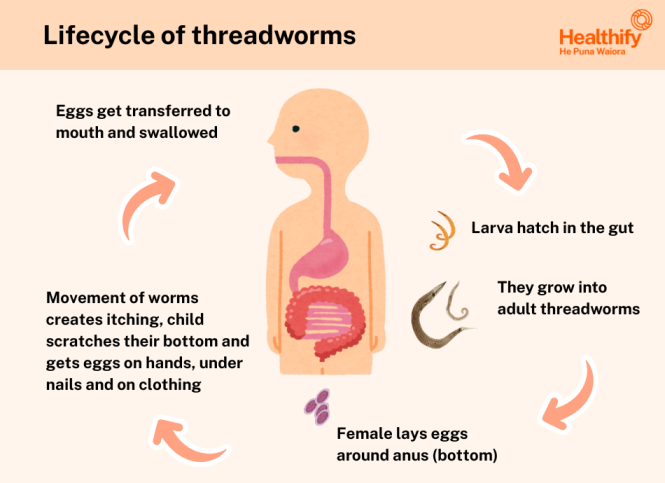
Image credit: Healthify He Puna Wairoa
It’s common to have a threadworm infection without any symptoms.
The most common sign of threadworms is itching around your anus (bottom), which is worse at night. This is because the worms are most active at night when females come out to lay eggs. In some instances, the worms can be seen in your stool (poo) or on toilet paper. You may see them emerging from your child’s bottom. Other signs include an itchy vulva in females, bedwetting, restless sleep, loss of appetite and irritability.
If you scratch the itchy skin it can become red and swollen and if you break the skin it can become infected.
The most obvious way an infection is diagnosed is if the threadworms can be seen in your stool (poo) or on toilet paper. But, if this is not the case, your healthcare provider may ask you to do a sticky tape test.
To do this you press some see-through tape on to the skin around your anus (bottom) – ideally at night. You then place the tape on a glass slide or put it in a specimen container. The tape is then sent to the laboratory to be looked at under a microscope to see if any threadworm eggs are stuck to it.
If you’ve scratched your bottom when you’ve got threadworms, your healthcare provider may be able to take a scraping from under your fingernails and look for eggs under a microscope.
In most cases, a threadworm infection can be treated with self-care – careful hygiene measures (washing and cleaning). The hygiene measures also prevent threadworms from spreading and reduce the likelihood of reinfection.
Medicine to treat a threadworm infection can be bought over the counter from your local pharmacy or prescribed by your healthcare provider.
Hygiene measures
Follow good hygiene practices to prevent threadworms or stop spreading them to others:
- wash your hands carefully and often
- avoid scratching around your bottom
- keep your fingernails short because the eggs can get stuck under your fingernails and transferred to your mouth
- wash your clothes and bedding regularly
- bathe and change your underwear every day
- avoid sharing a bathtub or face cloths
- vacuum your carpets often.
Medicine
The threadworms may go away by themselves with good hygiene, but you may need medicine to get rid of them. You can buy worm medicine such as mebendazole from your pharmacy. This medicine will kill the worms in your gut but won’t kill the eggs that have been laid around your bottom. Eggs can survive for up to 2 weeks outside your body on underwear or bedding, and in dust, so proper hygiene measures are important.
- All household members, including adults and those without symptoms, should be treated with worm medicine at the same time.
- It’s recommended you take 2 doses of mebendazole – one dose and then another dose 2 weeks later.
- After you take each dose, wash your underwear and bed linen, and vacuum your carpets.
- Read more about mebendazole.
All household members should be treated at the same time. Follow the good hygiene steps above to help prevent threadworm infection.
In most cases, you won’t need to see your healthcare provider. However, if you’re pregnant or breastfeeding and have threadworms, or if your child is under 2 years old and has threadworms, you should get advice. This is because the treatment in these circumstances is usually different from what's recommended for most other people.
Threadworms in children(external link) KidsHealth, NZ
References
- Pinworms(external link) DermNet, NZ, 2021
- About pinworm infection(external link) Centers for Disease Control, US, 2024
- Threadworms – important information(external link) NHS, UK, 2014
Can adults get threadworms?
Yes, people of any age can get threadworms, but they are more common in children.
What are the symptoms of threadworms?
The main symptom is an itchy bottom, especially at night when the female worms have emerged and are moving around laying eggs. This can disturb your sleep. The worms can also move to your vagina and cause itching there too. If you have a bad infestation (lots of threadworms) in your gut you may get a tummy ache, feel sick or vomit.
Where do threadworms lay eggs?
Threadworms come out of your bottom (anus) at night and lay eggs on the skin around your anus.
Need help now?



Credits: Healthify editorial team. Healthify is brought to you by Health Navigator Charitable Trust.
Reviewed by: Dr Sara Jayne Pietersen, FRNZCGP, Auckland
Last reviewed: