

You can now add Healthify as a preferred source on Google. Click here to see us when you search Google.
PEACE and LOVE and RICER
Self-care for soft tissue injuries such as sprains and strains
Key points anout PEACE and LOVE and RICER
- PEACE and LOVE are acronyms representing the self-care steps for what to do after a strain, sprain or other soft tissue damage.
- PEACE is for the first 2 to 3 days, LOVE is for the next days and weeks.
- It replaces the RICER approach (rest, ice, compression, elevation, review).
- It’s important to get guidance from a healthcare provider, especially if your injury is more than mild or doesn’t improve with self-care.
- It’s also important to get guidance on how, and how quickly, you can get back to your usual activities.
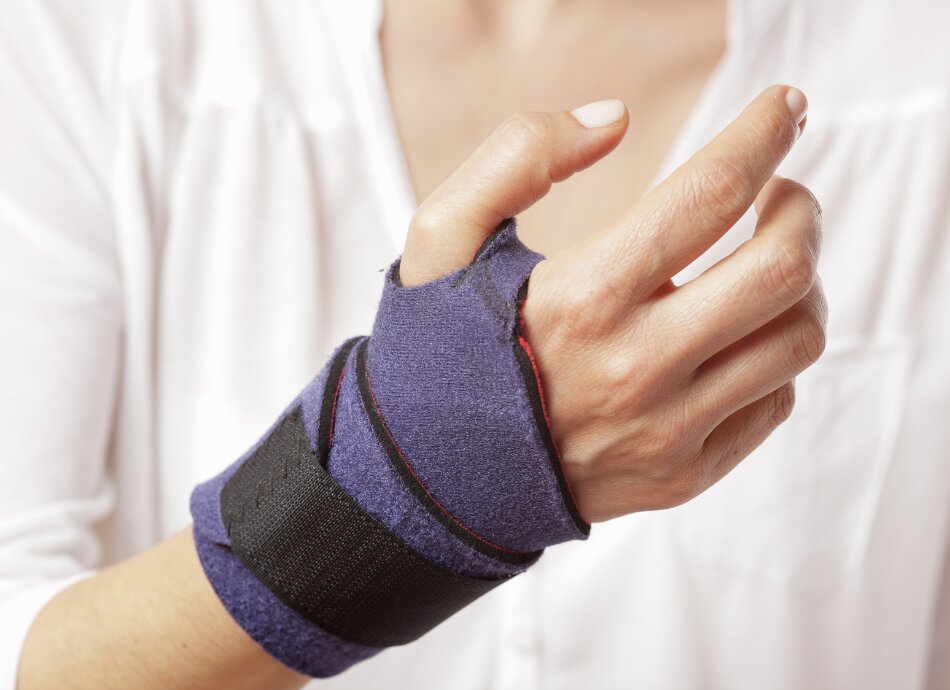
PEACE and LOVE is an acronym (term made from the starting letters of the words included) to help you remember how to look after a soft tissue injury. It replaces the earlier RICER approach.
Protect, Elevate, Avoid, Compression, Education (PEACE) and Load, Optimism, Vascularisation, Exercise (LOVE).
PEACE is for the first 72 hours (3 days) after the injury, LOVE is for the next stage of your recovery. Be aware that soft tissue healing can take up to 3 months, and sometimes longer.
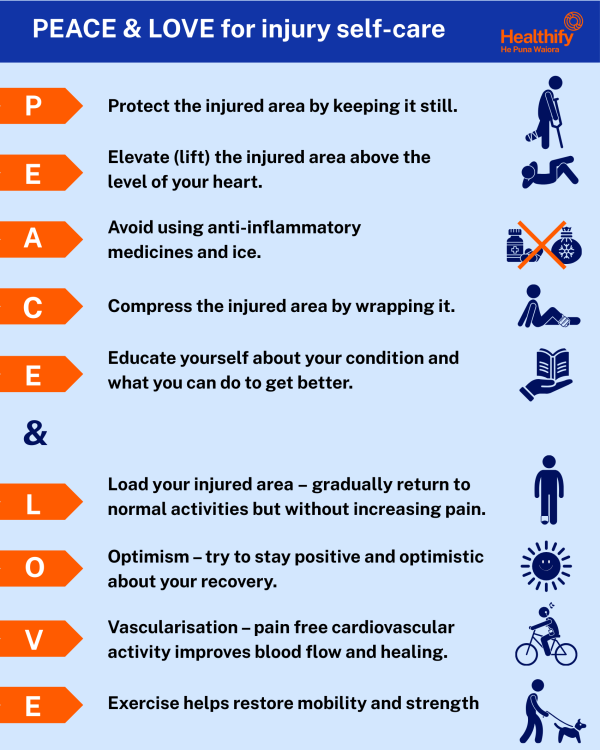
Image credit: Healthify He Puna Waiora
Avoid HARMS
Straight after your injury, avoid HARMS – another acronym.
H is for heat: Avoid heat such as hot packs or baths. Heat can increase the bleeding at the injury.
A is for alcohol: Avoid alcohol as it can increase bleeding and swelling and you may have less awareness of pain at the site of the injury.
R is for running (or any exercise): Running and exercise in the early stages could do more damage so should be avoided.
M is for massage: Massage in the first 72 hours (3 days) may increase bleeding and swelling and should be avoided.
S is for smoking: Smoking reduces the blood flow and the amount of oxygen in your blood getting to the injury. If you smoke or vape it can slow down the healing process.
Be guided by PEACE
P is for protect: For the first few days, keep your weight off, or don't load, the injured part to reduce bleeding and making the damage worse. Don't rest for too long though – as your pain improves, move on from protection.
E is for elevate: Lift your limb higher than your heart to help fluid flow downwards from your injury and reduce swelling.
A is for avoid: To help with healing, avoid using anti-inflammatory medicines (eg, ibuprofen) for a long time or at a high dose. The occasional one may help when you're really sore, as long as it's safe for you to take them. Avoid ice (or use it carefully) as it's no longer really recommended (see below) and avoid the HARMS mentioned above.
C is for compression: Taping or bandaging can help reduce bleeding and swelling.
E is for education: An active path to recovery works best so learn about what will help, be realistic about the likely timeframe but motivate yourself to get better.
After the first days have passed, soft tissue injuries need LOVE
L is for load: Start moving and using the injured arm or leg. Get back to your normal activities as soon as your symptoms allow you to.
O is for optimism: Stay positive. Feeling scared or overly worried about what might happen can get in the way of your recovery.
V is for vascularisation: This involves doing aerobic exercise (eg, swimming, cycling, brisk walking) to get blood flowing to the injured area and help your tissue heal. Moving early can get you back to work more quickly and lower your need for pain relief medicines.
E is for exercise: Exercising helps restore your mobility, strength, coordination and balance after an injury. Use pain as a guide for how much to do and when to increase the amount or frequency of activity.
Until PEACE and LOVE was introduced, the acronym RICER was used as a way to remember what to do when caring for a soft tissue injury. It's not wrong and there is overlap between the 2 approaches, but evidence for the helpfulness of using ice for a soft tissue injury (the I in RICER) is not as clear as it was thought to be. However, as long as you only use ice in the first few hours and not for longer than 10 to 15 minutes at a time it may help with pain and haematoma (swelling from bleeding from broken blood vessels). Read more about the use of ice below.
Otherwise, RICER in the first couple of days after an injury won't do any harm and as it's less detailed than the PEACE and LOVE approach, it may be easier to remember. It's important not to rest for too long though – with advice from your healthcare provider or physiotherapist, it's important to gradually get back to using the affected limb.
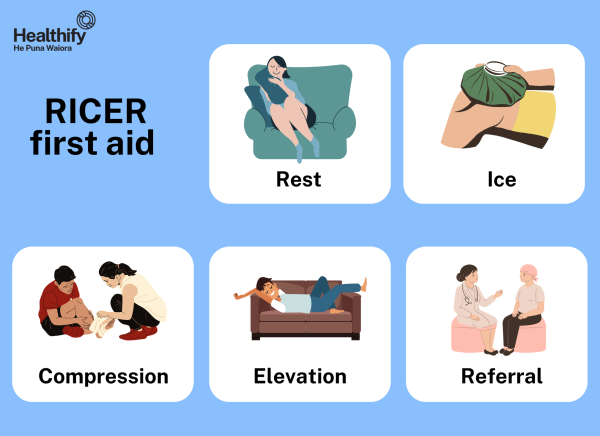
Image credit: Healthify He Puna Waiora
R is for rest: Stop the activity as soon as you have become injured. Try not to move or load the injured part. Total rest helps prevent further damage.
I is for ice: Apply ice or a bag of frozen veggies wrapped in a towel to the injury for 10 to 15 minutes as soon as possible after the injury. Cold will reduce the pain, bleeding and swelling around the injury, but shouldn't be used after the first few hours following an injury.
C is for compression: A firmly applied elasticated bandage will also reduce pain, bleeding and swelling. If there's any numbness or tingling in the fingers or toes, loosen the bandage.
E is for elevation: Raise the injured part above the level of your heart if possible, resting it on a chair or cushion. This will help reduce bleeding and swelling.
R is for referral: Within the first 2 days, if the swelling and pain have not eased and you can't use that limb or joint, it's important you visit a healthcare provider to have the injury checked and to get a precise diagnosis. It could be a broken bone or another injury as well as a sprain or strain. Further tests, treatment and physical rehabilitation may need to begin right away.
It used to be thought that cooling down the injured part, typically by putting ice (or a bag of frozen peas) on it was the best thing to do. It has the effect of numbing the area, and so making it less sore, and also reducing swelling (inflammation). Whether to ice an injury or not remains controversial but there is some thought that the swelling is part of the natural healing process and that cooling down the injured area (especially over a long period of time) may slow healing down by reducing the blood flow.
It may be that applying ice immediately after an injury is still fine, but it’s best not to use it after the first few hours. It may depend on how bad the injury, pain and swelling are. So, if your injury is more than mild, ask your healthcare provider for advice about using ice.
Note: Ice is not recommended if you have problems with circulation or sensation.
Brochures
The PEACE and LOVE approach to injury recovery(external link) lifemark, US
References
- Dubois B, Esculier J-F. Soft-tissue injuries simply need PEACE and LOVE(external link) Br J Sports Med. 2020;54(2):72–73
- Is it time to rethink RICE for soft-tissue injuries?(external link) RACGP news, Australia, 2019
- Soft tissue injury advice(external link) NHS Inform, UK, 2024
Need help now?


Credits: Helthify editorial team. Healthify is brought to you by Health Navigator Charitable Trust.
Reviewed by: Dr Penzy Dinsdale, Rural Hospital Registrar
Last reviewed: