

You can now add Healthify as a preferred source on Google. Click here to see us when you search Google.
Meniscal tears
Also known as a meniscus tear or torn meniscus
Key points about meniscal tear
- The menisci (singular is meniscus) are pieces of cartilage that sit between the bones in your knee joint.
- Your menisci can tear as a result of an injury, typically when playing sport.
- As you get older, your menisci can become worn and can get damaged more easily, even just by twisting your knee when standing up from a chair.
- Common symptoms are a ‘pop’ feeling when a meniscus tears, pain, stiffness, swelling, loss of movement and a feeling of your knee giving way.
- Minor tears may not need treating, but you may need surgery to trim or repair a more seriously torn meniscus.

The menisci are 2 pieces of tissue that sit in your knee joint and act as padding where your thigh bone (femur) meets your shinbone (tibia). The medial meniscus is C-shaped and is on the inner side of your knee joint, while the lateral meniscus is U-shaped and is on the outer side of the joint. Menisci are made of a strong, flexible type of cartilage. They play an important role in providing stability and spreading the weight-bearing load across your knee joint during movement.
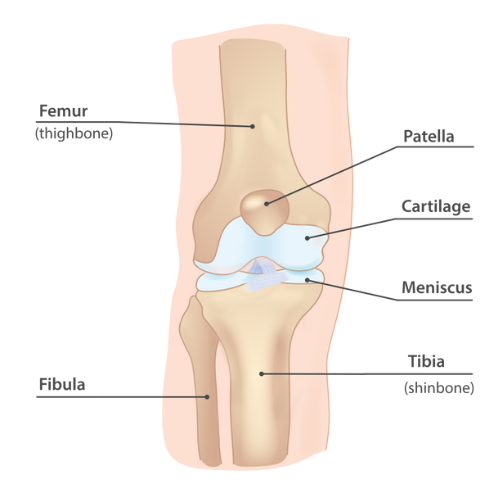
Image credit: InjuryMap via Wikimedia Commons(external link)
When stress is placed on your knee joint, particularly through twisting when you’re putting all your weight on one leg, the menisci can tear. It’s a common knee injury and people playing contact sports are most at risk. However, a meniscal tear can happen to anyone, and they happen more easily as we get older.
Your meniscus can tear in different places, and the different types of tears have different names.
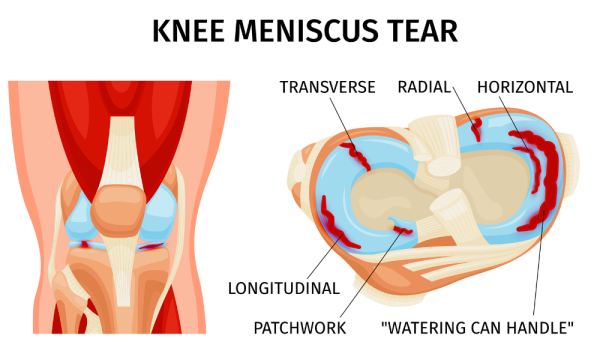
Image credit: Freepik
Some of the common types are listed below.
- Radial tears go across the meniscus. They can happen in either the medial or the lateral meniscus. They can range from a partial tear through to a full tear where the two parts can be separate by a gap of several millimetres. These are the most common type of meniscal tears.
- ‘Watering can handle’ or ‘bucket handle’ tears are more likely to happen in the medial meniscus and are called that because part of the cartilage can flip up (like a handle) and can get caught in the knee joint. They go lengthways around the meniscus.
- Longitudinal tears also go around the meniscus and are most commonly associated with an acute tear to the anterior cruciate ligament (ACL). Read more about ACL injuries(external link).
- Complex tears are combinations of different types of meniscal tears. They’re more common in people who have joint damage, such as older people.
At the time the damage is done, you may feel a ‘pop’ as the meniscus tears, and you may feel pain. Other symptoms can include:
- swelling of the knee joint
- stiffness
- catching or locking of your knee
- a feeling that your knee is giving way
- lack of movement of your knee.
You may still be able to walk on your knee, but over the next few days it’s likely to stiffen up and become more swollen.
Physical examination
Your healthcare provider will talk to you about what happened and will examine your knee and check for tenderness. They may perform the McMurray test which involves bending, straightening and turning your knee. If you have a torn meniscus the movement may cause pain, locking or clicking in your knee.
Tests
You may need an MRI scan to look at the soft tissue in your joint (eg, the meniscus, tendons and ligaments). An MRI is the most accurate way to diagnose a meniscal tear. However, in Aotearoa New Zealand an MRI would usually only be done for a suspected meniscal injury that isn’t improving as expected, rather than for all suspected meniscal injuries. Otherwise a CT arthrogram (CT scan with injected dye) or an ultrasound may be done. You may have an X-ray to exclude a different reason for your knee pain, such as arthritis or a fracture (broken bone).
Treatment depends on your symptoms and how severe they are. A minor injury may settle on its own over 6 to 8 weeks with self-care. A meniscal tear may recover on its own if you follow the P.E.A.C.E & L.O.V.E approach. Read more in the self-care section below.
If your injury is severe, isn’t settling down after a few days or your knee in locked in a fixed position and won’t unlock, see your healthcare provider or a physiotherapist. They may recommend you have surgery to have the torn meniscus tidied up (trimmed so it doesn’t catch in your knee joint) or repaired. Factors they’ll consider in deciding whether surgery is the best option for you include:
- your age – surgery may be the best option to prevent future knee problems for children and young adults
- how big the tear is
- the length of the tear
- whether your symptoms are affecting your daily life
- if you have other knee problems.
Surgery options
A repair is done by an orthopaedic surgeon, often with an arthroscopic procedure. This involves making small cuts (incisions) in the skin on your knee. An arthroscope (flexible camera and light) is put into one of the cuts and surgical tools are put in through others. The camera on the arthroscope sends images to a screen which the surgeon uses to guide the repair. The surgery is done with a general anaesthetic or after numbing your knee with local anaesthetic. Read more about knee arthroscopy.
The approach taken will depend on the type of tear plus the factors listed above.
- A partial meniscectomy is when the damaged part of the meniscus is trimmed away.
- A meniscus repair involves putting in stitches to hold the pieces together while they heal.
- A meniscus reconstruction involves replacing some or all of the damaged meniscus.
The first few days after the injury are when you’re most likely to experience pain and swelling with a meniscal tear. Paracetamol can help with pain, but avoid aspirin which can increase bleeding. If you’re not sure what type of pain relief is best for you, get some advice from a healthcare provider or pharmacist.
Follow the P.E.A.C.E & L.O.V.E approach to help your recovery
Straight after your injury, avoid harm (heat, alcohol, running, massage and also smoking) and allow PEACE to guide you:
P is for protect: For the first few days, keep your weight off, or don't load, the injured part to reduce bleeding and making the damage worse. Don't rest for too long though – as your pain improves move on from protection.
E is for elevate: Lift your limb higher that your heart to help fluid flow downwards from your injury and reduce swelling.
A is for avoid: To help with healing, avoid using anti-inflammatory medicines (eg, ibuprofen) for a long time or at a high dose. The occasional one may help when you're really sore, as long as it's safe for you to take them. Also avoid ice as it's no longer recommended.
C is for compression: Taping or bandaging can help reduce bleeding and swelling.
E is for education: An active path to recovery works best so learn about what will help, be realistic about the likely timeframe but motivate yourself to get better.
After the first days have passed, soft tissue injuries need LOVE.
L is for load: Start moving and using the injured leg. Get back to your normal activities as soon as your symptoms allow you to.
O is for optimism: Stay positive. Feeling scared or overly worried about what might happen can get in the way of your recovery.
V is for vascularisation: This involves doing aerobic exercise (eg, swimming, cycling, brisk walking) to get blood flowing to the injured area and help your tissue heal. Moving early can get you back to work more quickly and lower your need for pain relief medicines.
E is for exercise: Exercising helps restore your mobility, strength, coordination and balance after an injury. Use pain as a guide for how much to do and when to increase the amount or frequency of activity.
Once your healthcare provider has said you can use your knee joint, there are exercises you can try that may help with strengthening and flexibility. Read more about what to do and what to avoid(external link). Avoid exercises that include pivoting (turning on your knee), deep squatting and twisting. Often it can be useful to see a physiotherapist to get personalised exercises for your injury.
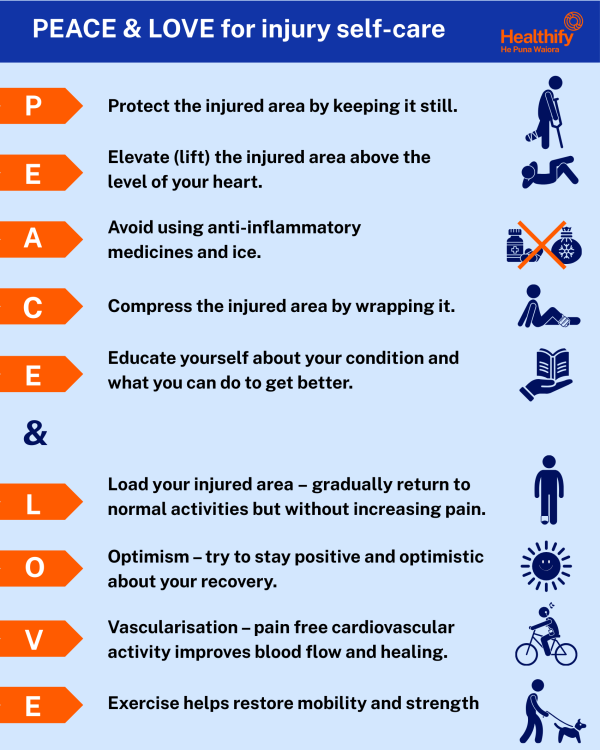
Image credit: Healthify He Puna Waiora
Apps reviewed by Healthify
You may find it useful to look at some knee exercise apps.
Some less severe tears can heal just with self-care and don’t need any other treatment. It usually takes about 6 weeks and you may need advice and exercises from a physiotherapist to help strengthen the muscles around your knee.
If you have a partial meniscectomy where the torn piece is trimmed off, recovery will take about 3 to 6 weeks. You should be able to put weight on your knee soon after the surgery.
A meniscus repair takes longer to recover from – it could be 3 to 6 months. You may have to keep weight off your knee for 6 to 12 weeks.
You may not be able to prevent a tear if you do very active sports or if you’re an older person and your knee is at risk due to ageing.
However, these tips may help you avoid a meniscal tear injury.
- Do exercises to keep the muscles around your knee joint strong.
- Make sure you’re fit enough to play your sport of choice and follow good guidelines for the particular positions or movements required.
- Warm up properly before taking part in physical activity, especially if it involves twisting and stopping and starting quickly, such as rugby, soccer, basketball, netball, tennis.
- Use protective gear to support your knee joint when playing support, such as a knee brace.
- Use appropriate footwear and make sure you lace it up properly.
- Deal with any minor niggles in your knee early to reduce the risk of these becoming a more serious injury.
8 exercises for a meniscus tear(external link) Healthline, US, 2019
Brochures
Caring for your knee injury(external link) ACC, NZ, 2010
References
- Meniscus tears(external link) OrthoInfo, US, 2025
- Patil SS, Shekhar A, Tapasvi SR. Meniscal preservation is important for the knee joint(external link) Indian J Orthop. 2017 Sep-Oct;51(5):576–587
- 7 types of meniscus tears(external link) verywellhealth, US, 2025
- Radial meniscal tear(external link) Radiopaedia, US, 2024
- Chahla J, Knapik DM, Jawanda H, et al. Meniscal radial tears – a classification system based on tear morphology(external link) Arthroscopy Techniques 2024;13(3):10288
- Meniscus tear of the knee(external link) Healthline, US, 2019
- Caring for your knee injury(external link) ACC, NZ, 2010
- Dubois B, Esculier J-F. Soft-tissue injuries simply need PEACE and LOVE(external link) Br J Sports Med. 2020;54(2)
Why do meniscal tears happen?
The cartilage layer (menisci) between the bones in your knee joint can tear as a result of a sports injury or due to age-related wear and tear of the joint. Physical activities involving stopping and starting and twisting of your knee can tear the menisci.
Which meniscus is commonly torn?
There are 2 menisci in each knee, one on the inner side of your knee (medial) and the other on the outer side (lateral). The most common meniscus tear is a radial tear and it can happen in either meniscus. A bucket handle tear is more likely to happen in the medial meniscus.
Will a meniscal tear heal on its own?
Some more minor tears can heal on their own, but a more severe one may need surgery, usually a knee arthroscopy.
What is the recovery time for a meniscal tear?
If it can heal on its own, the recovery time will be about 6 to 8 weeks. If you need surgery, a partial meniscectomy (trimming) will usually recover in 3 to 6 weeks. If you need a repair done, recovery will take about 3 to 6 months and you’ll need to keep weight off your knee for some of that time.
Need help now?



Credits: Healthify editorial team. Healthify is brought to you by Health Navigator Charitable Trsut.
Reviewed by: Dr Penzy Dinsdale, Rural Hospital Registrar
Last reviewed: