

Supporting people with dementia – tips from personal experience
Knowledge, kindness and understanding
Key points about supporting somebody with dementia with knowledge, kindness and understanding
- Living with dementia is a very different experience for each individual.
- It can be hard on those who love and care for them but there are ways of approaching it to make it easier for them and for yourself.
- On this page Sarah talks about what she learned from supporting her mother with dementia and shares some tips she hopes others will benefit from.
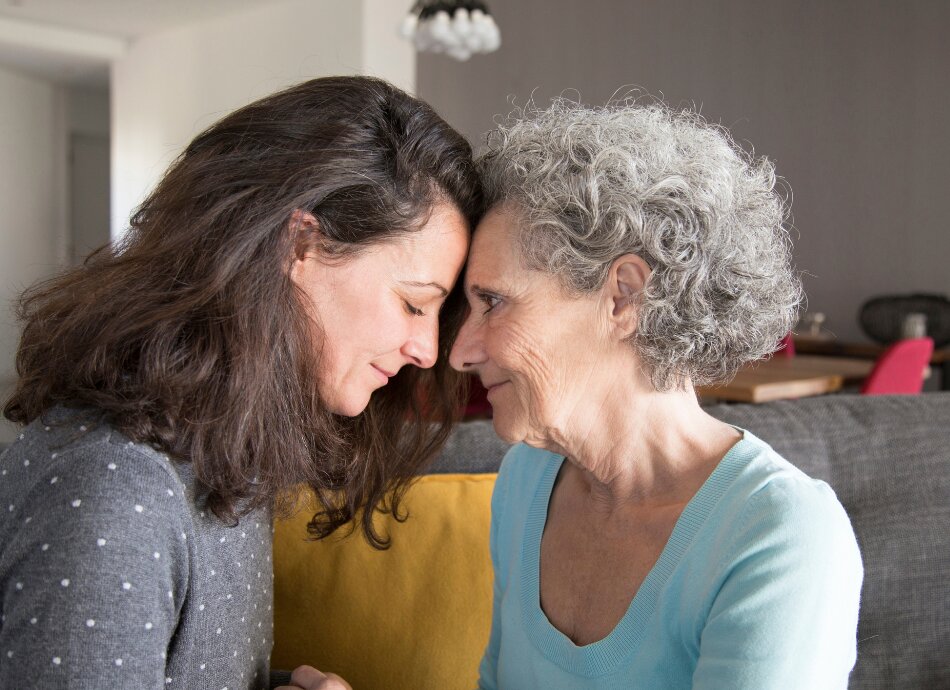
When my mother developed serious memory problems, it was my first experience of supporting a family member who was living with dementia. At the start it was the small things I noticed – missed appointments, recent conversations forgotten and interests, hobbies and routines gradually falling away. Once Mum could no longer rely on her memory to manage everyday tasks, health professionals raised the possibility of dementia. I remember feeling scared, sad and very upset. I assumed Mum felt the same but I was wrong. It was as if she was unwilling to acknowledge there was any kind of problem.
Despite her difficulty keeping track of daily tasks, my mother continued to be her intelligent, curious and rational self. We could have perfectly logical conversations about all sorts of things but my attempts to talk with her about the challenges of living with memory loss went nowhere. Our conversations developed a familiar pattern. I would talk about the need for more support and Mum would get impatient, then angry, insisting that nothing was wrong. I became convinced she was in denial.
I thought I knew what dementia was like. Then I talked to a support worker who gently explained that the way Mum was behaving wasn't ‘denial’, it was part of the condition. Mum’s brain couldn't recognise or process what her senses were telling her. She was ‘forgetting the forgetting’ and unable to understand that she was living with significant memory loss.
Mum was eventually diagnosed with Alzheimer's Disease, one of the most common forms of dementia. ‘Dementia’ is an umbrella term for a range of conditions that affect brain function. For my mother, it was her short term memory – the ability to remember, think and plan – that was most affected, along with her ability to have insight into her condition. The language part of her brain was seemingly untouched.
Over the years, meeting other people at rest homes and hospitals, I learnt about various types of dementia and the different ways they can affect behaviour and functioning. Not everyone has the same problems with insight or retains the same skills. Some people experience different symptoms such as agitation, disorientation or personality changes.
It's important to understand the condition itself, as well as the specific ways it affects the person who is living with it.
When I was first learning about dementia, I found a tip sheet that completely changed the way I communicated with my mother. Written by Liz Ayres, a former caregiver and Alzheimer’s educator, 'Compassionate Communication with the Memory Impaired(external link)' explains what's going on for people who are experiencing dementia. It describes the do’s and don'ts of conversation and provides simple, helpful examples. The key message is compassion – it's more important to be kind than to be right.
At that time, Mum was still living independently but phoning me for help and reassurance, often several times a day. I printed out Liz’s tip sheet and kept it close at hand. Three key messages became my mantra:
- Don't remind them they forgot.
- Don't question recent memory.
- Don't take it personally.
The tip sheet made a huge difference. I stopped trying to reason with Mum and learnt to listen to how she was feeling, and to respond with tact and kindness. The advice and examples were as relevant at the beginning of Mum’s illness as they were at the end.
It helps to look beneath the surface, to try and understand what is behind people’s behaviour.
Once our communication was back on an even keel, I had the time and space to notice other things. Like the way my mother’s memory was working. Mum could still recite poems she’d learnt as a child, play the piano and translate basic French into English. But she was constantly forgetting the details of day-to-day life. It wasn't just small things, like where to find the recycling timetable or how to make plunger coffee, but significant stuff, like major family events.

Image credit: Freepik
Memory is like an onion, with early, well-established memories at the centre and new ones built up in layers, over time. It seemed to me that the outside layers of Mum’s memory had begun to peel away. Gradually she was losing her recently acquired knowledge and skills. But many layers remained. There were plenty of things that Mum was still good at.
The best way to have happy times is to focus on the things people remember well – the knowledge and skills that are supported by long-term memory.
Need help now?



Credits: Sarah Scott
Reviewed by: Healthify editorial team. Healthify is brought to you by Health Navigator Charitable Trust.
Last reviewed: