

Low FODMAP diet
Key points about the low FODMAP diet
- FODMAP stands for Fermentable, Oligosaccharides, Disaccharides, Monosaccharides and Polyols.
- FODMAPs are types of carbohydrate (sugars) found in a wide variety of foods, which some people find difficult to digest and absorb in their small intestine.
- Symptoms of not being able to absorb FODMAPs include bloating, constipation, gas and pain – common symptoms of irritable bowel syndrome (IBS).
- A low FODMAP diet is a temporary diet that restricts high FODMAP foods to identify trigger foods. It shouldn’t be followed long-term.
- Always get advice from a dietitian with experience in the low FODMAP diet before removing any foods to ensure you have a plan tailored to you.
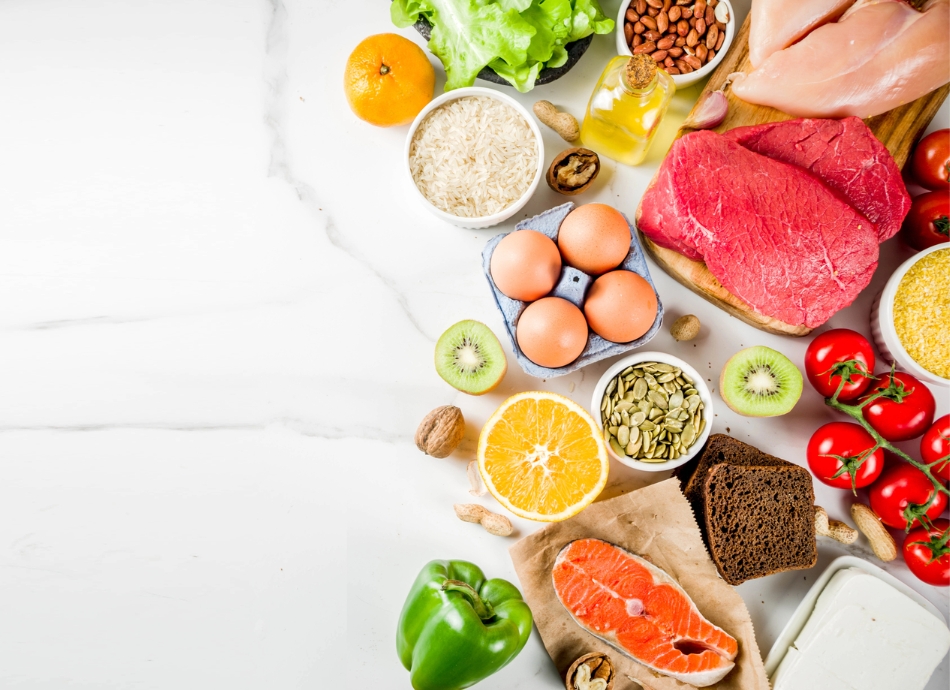
FODMAPs are types of carbohydrate (sugar), which some people find difficult to digest and absorb in the small intestine.
FODMAP stands for:
- Fermentable – rapidly broken down by bacteria in your bowel
- Oligosaccharides – fructans and galacto-oligosaccharides
- Disaccharides – lactose (found in dairy)
- Monosaccharides – fructose (found in fruits)
- And
- Polyols – sorbitol, mannitol, xylitol and maltitol (found in a range of packaged products).
Some common high FODMAP foods include garlic, onion, apples, milk, mushrooms, bread and chickpeas.
When these carbohydrates are poorly absorbed, they travel to the large intestine. There they attract water into the gut and are fermented by the gut bacteria, creating gas. The increased water can result in diarrhoea (runny poo) for some people. The gas resulting from fermentation can also lead to symptoms of bloating, constipation, gas and pain. These symptoms are common in people with irritable bowel syndrome (IBS) but can also be due to other health conditions.
FODMAPs are found in a wide variety of foods, including fruit and vegetables, grains and cereals, nuts, legumes, lentils, dairy foods and packaged foods.
This can make following a low FODMAP diet difficult to navigate as you can't simply guess which foods will be high or low in FODMAPs.
The image below gives you an idea of the foods high in FODMAPS but it's not a complete list.
In addition, the portion size for some foods can change whether they’re low or high FODMAP. For example, a 75 g serve of eggplant is low FODMAP, while 260 g of eggplant is high FODMAP.
Protein foods such as fish, meat and poultry are free of FODMAPs unless they’ve been processed or marinated with additives such as garlic and onion.
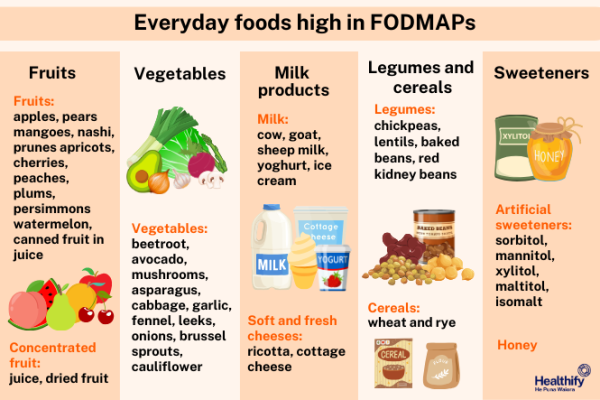
Image credit: Healthify He Puna Waiora
Note: This is not a complete list and should not replace advice from your dietitian or healthcare provider.
For a comprehensive database of FODMAP food information, see the Monash University FODMAP Diet App or list of high and low-FODMAP foods(external link). There are many lists of FODMAP foods available online, but the Monash University information is the most accurate and up-to-date source of information.
The low FODMAP diet is a temporary diet that restricts foods high in FODMAPs to help manage symptoms like bloating, diarrhoea and gas, particularly if you've been medically diagnosed with irritable bowel syndrome (IBS).
The low FODMAP diet can help you find out which FODMAPs you can tolerate and which FODMAPs cause your symptoms. Understanding this will help you to follow a less restrictive, more nutritionally balanced diet for the long term that only restricts the foods that trigger your symptoms.
A strict low FODMAP diet should only ever be followed short term (2 to 6 weeks). Always get advice from a dietitian with experience in the low FODMAP diet before removing any foods or food groups to make sure you have an approach that's tailored to you.
It's important to work with a dietitian
- Most people can tolerate at least some of the high FODMAP food groups. By identifying which foods are triggering symptoms, you can re-introduce groups that aren't a problem for you.
- You can avoid unnecessary restrictions to help increase the variety in your diet and ensure you’re getting the nutrients you need.
- Many high FODMAP foods are also high in prebiotics. These feed the healthy bacteria in your gut. Avoiding these long term can affect the health of your gut microbiome.
The image below gives you an idea of the foods high in FODMAPS but it's not a complete list. Refer to the Monash University FODMAP Diet App or list of high and low-FODMAP foods(external link) for a full list.
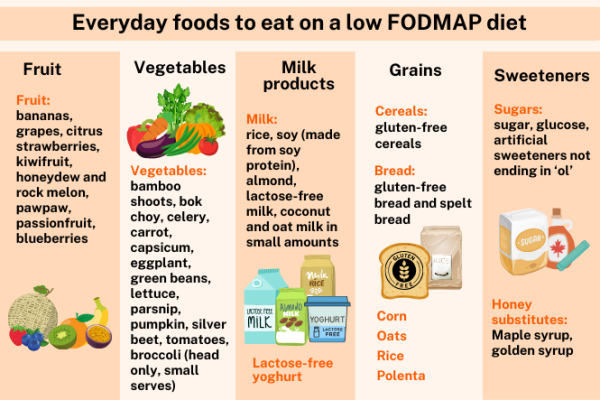
Image credit: Healthify He Puna Waiora
Gut problems can have many causes, and the foods which trigger symptoms are different for everyone.
Many dietitians and doctors now recommend a low FODMAP diet as a key part of a treatment plan for people with IBS. Research suggests that 3 in 4 people with IBS get symptom relief, usually within 1 to 4 weeks, from a low FODMAP diet. These positive effects can continue long term.
It's strongly recommended that you get support from a dietitian throughout this process, as it's important to follow the diet correctly and to make sure you're still eating a balanced diet.
Not everyone with IBS will improve on a low FODMAP diet. If you have no relief in your symptoms with this diet, it’s important to discuss other possible triggers with your dietitian or healthcare provider.
The following video provides a tour of the Monash University FODMAP diet app.
Video: FODMAP Diet App tour
(A Little Bit Yummy, NZ, 2022)
What the diet involves
The Low FODMAP diet is a three-step process
- Step 1: Cutting out foods that are high in FODMAPs for up to 6 weeks to see if your symptoms are caused by this group of foods.
- Step 2: Bringing back some of the high FODMAP foods (through food challenges) to see which FODMAP groups you're reacting to.
- Step 3: Gradually bringing back 'safe' foods and re-challenging every 6 months.
Read more about treating IBS with a 3-step FODMAP diet(external link).
Video: Three phases of the low FODMAP diet chat session
Watch a video about the 3 phases of the FODMAP diet and some helpful tips.
The Low FODMAP diet is not a diet for life. The goal is to identify and remove trigger foods and then slowly reintroduce them over time.
You don't need to cut out all FODMAPs for life. Removing food groups from your diet can result in deficiencies in key nutrients such as dietary fibre, calcium and iron.
FODMAPs and irritable bowel syndrome(external link) Monash University, Australia
Frequently asked questions about FODMAP(external link) Monash University, Australia
A Little Bit Yummy(external link)
Recipes(external link) A Little Bit Yummy, NZ
A Little Bit Yummy YouTube channel(external link)
Brochures
Treating IBS with a 3-step FODMAP diet(external link) Monash University, Australia
Apps
Book
The Gut Friendly Cookbook(external link) by Alana Scott (available in most libraries)
References
- FODMAPs and irritable bowel syndrome(external link) Monash University, Australia
- Treating IBS with a 3-step FODMAP diet(external link) Monash University, Australia
- van Lanen AS, de Bree A, Greyling A. Efficacy of a low-FODMAP diet in adult irritable bowel syndrome – a systematic review and meta-analysis(external link) Eur J Nutr. 2021 Sep;60(6):3505–3522
- Wang J, Yang P, Zhang L, et al. A low-FODMAP diet improves the global symptoms and bowel habits of adult IBS patients – a systematic review and meta-analysis(external link) Front. Nutr. 2021;8:683191
- Low and high FODMAP foods(external link) Monash University
- Irritable bowel syndrome(external link) Dietitians Australia
Need help now?



Credits: Healthify editorial team. Healthify is brought to you by health Navigator Charitable Trust.
Reviewed by: Lily Henderson, Registered Dietitian
Last reviewed: