

If you're a frequent visitor to Healthify, why not share our site with a friend? Don't forget you can also browse Healthify without using your phone data.
Food labels
How to get the most out of the information on food labels
Key points about reading food labels
- The key to a healthy diet is to eat plenty of wholefoods such as fruits, vegetables, wholegrains and legumes, and to limit highly processed foods.
- When you're shopping for packaged foods it's important to read food labels to help you choose the healthiest options for you and your whānau.
- You’ll see lots of claims on packs and it's best learn how to read the nutrition information panel (NIP) and to use tools such as the Health Star Rating.
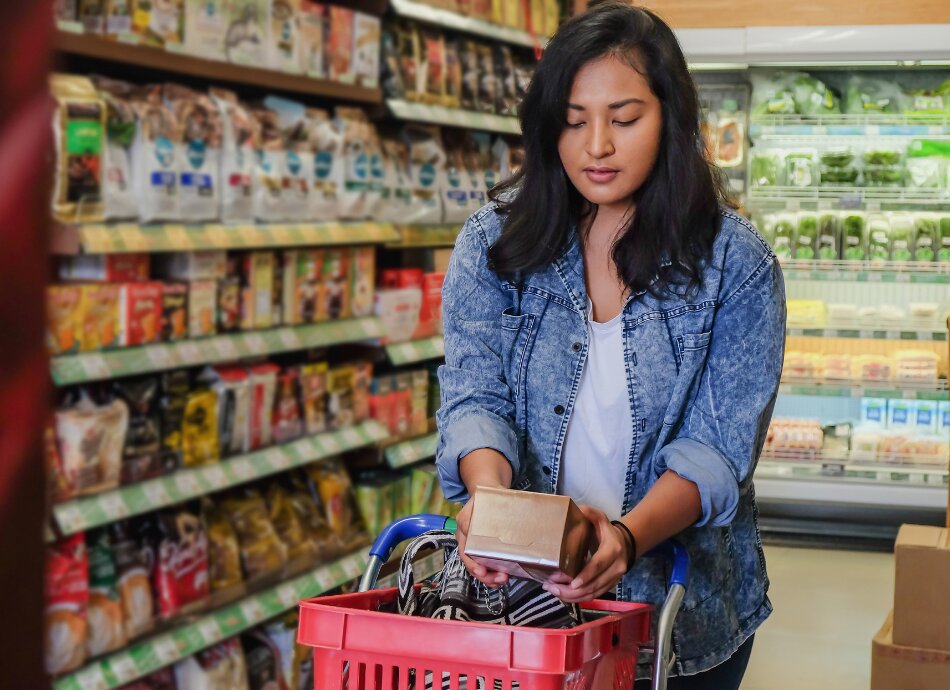
Food labels provide useful information to help you choose what to eat. They are there to keep you safe and healthy.
In Aotearoa New Zealand, all food manufacturers must follow special rules when producing and labelling food. They must show:
- a list of the ingredients in the food
- warning statements for ingredients, such as royal jelly, that can cause a severe reaction in some people
- advisory statements for ingredients such as unpasteurised milk and aspartame where there may be a health risk for some people
- an allergen ‘Contains ... ’ statement for the most common foods that cause an allergic reaction
- how to store and prepare food to keep it safe to eat
- use-by and best-before dates
- a nutrition information panel (NIP) – see below for tips.
These requirements are written in the Australia New Zealand Food Standards Code and the Food Act 2014. You can learn more about food labelling on the Ministry for Primary Industries website(external link).
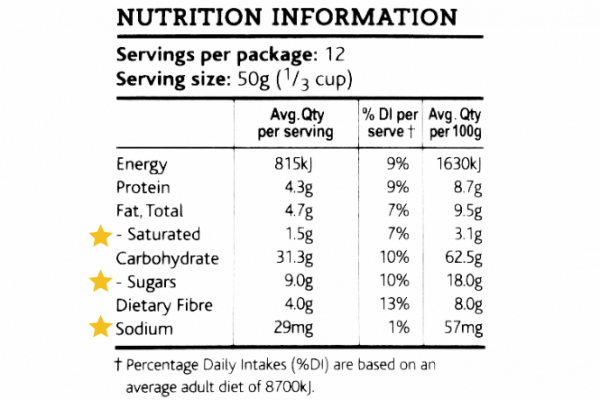
Image credit: Healthify He Puna Waiora
Almost all packaged foods must display a nutrition information panel (NIP) and ingredients list. The NIP and ingredients list are usually on the back of the packet.
Here are some tips to help you read food labels.
Read the ingredients list
The ingredients on a food label are listed from the highest to the lowest content. Look for words you can recognise. A long ingredient list full of additives is a sign that the food is highly processed and there may be a better option. If sugar (or another name for sugar such as sucrose or glucose) is listed first, the product is mostly sugar and not the best choice.
Use the per 100 g column
When reading food labels you want to focus on the quantity of each nutrient per 100 g rather than per serve column. This means you can compare different products more easily.
Compare products
When buying processed and packaged foods, compare similar products and choose the one with the least sugar, sodium, and saturated fat (the 3 Ss) per 100 g.
Sugar
1 teaspoon = 4 grams of sugar. It's recommended that adults eat/drink no more than 12 teaspoons of 'free sugars' per day. This includes added sugar, syrups, fruit juice and honey. Look for packaged and processed foods with less than 10 g sugar per 100 g. Remember dairy products contain milk sugars (from lactose) and you don’t need to consider sugar if it's a whole food option such as milk or plain yoghurt.
Sodium (salt)
The recommendation is to eat no more than 5 g of salt (about 2,000 mg sodium) per day. High salt foods include processed meats, sauces, stocks, chips, crackers, salted nuts and some ready made meals.
Where possible, choose low salt foods containing less than 120 mg of sodium per 100 g. Foods containing more than 600 mg per 100 g are high in salt and should be limited. Read more about sodium (salt).
Saturated fat
Eating too much saturated fat is linked with increased cholesterol and a higher risk of heart disease. Minimise your intake of saturated fats in processed and packaged foods by comparing products and choosing options lower in saturated fat per 100 g. Ingredients that will increase saturated fat include coconut oil, palm oil, butter, chocolate, cream, beef fat, bacon and other animal fats. Read more about fats and oils.
Dietary fibre
Dietary fibre is important for healthy digestion, maintaining stable blood glucose levels, and supporting heart health. Aim for packaged foods with more than 6 g of dietary fibre per 100 g.
Remember fibre from whole foods such as fruits, vegetables, whole grains, legumes, nuts and seeds is best, as it also provides essential nutrients and supports overall health.
Quick guide for reading a label
Remember whole foods such as lean meat, eggs, legumes, vegetables and fruit should make up a big part of your supermarket trolley. The information below can help you to choose the best packaged options for you and your whānau.
- Saturated fat: Less than 5 g per 100 g
- Sodium/salt: Less than 420 mg per 100 g
- Sugar (in food): Less than 15 g per 100 g
- Sugar (in drinks): Less than 1 g per 100 g
- Dietary fibre: More than than 6 g per 100 g
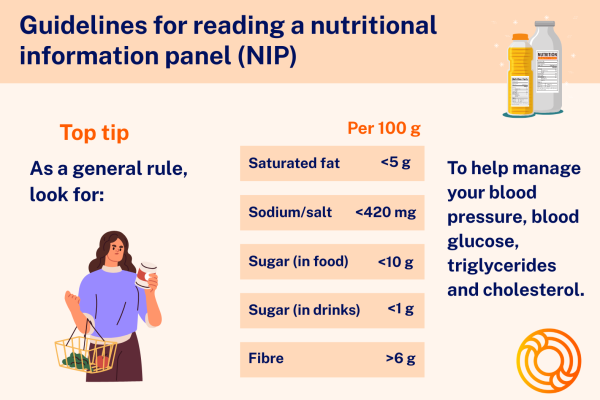
Image Credit: Healthify He Puna Waiora
Read the allergens statement
If you're managing an allergy or intolerance, read food labels to help you find packaged foods that are safe to eat. Common allergens such as peanuts, milk, egg, soy, sesame etc must be declared on the label using the plain English allergen labelling (PEAL) rules. Allergens must be clearly shown in bold font in the ingredients list with a separate ‘Contains ...’ statement.
Some labels may also have a ‘may contain’ or ‘may be present’ statement such as ‘may contain peanuts’. These are voluntary statements made by food businesses and mean that there is a risk that the allergen may be present due to cross-contamination during the manufacturing process.
The Health Star Rating is a quick and easy way to check how healthy a packaged food product is by looking at the front of the label.
- The Health Star Rating rates packaged foods from ½ a star to 5 stars. The more stars, the better the product (within its food category).
- Not all packaged foods have a health star rating so be aware of this.
- The number of stars a product gets is worked out by looking at healthy things in the food (eg, protein, fibre, fruit, veggies, nuts, seeds, and beans) and less healthy things (eg, sugar, salt, saturated fat, and energy).
- The rating system is designed for you to compare products within a category. So, for example, you can’t compare breakfast cereals with yoghurts.
- When you compare foods in the same category, pick the one with the most stars.
Video: What is the Health Star Rating
This Health Star Rating animation explains what the Health Star Rating system is and how you can use it to compare similar products. It's an Australian video but Australia and Aotearoa New Zealand follow the same guidelines for Health Star Ratings.
Food processing simply means anything we do to a food after it is harvested or collected from nature. It may include washing, cutting, grinding, freezing, fermenting or cooking.
Many processing methods can help to improve the nutrition, safety, and flavour of a food, eg, yoghurt, canned tomatoes or frozen berries.
Ultra processing is where foods are made using industrial processing techniques from highly processed ingredients such as refined grains, added sugars and chemical additives. Ultra processed foods (UPFs) have very little resemblance to the whole foods they came from.
Many UPFs, such as biscuits, savoury snacks, chips and sugary drinks, should be limited. This is because they provide energy (calories/kilojoules) but little or no nutrients and they're often eaten in place of whole foods.
Food labels – what do they mean?(external link) Food Standards Australia New Zealand
Eating for a healthy heart(external link) Heart Foundation, NZ
Healthy eating, active living(external link) HealthEd, NZ
Apps
References
- How to read food labels(external link) Heart Foundation, NZ
- Labelling and composition of food and drinks(external link) Ministry for Primary Industries, NZ
- Food allergies and intolerances(external link) Ministry for Primary Industries, NZ
- Health Star Rating system(external link) Australia and New Zealand
Need help now?


Credits: Healthify editorial team. Healthify is brought to you by Health Navigator Charitable Trust.
Reviewed by: Emma Mcmichael, Registered Dietitian, Tauranga; Lily Henderson, Registered Dietitian
Last reviewed: