

You can now add Healthify as a preferred source on Google. Click here to see us when you search Google.
Fungal nail infections
Also called onychomycosis or tinea unguium
Key points about fungal nail infections
- Fungal nail infections are common and usually affect toenails more often than fingernails.
- They can cause discolouration and thickening or brittleness of your nails.
- Most mild fungal nail infections aren’t serious and can be safely left untreated.
- Some people are at risk of complications from nail infections and must seek medical advice, eg, people with diabetes, peripheral vascular disease or connective tissue disease.
- Treatment for fungal nail infections takes a long time and the infection often comes back. Options include antifungal nail paints and antifungal tablets or capsules.
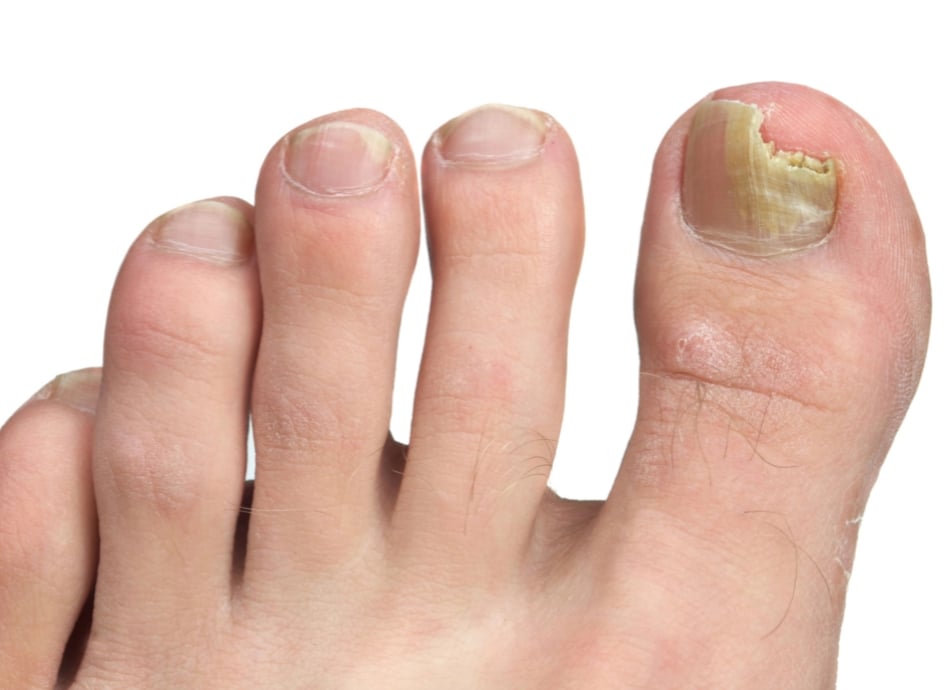
A fungal nail infection is when a nail, typically a toenail, becomes discoloured and thickened. It's caused by a fungus infecting your nail or the skin under your nail, called the nail bed. Not all discoloured and thickened toenails are infected as they can become discoloured or thicker from trauma and inflammatory skin conditions such as psoriasis.
Fungal nail infections are common in adults over 60 years of age and in sports people, and also in people with a weakened immune system or diabetes. But they can also affect children and adults of all ages.
Although a fungal nail infection isn’t usually serious, some people can get complications from nail infections and need to get medical advice. This includes people with diabetes, peripheral vascular disease or connective tissue disease.
Most fungal nail infections are caused by a group of fungi called dermatophytes, but other fungi such as moulds or yeasts can also cause nail infections.
Dermatophytes are fungi that live on a protein called keratin that’s in your skin, nails and hair. Fungal nail infections caused by dermatophytes are also called tinea unguium. You can read about other fungal tinea infections, such as athlete’s foot (tinea pedis), ringworm of the body or scalp (tinea corporis and tinea capitis) and jock itch (tinea cruris).
You’re more likely to get a fungal nail infection if:
- your nail has been damaged through small cuts in the skin around your nail or through the opening between your nail and nail bed
- you have abnormal nails due to trauma or an inflammatory skin disease such as psoriasis
- your hands or feet are constantly warm and damp
- you wear shoes that make your feet hot and sweaty
- you don’t keep your feet clean and dry
- you smoke, or have a weakened immune system, or certain other health conditions such as diabetes or peripheral arterial disease
- you share personal items such as nail clippers or towels
- you walk barefoot in areas such as public showers or pools
- you have athlete’s foot (a fungal infection between the toes) or fungal infection on the soles of your feet, where the fungus spreads from your skin to your nail.
A fungal nail infection may not cause any obvious symptoms at first, but as the infection progresses you may notice the following symptoms:
- Change in colour of some or all of your nail – it may turn yellow, white, or less often purple or black. Purple and black is more often due to bleeding under the nail.
- Thickening and change in the shape of the nail, making it difficult to trim.
- Pain or discomfort, particularly when using or placing pressure on the affected toe or finger.
- Brittle or crumbly nails – pieces may break off and come away completely.
- The skin near the nail may itch, or crack.
- Separation of the nail from the nail bed.
If you have infected toenails it can interfere with walking, exercise and how your shoes fit.
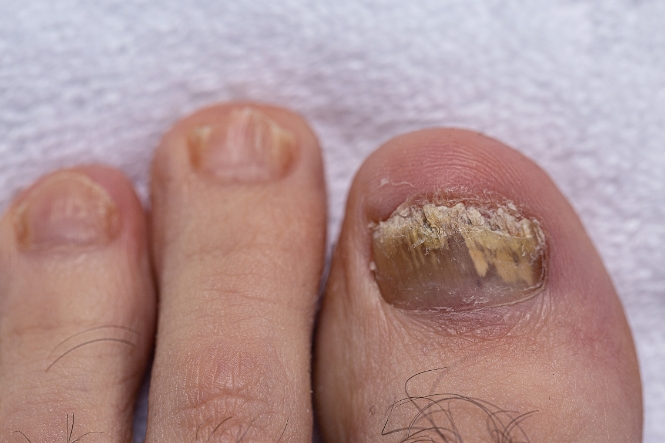
Image credit: Depositphotos
You can see a pharmacist if you think you have a fungal nail infection. They’ll look at your nail and talk to you about your symptoms. They’ll be able to recommend a treatment for you, such as an antifungal medicine that you brush onto your nail, or tell you if you need to see a healthcare provider.
Before starting treatment, it's best to have clippings of the nail or scrapings of the skin under the nail tested for fungus – your healthcare provider can arrange this with your local medical laboratory.
If treatments from the pharmacy don’t work, you should see your healthcare provider. Many nail conditions can look like a fungal infection, such as an old injury, a bacterial infection, psoriasis, or onychogryphosis (a condition common in older people where the nail is very thickened but not due to an infection). Your healthcare provider may take a small sample of your nail to confirm if it really is a fungal infection and what type of fungus it is.
Is treatment necessary?
Most mild fungal nail infections are only a cosmetic issue, not medically serious and can be safely left untreated.
See your pharmacist or healthcare provider for treatment if:
- the affected nails are painful or they bother you, eg, if walking is uncomfortable or if the look of your nails causes distress
- you’re at risk of complications (such as cellulitis) from the infection, eg, if you have diabetes, peripheral vascular disease, a connective tissue disorder or a weakened immune system
- your nail infection might be the source of a fungal skin infection somewhere else on your body, eg, your groin or feet.
Fungal nail infections can be difficult to cure. The decision to treat usually depends only on how much it bothers you. If left untreated it probably won’t go away, but it usually won’t cause medical problems.
Treatment options
Your healthcare provider or pharmacist can talk to you about your treatment options as well as self-care measures. Treatment includes applying medication to the nail, such as an antifungal paint, or taking antifungal tablets or capsules.
Here are some things to consider if you’re thinking about whether to get treatment or not:
- Treatment with antifungal tablets or capsules is successful for about 75% of people, and the use of antifungal paints is less effective. In other words, cure is not possible for 1 in 4 people, and even less so if you’re over 65 years of age.
- Even after successful treatment of the fungal infection, your nail may never look completely normal, especially if the nails have an underlying skin condition or are exposed to trauma.
- There is a 1 in 4 chance that the fungal infection will come back.
- Treatment is often needed for several months. It can take up to 12 months to confirm successful treatment, due to the slow growth of the nail.
- Treatment is more likely to work in combination with good hygiene practices.
If you’re an older person, or you’re also taking other medicines, the risk of treatment may outweigh the benefit. The success of treatment reduces with age and recurrence is very common.
Before starting treatment for fungal nail infection, your healthcare provider may send your nail clippings to the lab to confirm the diagnosis. The laboratory will issue an initial microscopy report within a few days, but if a nail culture is done it will take about 4 weeks to get the results. If you’ve been using any products to treat your nail infection, let your healthcare provider know.
Antifungal nail paints (also called nail lacquer)
- These include amorolfine (Loceryl®) and ciclopirox (Batrafen®) and are applied directly to your nail.
- They're less effective than taking tablets or capsules and aren’t effective for nails that have thickened.
- They may be used if you have an infection in only 1 or 2 nails, the infection is confined to the older, outer part of the nail, or if antifungal tablets or capsules aren’t suitable.
- Applying nail paints requires good mobility and eyesight, and time to file and cleanse your nails before applying the paint. They’ll need to be used for at least 6 to 12 months.
Antifungal tablets or capsules
- Antifungal tablets or capsules are more effective than paints, especially if the entire nail is infected or if the nail is thickened. Examples of oral antifungal medicines are terbinafine and itraconazole.
- Antifungal medicine is taken for 6 weeks for fungal infections of the fingernail and for 3 months for fungal infections of the toenail. A further treatment course may be necessary.
- They're not suitable if:
- you're an older person
- you take multiple other medicines
- you have certain conditions such as liver disease or heart disease
- you're pregnant.
- They interact with many other medicines which can increase your risk of side effects. Tell your healthcare provider about all medicines and herbal products you’re taking so they can check for possible interactions with the antifungal medicine (that is, whether they could react with each other).
Other treatment options
- If your nails are very thick it can be difficult to cut them and this can make walking painful. Reducing the thickness can help with these symptoms, but this doesn’t cure the infection. A podiatrist can help with this but funding is generally only available if you have diabetes. If you don’t have diabetes, you can pay to see a private podiatrist.
- Laser treatment is safe but it’s less effective than antifungal paints and oral medicines. It works by heating up the nail plate to destroy the fungus.
Whether you decide to have treatment or not, you should practise good foot hygiene to stop the infection getting worse or spreading to others.
- Keep your nails clean and trimmed. Avoid cutting the cuticle, which is the layer of clear skin at the bottom edge of your nail.
- Use a separate pair of scissors or clippers to cut the infected nail(s) and don’t share nail scissors or clippers with others.
- If your fingernails are affected, avoid repeated hand washing and using detergents and other chemicals. Wear protective gloves.
- If your toenails are affected, good foot care is important – wash and dry your feet well and check them regularly for cuts and rubbing injuries.
- Treat any other fungal skin infections you may have, such as athlete’s foot.
- Keep your feet cool and dry by wearing breathable footwear and cotton socks, as fungal infections like warm and damp places.
- Avoid high heels and shoes with narrow, pointy toes that may injure your nails. Wear properly fitted shoes with a wide toe box. Allow your shoes to dry out before putting them on again.
- Wear clean socks every day.
- Wear protective footwear, such as jandals, when using shared showers, eg, at the swimming pool or gym.
- If you need help from a podiatrist (someone who specialises in foot care), your healthcare provider will be able to refer you to one.
Keeping your feet and hands clean and dry is the best way to protect against fungal nail infections.
- Keep your feet cool and dry. Avoid footwear that makes your feet hot and sweaty. If you have to wear heavy boots at work, dry these out each day.
- Wear jandals in public changing rooms, showers and around swimming pools.
- Keep your nails short to avoid them getting damaged.
- Treat athlete’s foot as soon as possible to prevent it spreading to your nails. See tinea skin infections for information about athlete’s foot.
- Wear clean socks each day.
- Wash your towels regularly.
- Don’t share towels, socks or shoes with other people.
- Don’t share nail clippers or scissors with other people.
- Replace old shoes as these could be contaminated with fungal spores.
- If you have diabetes, make sure this is well controlled.
Take care when getting a pedicure
Having a pedicure can increase your risk of getting a fungal nail infection. Here are some things to consider when getting a pedicure.
- Make sure the salon you choose is clean and that the staff routinely sterilise their instruments. Speak up about the tools and methods you prefer.
- Foot baths or bowls should be cleaned with hospital-grade disinfectant between clients.
- Salon technicians should not tear or cut your skin with the tools they use during a pedicure. Bugs in foot bowls can enter through a cut and cause an infection.
- Don’t use a foot bath if you have broken skin, eg, from a bug bite, scratch or cut.
- Ask the salon technician to avoid cutting your toenails too short.
- Having artificial nails increases your risk of nail infections.
If you have a fungal nail infection that doesn’t bother you in any way, you don’t have to treat it. It probably won’t affect your health, although it may get worse.
Treatment of a nail infection takes time and if your nail has come off it may take up to a year for it to grow back again fully. It’s also common for the infection to come back so you may need treatment again.
References
- Management of fungal nail infections(external link) BPAC, NZ, 2025
- Fungal nail infections(external link) DermNet, NZ, 2022
- Fungal nail infections in adults(external link) Auckland HealthPathways, NZ, 2022
- Fungal nail infection(external link) NHS Inform, UK, 2025
- Fungal nail infection – tinea unguium(external link) Patient, UK, 2023
- Antifungal preparations(external link) NZ Formulary
- F(external link)ungal nail infections(external link) BMJ Best Practice, UK, 2021
Collecting specimens for the investigation of fungal infections(external link) BPAC, NZ, 2011
Management of fungal nail infections(external link) BPAC, NZ, 2025
Fungal nail infections(external link) DermNet NZ, 2022
Antifungal preparations(external link) NZ Formulary
Need help now?



Credits: Healthify editorial team. Healthify is brought to you by Health Navigator Charitable Trust.
Reviewed by: Professor Amanda Oakley CNZM, Dermatologist, Health New Zealand | Te Whatu Ora, Waikato
Last reviewed: