

You can now add Healthify as a preferred source on Google. Click here to see us when you search Google.
Tooth decay
Also known as holes, cavities or caries
Key points about tooth decay
- Tooth decay is damage that occurs when bacteria eat sugars in your mouth and produce acid as a by-product.
- The acid erodes your tooth enamel causing a ‘hole’ in the tooth, known as a cavity.
- Bacteria can hide in the hole where they're protected from cleaning efforts so they continue to eat sugars and produce more acid.
- As mouth bacteria feed off sugar, eating high-sugar foods regularly increases your risk of tooth decay.
- Tooth decay can cause pain, inflammation and infection – see your dentist if you have a problem.
- The best prevention is good dental care and regular dental check-ups.

Tooth decay is when the acid produced by bacteria in your mouth eats through the enamel coating of your teeth and makes a hole or a cavity. It can be painful and can cause inflammation (swelling around the tooth) and infection.
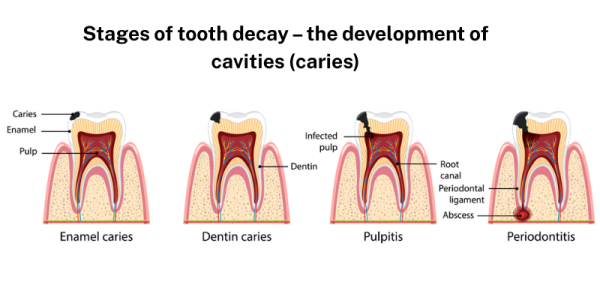
Image credit: Freepik
Healthy tooth enamel is the hardest substance in the human body – it's glassy hard. However, bacteria stick to it very easily, forming a layer called plaque. This forms most easily between your teeth, in the grooves (fissures) on the biting surfaces of teeth and at the gum line – basically in any hollows or hiding places.
When you eat, the bacteria eat too, and they continue to enjoy the small amount of food remaining on your teeth long after you eat. These bacteria get their energy from sugar and other carbohydrates, but a byproduct of this is acid. It's the acid that damages your teeth.
Some foods are especially bad for your teeth if they're already acidic (eg, soft or carbonates drinks and fruit juices), as this can damage your teeth even without the action of bacteria.
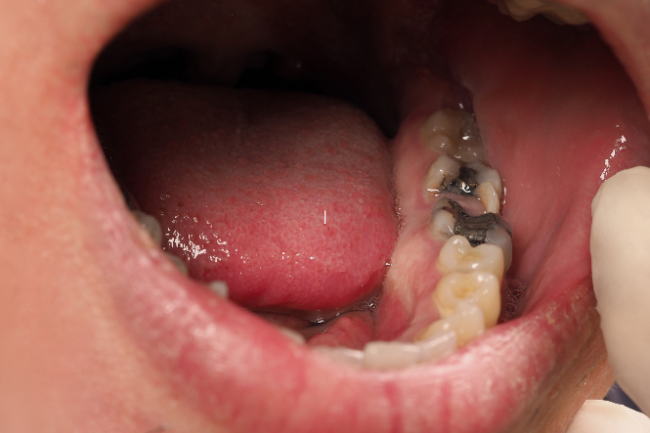
Image credit: Canva
You may notice you have:
- a tooth covered in food and debris
- holes in your teeth or food getting stuck between your teeth
- broken teeth
- brown or discoloured teeth
- sensitivity to hot or cold foods
- sensitivity to sweet foods
- difficulty eating or chewing, with sharp pain when food puts pressure on a tooth
- toothache as a dull ache even when you're not eating or drinking
- bad breath.
Your dentist will look at your teeth and the gums around them. They’ll check each one for signs of any problems including tooth decay. They generally use a mirror and a dental probe to see each tooth and check for any soft parts that may indicate you have a cavity.
An X-ray can provide more information about where a cavity is and how far it’s spread into your tooth. Decay can be hiding between your teeth and not be seen unless you have an X-ray, there can also be no symptoms. So it's important to have regular check-ups so any tooth decay can be found and treated early.
If you think you have decay or a tooth cavity (hole), visit your dentist as soon as possible. The sooner you get treatment, the more effective it will be.
Treatment of dental cavities can involve:
- applying fluoride to reverse early enamel damage
- sealing early or only slightly damaged enamel with resin, and resin sealing naturally formed crevices to prevent decay
- removing the decayed part of the tooth and filling the hole
- removing (extracting) the whole tooth if it can’t be saved
- a root canal filling – if the tooth pulp has died because of infection from the cavity, the tooth can often be saved this way by removing the infected soft nerve tissue and filling the internal space.
If it's not treated, a dental cavity can allow bacteria to start off decay in other teeth and contribute to localised gum disease or infection of your sinuses and beyond.
Some of these secondary infections can be serious, even life threatening. Doctors now understand that untreated dental infections can significantly affect the health of the rest of your body.
Plaque and tartar provide the ideal environment for bacteria to thrive in. Keeping plaque and tartar under control with good dental hygiene is the best way to prevent tooth decay.
- See your dentist regularly to prevent dental problems or spot them early. Seeing a dentist for X-rays to detect and prevent dental decay is far better than waiting until it's already sore or sensitive. The damage (and expense) is much worse then.
- Brush your teeth twice a day (especially last thing at night before going to bed) using a fluoride toothpaste.
- Floss (or use an interdental cleaner) between your teeth once each day.
- Avoid sugary food, especially between meals.
- Avoid fizzy drinks – even diet soft drinks are acidic and can erode your teeth. Instead, drink water and sugar-free drinks.
- Eat a healthy balanced diet with foods containing calcium (milk products and vegetables) and phosphate (leafy vegetables, fruit, meat and poultry).
Brochures
Keeping your teeth for a lifetime(external link) Healthy Smiles, NZ, 2012
Caring for teeth(external link) HealthEd, NZ, 2025
References
- Tooth decay(external link) NZ Dental Association
What is tooth decay?
Tooth decay is what happens when the hard enamel coating of your teeth is eaten away by acid. It can happen from eating or drinking things that contain acid (eg, carbonated drinks, fruit juices and acidic fruit) or from bacteria in your mouth producing acid that's not cleared away with regular tooth care. Bacteria can reach the dentine under the enamel. Dentine is hard but very porous, a bit like pumice, and the bacteria can rapidly get further and further into your tooth through these tunnel-like holes.
Bacteria can hide in tight spaces, that's why it's so important to brush your teeth twice a day with fluoride toothpaste and clean between your teeth with floss or an interdental brush. Read more about how to care for your teeth.
What does tooth decay feel like?
You may not know you have tooth decay in the early stages but as it gets worse you may find that your tooth:
- is sensitive to heat or cold
- hurts when you put pressure on it, or aches – even when you're not eating or drinking
- feels like it's got a fuzzy coating on it rather than feeling smooth and clean
- feels like it has food caught beside it which isn't normal for you
- feels like it has a chipped or different shaped surface when you run your tongue over it.
What's the difference between tooth decay and a cavity?
A cavity is a term used to describe a hollow that can occur if a filling loosens and falls out, or it can be newly formed because of decay by bacteria. As the enamel on your tooth breaks down during the tooth decay process, it forms a hollow or hole that dentists refer to as a tooth cavity. Bacteria can hide in the hollow, even when you clean your teeth, and keep producing acid that eats away more of your tooth.
Brochures

HealthEd, NZ, 2025
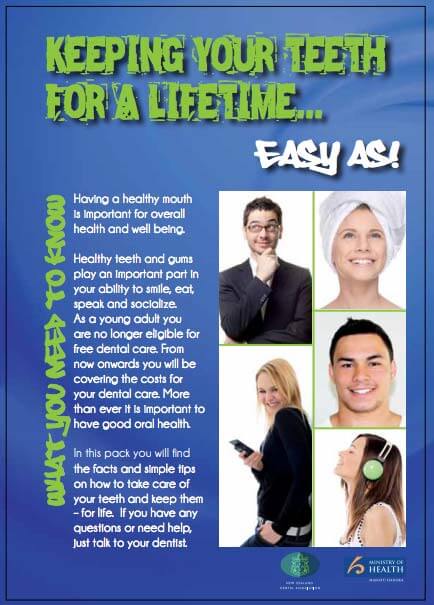
Healthy Smiles, NZ, 2012
Need help now?



Credits: Healthify editorial team. Healthify is brought to you by Health Navigator Charitable Trust.
Reviewed by: Sophie McKenna, General Dental Surgeon
Last reviewed: