

Seborrhoeic keratosis
Key points about seborrhoeic keratosis
- A seborrhoeic keratosis is a harmless skin growth caused by a build-up of skin cells.
- The growths look like warty or waxy spots stuck to your skin and they vary in colour and size.
- They’re common in adults especially with ageing.
- Seborrhoeic keratoses aren’t dangerous and don’t need to be treated.

Seborrhoeic keratoses are growths caused by a build-up of skin cells. They can look like warty or raised spots and can vary in colour from light to dark. They often have the appearance of being stuck onto the surface of the skin.
Seborrhoeic keratoses are very common in adults as a sign of ageing. They can appear as a single growth, but most people will have several, often grouped together. Some people even have hundreds of them. They can appear anywhere on your body except for the palms of your hands, soles of your feet or lips.
They’re harmless and don’t turn into skin cancer.
Seborrhoeic keratoses are also known as seborrhoeic warts or basal cell papillomas.
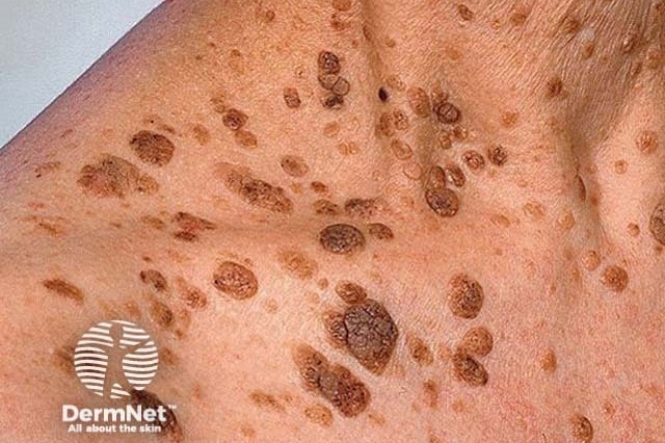
Image credit: DermNet NZ(external link)
The cause of seborrhoeic keratoses isn't known, though spending a lot of time in the sun may be a contributing factor. If you have a large number of seborrhoeic keratoses, there may also be a genetic component. When they appear in skin folds on your body, this could be because of friction.
They’re nothing to do with sebaceous (oil) glands or viral warts, and they’re not infectious so can’t be passed from one person to another.
Seborrhoeic keratoses can look different for everyone, and they can show up in different ways:
- They may look like flat or raised papules (solid bumps) or plaques (thick patches of skin). Small, flat ones often become larger and more raised as the years go by.
- They might feel warty and rough, or smooth and waxy.
- Colour can range from pink to yellow, brown, or black.
- Size can vary from a few millimetres to several centimetres across.
- They can appear anywhere on your body, except on the palms of your hands, soles of your feet or lips.
- You may have just one or many – they’re often grouped in certain areas of the body such as under your breasts and in your groin. They’re more common on the trunk of your body, head and neck.
- They may look like they’re stuck onto the surface of the skin and are sometimes referred to as ‘skin barnacles’.
They can sometimes feel itchy and may be easily irritated or inflamed if they catch on clothing or jewellery – in which case bits may drop off or they may bleed. This inflammation should settle within a few weeks.
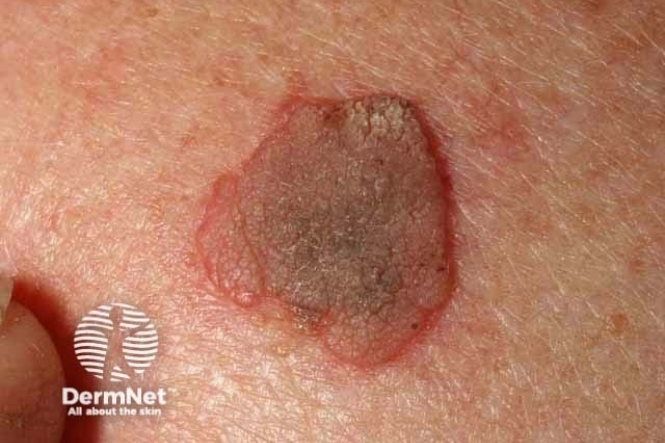
Image credit: DermNet NZ(external link)
Your healthcare provider can usually diagnose seborrhoeic keratoses just by looking at them because they have a typical ‘stuck-on’ look.
They’re far more common than skin cancers but can look a bit like melanomas if they’re very dark. It’s important to see a healthcare provider if you have any skin spots that are changing, in case it’s something more serious such as a skin cancer. If it’s not clear what it is, your healthcare provider may take a small piece (biopsy) to check.
Seborrhoeic keratoses are harmless and don’t need to be treated. They’re only a problem if they bother you – you might find them unsightly or have some that constantly catch and bleed depending on where they are.
Possible treatments to remove them include:
- freezing them off with liquid nitrogen (cryotherapy)
- scraping them off and using heat to seal the area (curettage and electrocautery)
- removing them with a laser
- cutting them off with a scalpel (shave biopsy).
Removal may result in scarring or changes in skin colour, especially if you have darker skin. They can also grow back after being removed.
Once seborrhoeic keratoses appear they tend to remain on your skin for life although sometimes they drop off by themselves. New ones may continue to appear as you get older – you can’t prevent new ones from growing.
Seborrhoeic keratoses aren’t dangerous and won’t turn into skin cancer but they may be confused with skin cancer. It's important to check your own skin from head to foot every few months – point out any new or unusual looking spots to your healthcare provider at an annual skin check. Find out more about how to check your skin.
Don’t forget to protect yourself from the sun.
Seborrhoeic keratosis(external link) DermNet, NZ
Brochures
Patient information leaflet – seborrhoeic keratoses(external link) British Association of Dermatology, UK, 2022
Apps
References
- Seborrhoeic keratosis(external link) DermNet, NZ, 2016
- Seborrheic keratosis(external link) NIH, US, 2024
- Seborrhoeic keratoses(external link) PCDC, UK, 2025
Seborrhoeic keratosis (syn. seborrhoeic wart, basal cell papilloma)(external link) Primary Care Dermatology Society, UK, 2025
Seborrhoeic keratosis(external link) DermNet, NZ, 2016
Greco MJ, Bhutta BS. Seborrheic keratosis(external link) StatPearls, NIH, US, 2024
Need help now?



Credits: Healthify editorial team. Healthify is brought to you by Health Navigator Charitable Trust.
Reviewed by: Professor Amanda Oakley CNZM, Dermatologist, Health New Zealand | Te Whatu Ora Waikato
Last reviewed: